As an Amazon Associate, Akermin earns from qualifying purchases. Product links on this page are affiliate links.
Choose a PV tester whose open-circuit voltage limit exceeds the coldest-morning Voc of what you will test with margin (80 V class for single panels and portables, 150 V class for two or three in series, 1000 V class for rooftop strings), whose power and current limits cover the panel or string, and which performs an MPPT sweep to report Pmax rather than only Voc and Isc. Require a CAT rating (CAT III at the working voltage), double-insulated probes and MC4 leads. Add irradiance and temperature inputs, I-V curve display and logging for commissioning work.
Step 1: Range
| What you test | Voc to expect (cold) | Tester class |
|---|---|---|
| Portable and RV panels (12 V nominal) | 20 to 25 V | 80 V |
| Single residential module | 45 to 55 V | 80 V |
| Two or three modules in series | 100 to 165 V | 150 V or more |
| Rooftop string of 8 to 12 modules | 400 to 650 V | 1000 V class, string tester |
| Commercial strings | Up to 1,500 V | 1500 V string tester |
Check current too: 35 A covers modules; strings carry the same current as one module. Power ratings of 1,000 to 2,000 W cover residential; string testers go higher. See Voc vs operating voltage.
Step 2: MPPT sweep
Voc and Isc confirm the panel is connected and lit. Only an MPPT sweep finds Pmax and exposes failed bypass diodes, cracked cells, mismatch and partial shading, which leave Voc nearly normal. Any tester worth buying reports Pmax, Vmp and Imp. Better ones show the I-V curve, on which a failed diode appears as a step.
Step 3: Safety
- CAT III rating at or above the working voltage; CAT III 1000 V for strings.
- Double-insulated probes and MC4 leads with the right rating.
- IP54 for rooftop use.
- Reverse polarity, over-voltage and over-current protection.
See what a CAT rating is.
Step 4: Features
- Power source: some testers run from the panel under test (FROGBRO class); others from batteries. Self-powered testers cannot test in low light.
- Irradiance and temperature inputs: commissioning testers take an irradiance sensor and a panel temperature probe and correct Pmax to standard test conditions.
- Display: backlit, readable in sun; I-V curve on higher models.
- Logging and export: for string-by-string commissioning records.
- Insulation resistance test: on professional string testers, for fault-finding on wet or damaged arrays.
Picks
| Use | Choose |
|---|---|
| Portable and single panels | 80 V MPPT tester (ZIBOO FT-1000W class) |
| Small series arrays, off-grid systems | 150 V MPPT tester (ZIBOO FT-2000W, FROGBRO 1800W class) |
| Rooftop residential strings | 1000 V string tester with irradiance input (Seaward PV, HT Instruments, Fluke class) |
| Commercial commissioning | 1500 V string tester with I-V curve tracing, logging and insulation test |
Using it
- Confirm Voc is inside the tester’s range before connecting.
- Isolate the panel or string at the disconnect; never pull MC4 connectors under load.
- Connect the tester; take the irradiance reading at the same moment.
- Read Voc, Isc, Pmax; compare with the irradiance-and-temperature-corrected rating. See how to measure solar panel output.
- Compare panels and strings with each other; the outlier is the finding.
Full comparisons are in best solar panel testers; the irradiance side in how to choose a solar irradiance meter.
Recommended Tools

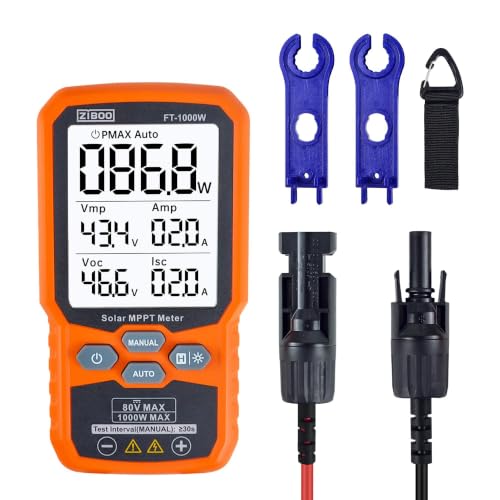

Products shown because their documented specifications fit this guide. Price and availability are on Amazon and can change.
Frequently Asked Questions
What voltage range does my PV tester need?
Above the highest open-circuit voltage you will connect, on a cold morning. A single residential panel is 40 to 50 V; two in series 100 V; a string of ten 500 V. Choose 80 V, 150 V or 1000 V class testers accordingly.
What is an MPPT tester?
A tester that sweeps a variable load across the panel to find the maximum power point and reports Pmax, Vmp and Imp, alongside Voc and Isc. Simple meters read only Voc and Isc, which miss most faults.
Is a PV tester safe on a rooftop string?
With a CAT III rating matching the string voltage, insulated probes, the string isolated at the disconnect before connecting, and never breaking a DC connection under load. The tester itself does not remove the risk of DC arcs.
Affiliate disclosure: Akermin earns a commission from qualifying Amazon purchases made through links on this page. Our editorial picks are based on documented specifications and owner feedback, not commissions.
Related Guides

UNI-T UT503PV Review: A DC 1000 V Headline on a CAT III 600 V Body
A solar insulation resistance tester that works on energised PV strings up to DC 1000 V, with test voltages of 125, 250, 500 and 1000 V, a range to 4000 megohms, automatic discharge, 1000 stored result sets and USB or Bluetooth transfer.
Read More→
ANCEL BA101 Review: The Exclusion List Is the Most Useful Bullet
A 12 volt battery, cranking and charging system tester covering 100 to 2000 CCA that reports state of health, state of charge, voltage, current and CCA, drawing its own power from the battery under test.
Read More→
Tenmars Solar Power Meter Review: One Accuracy Figure, Two Very Different Jobs
A handheld solar irradiance meter reading 0 to 1999 watts per square metre or 0 to 634 BTU per square foot per hour, with a selectable 199.9 or 1999 scale, maximum and minimum tracking, data hold and manual zeroing.
Read More→