As an Amazon Associate, Akermin earns from qualifying purchases. Product links on this page are affiliate links.
Open-circuit voltage (Voc) is the voltage a panel produces with nothing connected and no current flowing; it is the highest voltage the panel will ever show. Operating voltage is the voltage while the panel delivers current to a load, and the operating point that gives the most power is the maximum power point voltage (Vmp), typically 15 to 25 percent below Voc. Voc matters for safety and inverter sizing; Vmp and the current at that point (Imp) matter for power. Both move with temperature.
The current-voltage curve
A solar cell’s output traces a curve. At zero current the voltage is Voc. As current is drawn, voltage stays nearly constant for a while, then falls sharply toward zero at short-circuit current (Isc). Power (V × I) is zero at both ends and peaks at the knee of the curve, at Vmp and Imp. A panel’s nameplate lists all four: Voc, Isc, Vmp, Imp, at standard test conditions.
| Point | Typical value, 400 W residential panel | Depends mainly on |
|---|---|---|
| Voc | 45 to 50 V | Temperature (rises when cold) |
| Vmp | 37 to 42 V | Temperature |
| Imp | 9.5 to 11 A | Irradiance |
| Isc | 10 to 12 A | Irradiance |
Why Voc matters
- Inverter and charge controller limits. String Voc is the sum of the panel Vocs, and it is highest on a cold, bright morning before the panels warm up. Inverters specify a maximum DC input voltage; exceeding it damages them. Designers calculate string Voc at the record low temperature for the site.
- Safety. Voc is present whenever light hits the panel, load or no load. A ten-panel string at 480 V Voc is live the moment the sun rises.
- Basic health check. Voc near nameplate (corrected for temperature) confirms the cells and connections are intact, though it does not prove the panel can deliver power.
Why operating voltage matters
The inverter’s maximum power point tracker (MPPT) continuously adjusts the load to hold the string at Vmp, where power is highest. Vmp falls as panels heat: about 0.3 percent per °C, so a 40 V panel operates near 36 V on a hot roof. MPPT input ranges are specified so that string Vmp stays inside them in both winter and summer. Charge controllers for batteries do the same job at lower voltages.
What the readings diagnose
| Reading | Meaning |
|---|---|
| Voc normal (temperature-corrected), Isc normal, Pmax normal | Healthy |
| Voc normal, Isc low | Low irradiance, soiling, or shading across the whole panel |
| Voc normal, Pmax low, Isc normal | Partial shade or a failed bypass diode: the curve has a step |
| Voc reduced by a third or two thirds | A bypass diode conducting permanently, or one sub-string failed |
| Voc zero | Open circuit: broken connector, cable or junction box |
| Operating voltage far below Vmp with the inverter on | Inverter pulling the string down: shading, mismatch, or an MPPT fault |
Measuring
A multimeter reads Voc with the panel disconnected. An MPPT tester sweeps the curve and reports Vmp, Imp and Pmax, which is the reading that finds most faults. See how to measure solar panel output and best solar panel testers. For how irradiance drives the current side, see solar irradiance vs panel output.
Recommended Tools
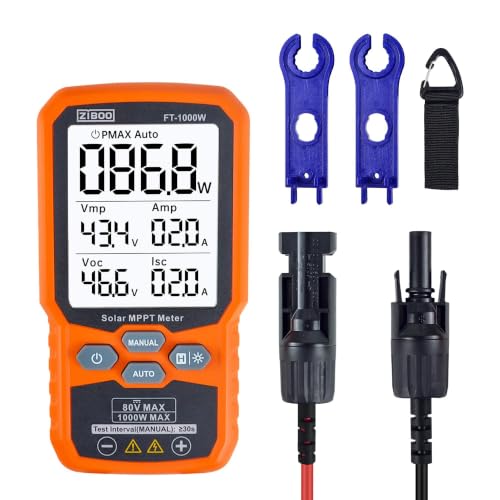
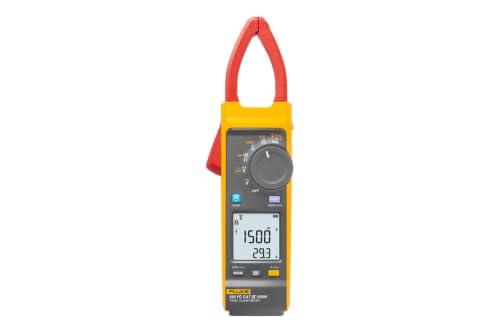
Products shown because their documented specifications fit this guide. Price and availability are on Amazon and can change.
Frequently Asked Questions
Why is Voc higher than the panel's rated voltage?
The rated voltage is Vmp, the voltage at maximum power. With no current flowing, the cell voltage rises to Voc, typically 15 to 25 percent higher.
Why does Voc go up in cold weather?
Cell voltage rises as temperature falls, about 0.3 percent per °C. On a cold, bright morning a string's Voc can be 10 to 15 percent above its nameplate, which is why inverter maximum input voltage is checked against the coldest expected temperature.
My panel reads correct Voc but produces little power. Why?
Voc depends mostly on temperature and is nearly normal even from a panel with a cracked cell, failed bypass diode or heavy shading. Isc and Pmax reveal those faults; Voc does not.
Affiliate disclosure: Akermin earns a commission from qualifying Amazon purchases made through links on this page. Our editorial picks are based on documented specifications and owner feedback, not commissions.
Related Guides

UNI-T UT503PV Review: A DC 1000 V Headline on a CAT III 600 V Body
A solar insulation resistance tester that works on energised PV strings up to DC 1000 V, with test voltages of 125, 250, 500 and 1000 V, a range to 4000 megohms, automatic discharge, 1000 stored result sets and USB or Bluetooth transfer.
Read More→
ANCEL BA101 Review: The Exclusion List Is the Most Useful Bullet
A 12 volt battery, cranking and charging system tester covering 100 to 2000 CCA that reports state of health, state of charge, voltage, current and CCA, drawing its own power from the battery under test.
Read More→
Tenmars Solar Power Meter Review: One Accuracy Figure, Two Very Different Jobs
A handheld solar irradiance meter reading 0 to 1999 watts per square metre or 0 to 634 BTU per square foot per hour, with a selectable 199.9 or 1999 scale, maximum and minimum tracking, data hold and manual zeroing.
Read More→