As an Amazon Associate, Akermin earns from qualifying purchases. Product links on this page are affiliate links.
Resolution in a digital meter is the smallest change the display can show. It is described by counts (2000, 4000, 6000, 20000) or by digits (3½, 3¾, 4½). A 6000-count meter can display 0 to 5999 in any range, so on its 6 V range it resolves 1 mV and on its 600 V range 0.1 V. Resolution is not accuracy: a meter can resolve 1 mV while being 30 mV wrong. Accuracy specifications include a “digits” term precisely because the last digit is uncertain.
Counts and digits
| Counts | Digits | Max display | Resolution on a 6 V range |
|---|---|---|---|
| 2000 | 3½ | 1999 | 1 mV on a 2 V range; 10 mV on 20 V |
| 4000 | 3¾ | 3999 | 1 mV on 4 V; 10 mV on 40 V |
| 6000 | 3¾ | 5999 | 1 mV on 6 V; 10 mV on 60 V |
| 20000 | 4½ | 19999 | 0.1 mV on 2 V; 1 mV on 20 V |
| 50000 | 4¾ | 49999 | 0.1 mV on 5 V |
The “half digit” is a leading digit that can only be 0 or 1 (2000 counts); “three-quarters” means a leading digit up to 3, 5 or 9 depending on the maker. The practical difference between 2000 and 6000 counts is that a 12.4 V car battery reads 12.4 on a 2000-count meter (20 V range, 10 mV steps show as 12.40 but the last digit flickers) and 12.43 on a 6000-count meter (60 V range) without changing range.
Resolution changes with range
Each range spreads the counts over a different span. Auto-ranging meters pick the lowest range that fits the reading, which gives the finest resolution. Manual meters leave it to the user; choosing too high a range throws away digits. See the multimeter picks in best multimeters for home and DIY.
How accuracy uses digits
A specification such as ±(0.5% + 2 digits) has two parts: a percentage of the reading and a fixed number of counts of the least significant digit. On a 6000-count meter reading 5.000 V, ±0.5 percent is ±0.025 V and 2 digits is ±0.002 V, total ±0.027 V. On a reading of 0.050 V on the same range, the percentage part is ±0.00025 V and the digits part is still ±0.002 V, which now dominates. Small readings at the bottom of a range are always relatively less accurate, which is another argument for the right range. See measurement range vs resolution.
When resolution matters
- Battery and charging diagnostics: the difference between 12.6 and 12.4 V is a state-of-charge difference; 10 mV resolution is enough, 100 mV is not.
- Voltage drop across connections: a few tens of millivolts across a corroded terminal needs a low range and fine resolution.
- Low resistance: reading a 0.3 Ω heater element needs resolution of 0.1 Ω or better.
- Trend watching: seeing a slow drift needs a stable last digit as much as a fine one.
When it does not
Checking whether an outlet is live, testing a fuse, or reading mains voltage to the nearest volt does not need more than 2000 counts. Buy for True-RMS, safety rating and input protection first; counts are a convenience. See what True-RMS is and what a CAT rating is.
Recommended Tools

Fluke 117 Digital Multimeter, Non-Contact AC Voltage Detection, Measures Resistance/Continuity/Frequency/Capacitance/Min
View on Amazon
Products shown because their documented specifications fit this guide. Price and availability are on Amazon and can change.
Frequently Asked Questions
What does 6000 counts mean?
The display can show values from 0 to 5999 in each range. On a 6 V range that is 0.001 V steps; on a 60 V range, 0.01 V steps. Also written as 3¾ digits.
Is a 6000-count meter more accurate than a 2000-count one?
Not by itself. Accuracy is a separate specification. Higher counts let you see smaller changes and read closer to a range boundary without switching ranges.
What does "±(0.5% + 2 digits)" mean?
The error can be up to 0.5 percent of the reading plus two counts of the last displayed digit. On a 6 V range showing 5.000 V, that is ±0.025 V plus ±0.002 V.
Affiliate disclosure: Akermin earns a commission from qualifying Amazon purchases made through links on this page. Our editorial picks are based on documented specifications and owner feedback, not commissions.
Related Guides

Fluke 1AC II VoltAlert Review: Two Detection Thresholds in One Listing
A pocket sized non contact voltage tester whose tip glows red and beeper sounds when voltage is detected, with a continuous self test and a choice of audible or silent operation.
Read More→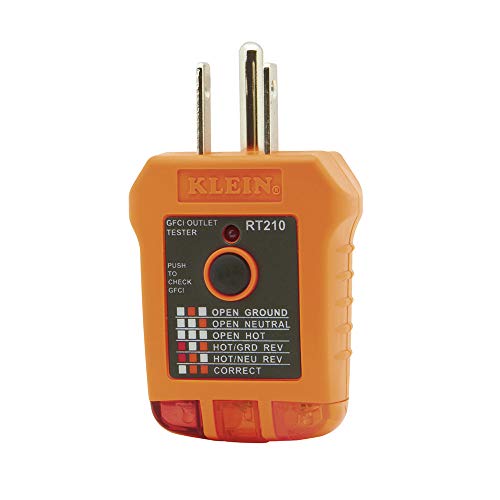
Klein Tools RT210 Review: A Fault Finder That Does Not List Its Faults
A three wire receptacle tester for standard and GFCI North American outlets, specified for 110 to 125 volts AC at 50 or 60 Hz, a 6.6 foot drop and an operating range of 32 to 140 degrees Fahrenheit.
Read More→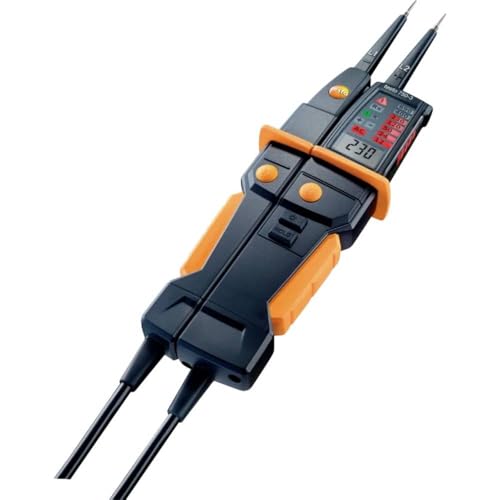
Testo 750-3 Review: Four Bullets, and No Published Category Rating
A two pole voltage tester with a three digit LCD showing measured voltage, a patented LED voltage bar viewable from any angle, polarity detection on DC and a GFCI test function for AC outlets.
Read More→