Best CO2 Monitors for Greenhouses: 7 Picks for Enrichment and Ventilation
A greenhouse is the one place where carbon dioxide is deliberately raised rather than vented away, so the instrument has a different job from a bedroom monitor. Some growers only need to watch the number. Others need the number to operate a regulator and a fan. This guide separates the two.
As an Amazon Associate, Akermin earns from qualifying purchases. Product links on this page are affiliate links.
Our Top Picks
Products were sorted by the sensor technology each listing names, the stated range and accuracy, battery or mains operation, and whether the device only displays carbon dioxide or can also switch equipment. We did not run laboratory tests and publish no measurements of our own. Where a listing gives no figure, the entry reads Not stated.
Best Overall
Inkbird ICC-510 CO2 Controller
The only device here that acts on the reading instead of just showing it.
Dual output: connects CO2 equipment and ventilation at the same time
Light sensor adjusts CO2 output with light intensity, per the listing
Figures are the manufacturer published specifications from each listing. Where a listing publishes nothing, the cell reads Not stated rather than an estimate.
How to Choose a Greenhouse CO2 Monitor
Growing spaces break two assumptions that ordinary indoor monitors are built on: the level is deliberately high, and the air is humid.
Check the Ceiling, Not the Accuracy
Enrichment targets sit around 800 to 1500 ppm and overshoot easily. A monitor that stops at 2000 ppm goes blind exactly when a regulator sticks. Look for 5000 ppm or more.
Display or Control
A meter tells you the level. A controller switches the regulator and the exhaust fan. If your enrichment runs on a timer rather than a setpoint, you are dosing blind and a controller is the upgrade.
Light Matters More Than Time
Plants only take up carbon dioxide while photosynthesising. Enriching a dark space wastes gas. A light sensor, or at minimum a lighting-linked timer, is worth more than a tighter accuracy figure.
Humidity Is the Enemy
None of these listings publish an ingress rating. Keep the instrument out of direct spray and mist, and expect a shorter life in a propagation house than in an office.
Power Decides Placement
A mains device sits where the socket is. A long-battery monitor sits in the canopy where the plants are, which is where the measurement should be taken.
Calibrate Between Cycles
Consumer NDIR sensors re-baseline against fresh air. A monitor that never leaves an enriched space drifts upward. Take it outdoors between crops and let it settle.
Enrichment targets are commonly quoted between 800 and 1500 ppm against an outdoor background near 400 ppm, and the right figure depends on the crop, the light level and the temperature. Consult growing guidance for your specific crop rather than treating any number as universal. What every source agrees on is that enrichment only helps while the plants are lit and photosynthesising.
Why does the ceiling of the range matter so much?
Because a sealed space with a regulator running can overshoot fast. If your monitor tops out at 2000 ppm and the solenoid sticks, the display simply shows over-range and tells you nothing about how bad it got. The SwitchBot unit here states 9000 ppm, and several others state 5000 ppm.
Do I need a controller or is a monitor enough?
A monitor is enough if you are hand-dosing or running a small tent you visit often. A controller earns its place once enrichment is automated, because it switches on a measured level rather than a guess, and it can stop dosing when the lights go off. The Inkbird unit here states dual outputs for CO2 equipment and ventilation.
Will high humidity damage the monitor?
None of these listings publish an ingress protection rating, which means none of them are designed for direct spray or misting. Mount away from nozzles and vents, and accept that a propagation environment is harder on electronics than a living room.
How often should I calibrate?
Consumer NDIR monitors use an automatic baseline routine that assumes the device periodically sees fresh outdoor air. A monitor that lives permanently in an enriched space never sees that reference and drifts upward. Take it outside between growing cycles, let it settle, and use any calibration routine the app offers.
Is CO2 dangerous for the person working in the greenhouse?
Enrichment levels are well below acute danger but they are not nothing, and a sealed space with a failed regulator can reach levels that cause headaches and drowsiness. Ventilate before extended work inside an enriched space, and treat an alarming monitor as a reason to open up rather than to silence it.
Reviews
Inkbird ICC-510 CO2 Controller Best Overall
Every other product on this page tells you the carbon dioxide level and leaves the rest to you. This one closes the loop. The listing states a dual output design that connects to CO2 equipment and a ventilation system simultaneously, which is the arrangement a grow space actually needs: raise the level with a regulator until the setpoint is reached, then let the exhaust fan bring it back down when it overshoots or when the space needs air changes for temperature and humidity.
The feature worth paying attention to is the light sensor. Plants only use carbon dioxide while photosynthesising, so enriching a dark space wastes gas and money. The listing states the controller adjusts CO2 output based on light intensity, which automates the single most common mistake in enrichment: leaving the regulator running at night.
What the listing does not publish is the sensor technology, the measurement range or an accuracy figure, and for a controller those matter as much as for a meter, because a drifting sensor will happily dose a room to the wrong level all season. Check the datasheet, calibrate it in outdoor air when new, and confirm it before each growing cycle.
Strengths
Switches enrichment and ventilation from one controller
Light sensor prevents dosing a dark space
Universal 100 to 240 V supply
Removes the need for a separate timer and meter
Limitations
No sensor type, range or accuracy stated
Mains powered, so it cannot move around the way a handheld can
Temtop CO2 Monitor with NDIR Sensor Best for Accuracy
This is the most completely specified meter in the group. The listing names a Swiss-engineered NDIR sensor, publishes a range of 400 to 5000 ppm, quotes accuracy of 40 ppm plus 5 percent of reading across the critical 400 to 2500 ppm band, and states 1 ppm resolution with a 5 second refresh. That combination lets you check the instrument against its own specification instead of taking the brand on trust.
The 5000 ppm ceiling matters for a greenhouse in a way it does not for a house. Enrichment targets commonly sit between 800 and 1500 ppm, and a sealed tent with a regulator running can overshoot well past that. A meter that tops out at 2000 ppm leaves you blind exactly when you need to see the number.
The stated 70 day standby is the other greenhouse-relevant figure. A meter that needs charging every three days ends up on a bench rather than in the canopy. What you do not get is any ability to act on the reading, so pair it with a timer or a controller if enrichment is automated.
The widest stated range on this page, at 400 to 9000 ppm, which is the specification that matters most in an enriched space. Overshoot in a small sealed tent is common when a regulator sticks or a solenoid fails, and levels well above 5000 ppm are both wasteful and unpleasant for anyone who walks in. A meter that keeps reading at those levels tells you what went wrong; one that shows over-range does not.
Accuracy is stated as a flat plus or minus 50 ppm rather than a percentage that grows with the reading, which works in your favour at enrichment levels. A one second measurement interval also makes it practical to watch the response as you open a vent or trigger a burst of gas, which is how you tune a system.
The listing notes that app notifications require a SwitchBot hub. If you already run their ecosystem that is free; if not, count it as an extra purchase, because on-device alerts alone will not reach you when you are not in the greenhouse.
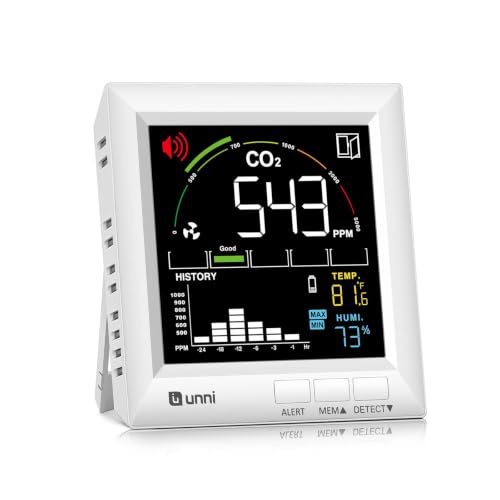
U UNNI CO2 Monitor with History Chart Best for Trends
A history chart on the device itself is more useful in a greenhouse than it sounds. Enrichment is a cycle, not a setting: the level climbs while the regulator runs, holds while the space is sealed, and falls when the exhaust fan comes on for temperature control. Seeing that shape tells you whether your timing is right in a way that a single live number never will.
The listing states a Swiss photoacoustic sensor with a 400 to 5000 ppm range and accuracy of 5 percent plus 50 ppm, so at a 1200 ppm target the uncertainty works out at roughly 110 ppm. That is comfortably fine for enrichment decisions, where the useful bands are hundreds of ppm apart.
The adjustable alarm volume and backlight are small details that matter for a device living in a working space. The listing also names RV and grow tent use directly, which is a fair description of where this sits: a capable budget monitor rather than a reference instrument.
The case for this one is portability. A grower with a tent, a propagation area and a polytunnel does not need three meters; they need one that can be carried between them and will run for a working weekend without a cable. The listing states a 1600 mAh battery giving up to 72 hours and USB charging, which covers that pattern.
Specifications are otherwise conventional for the class and honestly stated: a Swiss-made sensor, a 400 to 5000 ppm detection range and accuracy of plus or minus 50 ppm, with readings every second. The AQI figure alongside is a derived summary rather than a separate measurement, so treat the carbon dioxide number as the real output.
If you intend to leave a meter in one space permanently, one of the mains-capable units above makes more sense. If you intend to walk around with it, this is the one built for that.
Altitude is the quiet problem with carbon dioxide measurement, and it hits greenhouses harder than houses because many are on farms well above sea level. An NDIR sensor measures absorption along a path, which depends on gas density as well as concentration, so thinner air reads low. A monitor that under-reports will tell you a space needs more gas when it does not.
This listing states built-in pressure compensation for any altitude, names the SCD4x sensor and publishes accuracy of 40 ppm plus 5 percent with a 5 second refresh. For a grower above a few hundred metres, that one line is the reason to choose it over a cheaper monitor with an unnamed sensor.
The email report channel is unusual and genuinely useful for a space you visit rather than live in. The listing also advises calibrating outdoors through the app if required, which is sound practice for any consumer NDIR monitor and worth doing between growing cycles.
Strengths
Stated altitude compensation, rare at this level
Named sensor and published accuracy
Email reports as well as app and buzzer alerts
Inexpensive enough to run more than one
Limitations
Clock function needs the app
No control outputs
5000 ppm class monitor, so heavy enrichment can over-range it
Temtop Professional Air Quality Analyzer Best for Records
This is the instrument for a grower who has to demonstrate conditions rather than simply manage them, or for anyone running a commercial space where a record matters. The listing names three separate sensors by manufacturer, states USB export of every parameter, and claims memory for more than three months of continuous logging.
The built-in calibration program is the feature that separates a professional handheld from a consumer monitor. Every NDIR sensor drifts, and a device that can be re-referenced without being returned stays trustworthy for years rather than months. In a greenhouse, where humidity, dust and temperature swings all work against electronics, that matters more than usual.
The particulate and formaldehyde channels are not what you bought it for, but they are not wasted either: dust from media, perlite and pruning is a real exposure question in an enclosed growing space. The cost is significant, so this only makes sense if the record is worth something to you.
Short answer: the Inkbird ICC-510 is the best overall buy because it is the only device here that switches both the carbon dioxide supply and the exhaust fan on a measured level; the Temtop NDIR monitor is the best pure meter, publishing sensor type, a 400 to 5000 ppm range and a 40 ppm plus 5 percent accuracy figure; and the SwitchBot CO2 Detector is the one to choose if your space is heavily enriched, because it states a range to 9000 ppm.
A greenhouse monitor has the opposite job
Every other carbon dioxide page on this site is about ventilation: the level is rising because people are breathing, and the answer is fresh air. In a growing space the logic reverses. Carbon dioxide is a raw material, the level is raised on purpose, and fresh air is the thing that undoes the work. That changes which specifications matter. The ceiling of the range becomes more important than the resolution at the bottom. The ability to switch equipment becomes more valuable than a smartphone app. And the placement moves from head height to canopy height, because that is where the gas is being used.
The overshoot problem nobody mentions
Most enrichment failures are not under-dosing, they are overshoot. A solenoid that sticks open, a regulator set too high, or a timer that runs after the lights go out will push a sealed tent far past any useful level. Gas is wasted, the space becomes unpleasant to work in, and in a small sealed room the level can climb further than people expect. This is why the stated ceiling in the comparison table is the first column to read. A monitor that reports 9000 ppm shows you the failure; one that stops at 2000 ppm shows the same over-range symbol whether the level is 2100 or 8000.
Light, not time, should drive enrichment
Plants take up carbon dioxide while they are photosynthesising and not otherwise. Enriching a dark space is a straight loss, and in a sealed room overnight it is also the fastest way to reach a level that is uncomfortable for anyone who opens the door in the morning. The Inkbird listing states a light sensor that adjusts output with light intensity, which automates the discipline that most hand-managed systems get wrong. If you are using a meter rather than a controller, wire the regulator to the lighting circuit rather than to an independent timer.
Humidity is the reason these instruments die
None of the listings on this page publish an ingress protection rating. A propagation house with misting is a hostile environment for an unsealed electronic instrument, and a monitor mounted in the path of a nozzle will not last a season. Mount high, away from spray, with some airflow, and accept a shorter service life than the same device would have in an office. If the space is genuinely wet, consider treating the monitor as a consumable and buying two cheap units rather than one expensive one.
Calibration between crops
Consumer NDIR sensors hold their zero by assuming they will periodically see ordinary outdoor air near the global background. A monitor that lives permanently in an enriched greenhouse never sees that reference, so its baseline creeps upward and it gradually reports more carbon dioxide than is present, which leads to under-dosing. The fix costs nothing: take the instrument outdoors between growing cycles, leave it until the reading settles near the outdoor background, and run any calibration routine the app provides. Our CO2 level checker explains what the resulting numbers mean in ordinary indoor terms, and CO2 versus VOC monitoring covers why a genuine optical sensor matters.
How We Research
Listings were compared on the carbon dioxide sensor technology each manufacturer names, the stated detection range, the stated accuracy and the reading interval, whether the device can switch external equipment, how it is powered, and what it states about calibration. Products were only included if their own listing describes them as measuring or controlling carbon dioxide. We did not run laboratory tests, we publish no measurements of our own, and no figure appears on this page unless the manufacturer published it. Amazon data supplies images, availability and links only.
A WiFi monitor claiming AQI, CO2, PM2.5, PM1.0, PM10, TVOC and HCHO with Tuya app logging, reviewed from a listing that never says how any of it is measured.
A seven inch multi sensor monitor with an NDIR CO2 sensor, electrochemical formaldehyde, semiconductor TVOC and laser particle sensing, reviewed from the listing.
Two mail-in lab kits listed under EPA measurement programmes, and four digital monitors that charge no lab fee, compared on what each one is actually for.