As an Amazon Associate, Akermin earns from qualifying purchases. Product links on this page are affiliate links.
For most people who want a CO2 number on a shelf with no cable and no account, the SAF Aranet4 Indoor Air Quality Monitor is the pick: the listing states an e-ink display and up to four years of battery life, with CO2, temperature, humidity and pressure. If you also want radon and particulates in the same box, the Airthings 2960 View Plus is the broader instrument, but the listing says the app is required and the device needs internet access, so it is a different kind of product. The AccUnni CO2 Monitor Air Quality Monitor is the straightforward budget option with a stated accuracy figure and a sound alarm. The AirKnight Premium Indoor Air Quality Monitor is the portable, rechargeable multi-sensor unit, and the SAF Aranet4 CO2 plus Radiation Sensor bundles the SAF Aranet4 Indoor Air Quality Monitor monitor with a radiation sensor for buyers who want both.
Why battery power changes what a CO2 monitor can be
A mains-powered CO2 monitor can afford to run a bright screen, a WiFi radio and a cloud connection continuously. A battery-powered one has to budget every milliamp, and the choices the designer makes show up in the specifications you read on the listing.
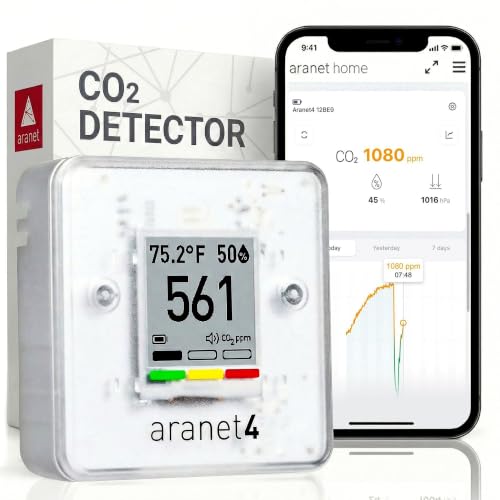
The clearest example is the display. The SAF Aranet4 Indoor Air Quality Monitor uses an e-ink panel, which only draws current when the image changes, and the listing states up to four years of battery life as a result. E-ink is also readable in direct sunlight and does not glow in a dark bedroom, which matters if the monitor sits on a nightstand. The trade-off is that the number updates slowly and there is no colour animation.
The second example is connectivity. The Airthings 2960 View Plus is battery powered but WiFi connected, and the listing states the monitor requires the Airthings app to function and that both the monitor and the app need internet access, with data saved in the cloud. That is a legitimate design for a whole-home monitor, but it means the device depends on your router. If the internet is down for a day, the listing does not describe what the screen shows. The SAF Aranet4 Indoor Air Quality Monitor, the AccUnni CO2 Monitor Air Quality Monitor and the AirKnight Premium Indoor Air Quality Monitor do not state a network requirement, so the number is on the device.
Battery chemistry also sets the maintenance rhythm. The AirKnight Premium Indoor Air Quality Monitor uses a stated 3000 mAh rechargeable lithium-polymer cell, so it is charged like a phone. The SAF Aranet4 Indoor Air Quality Monitor, the Airthings 2960 View Plus, the AccUnni CO2 Monitor Air Quality Monitor and the SAF Aranet4 CO2 plus Radiation Sensor use disposable or long-life cells, so the rhythm is a battery change measured in years rather than a charge measured in days.
What the CO2 accuracy claims in these listings actually mean
Only one listing on this page publishes a CO2 accuracy figure. The AccUnni CO2 Monitor Air Quality Monitor states a detection range of 400 to 5000 ppm and accuracy of +/- 5% +100 ppm. That is the honest way to quote a non-dispersive infrared sensor: a percentage of reading plus a fixed offset. At 1000 ppm the tolerance is roughly 150 ppm, so a reading of 1000 ppm could be anywhere from about 850 to about 1150 ppm. That is fine for deciding whether to open a window, and not fine for calibrating another instrument.
The SAF Aranet4 Indoor Air Quality Monitor, the Airthings 2960 View Plus, the AirKnight Premium Indoor Air Quality Monitor and the SAF Aranet4 CO2 plus Radiation Sensor do not publish a CO2 accuracy figure in the bullets supplied. You should read that as unknown rather than excellent. The absence of a number is not evidence of a problem, but it does mean you cannot compare them numerically on accuracy.
The related number is calibration. The AccUnni CO2 Monitor Air Quality Monitor is the only listing here that describes it: after a manual calibration in a 400 ppm reference environment such as an open window or outdoors, the device self-calibrates to the minimum CO2 reading it sees over seven days of continuous monitoring. That is a common automatic baseline correction scheme. It works well in a home that regularly drops to fresh-air levels. It drifts if the room is never ventilated, because the sensor slowly decides that a stale room is the new baseline.
If you need a documented CO2 record rather than a live number, the relevant question is export, not accuracy. Our page on monitors with exportable CO2 data covers that distinction.
Alerts, alarms and the difference between a meter and a safety device
None of the products on this page is a life-safety device, and the listings should not be read as claiming that. A CO2 monitor tells you about ventilation. It does not detect carbon monoxide, and it does not replace a smoke or CO alarm.
The AccUnni CO2 Monitor Air Quality Monitor is the most explicit about alerting. The listing states three colour bands for visual status, an audible alarm when concentration exceeds preset thresholds, and three volume levels. It also states you can silence the sound at night and rely on the colour. That is a sensible design for a bedroom, because an alarm that wakes you at 2am for a 1200 ppm reading is a nuisance, not a safety feature.
The SAF Aranet4 Indoor Air Quality Monitor states colour coding, a prominent CO2 number and an optional buzzer. The word optional matters: you can run it silent and just read the screen. The SAF Aranet4 CO2 plus Radiation Sensor states that the radiation sensor in the bundle includes an alarm for high radiation levels, and that both devices have e-ink displays. The Airthings 2960 View Plus states that you receive air quality notifications wherever you are, which depends on the cloud connection described above. The AirKnight Premium Indoor Air Quality Monitor does not describe an audible alarm in the supplied bullets.
One caution that applies to every listing here: a threshold alarm is only as good as the threshold you set. A monitor that beeps at 1000 ppm in a room where 1000 ppm is normal will be muted within a week, and a muted alarm protects nobody.
The battery-powered CO2 monitors, pick by pick
SAF Aranet4 Indoor Air Quality Monitor
The listing states an e-ink display and up to four years of battery life, which is the longest runtime claimed here. It measures CO2, temperature, relative humidity and atmospheric pressure, and the app shows up to 90 days of history. No account requirement is stated in the bullets.
Airthings 2960 View Plus
A WiFi-connected monitor that adds radon, PM2.5 and VOC sensing to CO2, humidity, temperature and pressure. The listing states the Airthings app is required to function and that the monitor and app both need internet access, with data stored in the cloud.
AccUnni CO2 Monitor Air Quality Monitor
A small, thin, battery-powered unit with a foldable stand. The listing publishes a CO2 range of 400 to 5000 ppm, stated accuracy of +/- 5% +100 ppm, temperature accuracy of +/- 0.72 F and humidity accuracy of +/- 3%. It has three-colour visual alerts and an audible alarm with three volume levels.
AirKnight Premium Indoor Air Quality Monitor
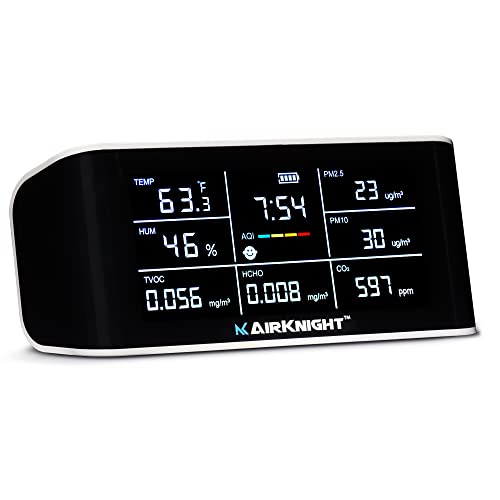
A 10-in-1 monitor covering CO2, PM2.5, PM10, TVOC, HCHO and more on one LCD, powered by a stated 3000 mAh rechargeable lithium-polymer battery. The listing positions it for portability and for wildfire smoke events.
SAF Aranet4 CO2 plus Radiation Sensor Bundle
A two-device bundle: the Aranet4 CO2 monitor plus a radiation sensor that the listing says measures gamma, beta and x-rays with real-time dose rate and total dose, and includes an alarm for high radiation levels. Both are wireless and the listing states up to five years of battery life.
The comparison table, built only from listing facts
| Pick | Stated battery | Display | Measured quantities | Stated CO2 accuracy | Network requirement |
|---|---|---|---|---|---|
| SAF Aranet4 Indoor Air Quality Monitor | Up to 4 years | E-ink, colour coded | CO2, temperature, humidity, pressure | Not stated in the listing bullets | Not stated |
| Airthings 2960 View Plus | Not stated in the listing bullets | Not stated in the listing bullets | Radon, PM2.5, CO2, VOC, humidity, temperature, pressure | Not stated in the listing bullets | App required; monitor and app need internet |
| AccUnni CO2 Monitor Air Quality Monitor | Not stated in the listing bullets | Not stated in the listing bullets | CO2, temperature, humidity | +/- 5% +100 ppm, range 400 to 5000 ppm | Not stated |
| AirKnight Premium Indoor Air Quality Monitor | 3000 mAh rechargeable lithium-polymer | Large LCD | CO2, PM2.5, PM10, TVOC, HCHO, AQI, temperature, humidity | Not stated in the listing bullets | Not stated |
| SAF Aranet4 CO2 plus Radiation Sensor | Up to 5 years for both devices | E-ink on both | CO2, temperature, humidity, pressure, plus ionising radiation on the second device | Not stated in the listing bullets | Not stated |
Two things stand out. First, battery life is stated in years for the e-ink devices and in milliamp hours for the rechargeable one, so the two are not directly comparable. Second, the Airthings 2960 View Plus is the only pick whose listing states a hard dependency on an app and an internet connection, which is the single biggest difference in how the product is used day to day.
Placement, drift and the maintenance nobody mentions
Where you put the monitor determines what it measures. CO2 is exhaled, so a monitor on a shelf behind a sofa reads the room, while a monitor on the floor beside a vent reads the supply air. The listing for the AccUnni CO2 Monitor Air Quality Monitor mentions a foldable stand, which lets you raise it to breathing height. The AirKnight Premium Indoor Air Quality Monitor is explicitly portable, so it moves with you. The SAF Aranet4 Indoor Air Quality Monitor and the SAF Aranet4 CO2 plus Radiation Sensor are small enough to sit on a shelf or desk.
Drift is the maintenance item that no listing advertises prominently. NDIR CO2 sensors age, and automatic baseline correction slowly re-zeroes them. The AccUnni CO2 Monitor Air Quality Monitor describes the seven-day minimum-reading routine. For the other picks, the listings do not describe a calibration procedure, so you should assume the manufacturer handles it internally and that a unit which has spent a year in a sealed bedroom may read low.
The practical habit is to give any CO2 monitor a regular breath of outdoor air. Take it outside or beside an open window for twenty minutes every few months. If it does not come down toward the 400 to 450 ppm range, either the sensor has drifted or the air really is that still. Our general CO2 monitor guide goes further into baseline behaviour.
Battery maintenance is simpler. Disposable cells should be replaced on schedule even if the device still runs, because a weak cell can cause a sensor warm-up fault. Rechargeable units like the AirKnight Premium Indoor Air Quality Monitor should be charged before they are flat, not after.
Where a battery-powered CO2 monitor stops being the right answer
If your question is about combustion safety, stop here. A CO2 monitor does not detect carbon monoxide, and no product on this page is a substitute for a CO alarm. If your question is about radon as a health risk, note that Airthings 2960 View Plus is the only pick here that measures radon, and a continuous monitor is a screening tool, not a substitute for a certified radon test.
If you need a permanent, always-on record for a workplace or a classroom, a battery device that you have to remember to check is a weaker choice than a mains-powered logger with a documented calibration interval. Battery power is a convenience feature, and convenience features are the first thing to fail in an institutional setting.
If you are monitoring a workshop, a 3D printer room or a kitchen, CO2 is often not the pollutant that matters. Particulates and VOCs dominate in those spaces, and you may be better served by a different instrument. Our pages on 3D printer rooms and particle monitors cover those cases.
Finally, if you want to know whether a room is ventilated well enough for a specific activity, a single CO2 number is only half the story. Occupancy, room volume and air changes per hour all matter. A CO2 monitor tells you the result; it does not tell you why.
Recommended Tools



Products shown because their documented specifications fit this guide. Price and availability are on Amazon and can change.
Frequently Asked Questions
Do any of these monitors need WiFi or an account to show a CO2 reading?
the Airthings 2960 View Plus is the only pick whose listing states that the Airthings app is required to function and that both the monitor and the app need internet access, with data stored in the cloud. The other four listings do not state a network or account requirement, so the reading appears on the device itself.
Which pick has the longest stated battery life?
the SAF Aranet4 CO2 plus Radiation Sensor states up to five years for both devices in the bundle. The SAF Aranet4 Indoor Air Quality Monitor states up to four years. Neither the Airthings 2960 View Plus nor the AccUnni CO2 Monitor Air Quality Monitor publishes a battery life figure in the supplied bullets, and the AirKnight Premium Indoor Air Quality Monitor states a 3000 mAh rechargeable battery rather than a runtime.
Can I use these to detect carbon monoxide or natural gas?
No. None of the listings describes carbon monoxide or combustible gas detection. A CO2 monitor measures carbon dioxide, which is a ventilation indicator. For CO you need a dedicated CO alarm, and for gas leaks you need a combustible gas detector.
the AccUnni CO2 Monitor Air Quality Monitor publishes a CO2 accuracy figure but the others do not. Does that make it the most accurate?
It makes it the only one whose accuracy you can evaluate. The others may be equally good, but the listings do not publish a figure, so there is no basis for comparison. Treat unpublished accuracy as unknown, not as a guarantee.
What does the calibration routine described for the AccUnni CO2 Monitor Air Quality Monitor actually do?
The listing states that after a manual calibration in a 400 ppm reference environment, the device self-calibrates to the minimum CO2 reading it detects over seven days of continuous monitoring. This is automatic baseline correction. It assumes the room regularly reaches fresh-air CO2 levels, which is not true of a sealed bedroom.
Is the radiation sensor in the SAF Aranet4 CO2 plus Radiation Sensor a replacement for a home radon test?
No. The listing describes the radiation sensor as measuring ionising radiation including gamma, beta and x-rays with real-time dose rate and total dose, and it includes an alarm for high radiation levels. Radon is a different measurement, and the Airthings 2960 View Plus is the only pick here that lists radon detection. A continuous radon monitor is a screening tool, not a certified test.
Affiliate disclosure: Akermin earns a commission from qualifying Amazon purchases made through links on this page. Our editorial picks are based on documented specifications and owner feedback, not commissions.