As an Amazon Associate, Akermin earns from qualifying purchases. Product links on this page are affiliate links.
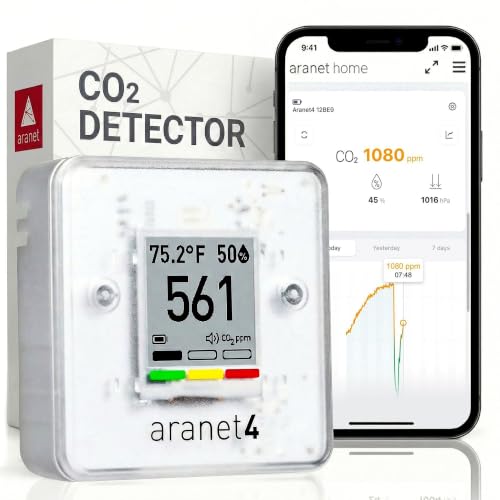
For pure CO2 logging with the longest published battery life, the Aranet4 Indoor Air Quality Monitor is the straightforward pick: the listing states up to four years on its e-ink display and a free app that shows up to 90 days of history. If you need a file rather than a graph, the Temtop M2000C 2ND is the only pick whose listing explicitly promises CSV export over USB, which is what you want for long-term tracking in a spreadsheet. The IQAir AirVisual Pro is the broadest instrument here, adding PM2.5 and a Wi-Fi app, and the Aranet4 Monitor with Aranet2 Sensor Bundle is simply the Aranet4 Indoor Air Quality Monitor bundled with a second sensor for humidity and temperature. The catch with all four is the same: none of these listings publishes a CO2 accuracy figure in ppm, so treat the displayed number as a trend indicator, not a calibrated reference.
What “exportable” actually means for a CO2 record
Export is not one feature. It is at least three different things, and the four listings here cover different parts of it.
The first is in-app history: the device sends readings to a phone app, and the app draws a graph. The Aranet4 Indoor Air Quality Monitor and the Aranet4 Monitor with Aranet2 Sensor Bundle both describe a free smartphone application for viewing and analysing up to 90 days of historical data, complete with user-friendly graphs. The IQAir AirVisual Pro describes historical indoor AQI, temperature and humidity in the IQAir app. That is fine for looking back, but a graph on a phone is not a file you can sort, filter, or attach to a report.
The second is file export. Only the Temtop M2000C 2ND’s listing states this plainly: readings can be downloaded in CSV format via USB. CSV is the format that opens in any spreadsheet, which is what makes it useful for long-term tracking and detailed environmental analysis. If your reason for buying is a data set rather than a dashboard, that sentence is the one that matters.
The third is continuity, meaning whether the record survives when the battery dies or the app changes. None of these listings publishes a retention guarantee, a cloud policy, or a statement about what happens to your history if the app is discontinued. That is a real gap, and it is why the CSV route is worth preferring where it is offered.
The export and sensor facts side by side
Everything in this table comes from the supplied listings. Where a listing is silent, the cell says so rather than guessing.
| Pick | Measured quantities | Export route stated | History stated | Battery claim | Connectivity |
|---|---|---|---|---|---|
| Aranet4 Indoor Air Quality Monitor | CO2, temperature, relative humidity, atmospheric pressure | Free smartphone app | Up to 90 days | Up to 4 years | Wireless, e-ink display |
| Aranet4 Monitor with Aranet2 Sensor Bundle | CO2, temperature, humidity, pressure, plus separate humidity and temperature sensor | Free smartphone app | Up to 90 days | Up to 5 years | Wireless |
| IQAir AirVisual Pro | PM2.5, CO2, smoke, dust, temperature, humidity, AQI | IQAir app on phone, tablet or desktop | Historical indoor AQI, temperature, humidity (period not stated) | Rechargeable via outlet or USB | Wi-Fi |
| Temtop M2000C 2ND | CO2, PM2.5, PM10, temperature, humidity | CSV via USB | Not stated in the listing bullets | Rechargeable battery | USB |
The table makes the trade-off visible. The Aranet4 Indoor Air Quality Monitor and the Aranet4 Monitor with Aranet2 Sensor Bundle give you a long-running wireless record you view in an app. The Temtop M2000C 2ND gives you a file you can keep. The IQAir AirVisual Pro gives you the widest set of sensors but the listing does not state how far back its history goes.
Why the accuracy figure is missing, and what to do about it
None of the four listings publishes a CO2 measurement accuracy in parts per million. The Aranet4 Monitor with Aranet2 Sensor Bundle mentions NDIR technology, which is the standard non-dispersive infrared method for CO2 sensing and is the right technology for the job. But the word NDIR tells you the mechanism, not the tolerance.
This matters because CO2 sensing is where cheap instruments quietly fail. NDIR sensors drift as the lamp and detector age, and most consumer units rely on a baseline correction routine that assumes the sensor will periodically see fresh outdoor air, roughly 400 to 420 ppm. If your monitor lives in a sealed bedroom or a basement that never sees outside air, that assumption breaks and the readings slowly slide. A monitor can be perfectly consistent and still be wrong.
So use these instruments for what they are good at: relative change. If a room reads 600 ppm with the window open and 1,800 ppm after an hour with the door shut, the difference is real and actionable regardless of absolute calibration. If you need a defensible absolute number for a compliance record, you need a calibrated reference instrument, and none of these four listings claims to be one.
One more caution on the listings themselves. The Aranet4 Indoor Air Quality Monitor and the Aranet4 Monitor with Aranet2 Sensor Bundle both describe the Aranet4 as the top-rated indoor air quality monitor in Amazon’s CO2 monitor segment. That is a sales-rank claim from the listing, not a measurement claim, and it tells you nothing about accuracy. Ignore it when comparing.
The four picks and what each one exports
Aranet4 Indoor Air Quality Monitor
The listing states up to four years of battery life on an e-ink display and a free app holding up to 90 days of CO2 history, which makes it the least fussy way to keep a long CO2 record without cables.
Aranet4 Monitor with Aranet2 Sensor Bundle
This is the same Aranet4 CO2 monitor bundled with a separate humidity and temperature sensor. The listing claims up to five years of battery life, which is longer than the Aranet4 Indoor Air Quality Monitor’s stated figure, so the bundle is worth a look if you want humidity tracked separately from the CO2 unit.
IQAir AirVisual Pro
The listing describes professional-grade sensors for PM2.5, CO2, smoke and dust, Wi-Fi connectivity, and historical indoor AQI, temperature and humidity. It is the broadest instrument in this group, not just a CO2 logger.
Temtop M2000C 2ND
The listing states that readings can be downloaded in CSV format via USB. That is the only explicit file-export promise among the four, and it is the reason this pick exists on a page about exportable data.
Choosing between an app record and a file
The decision usually comes down to who the record is for.
If it is for you, and you want to glance at a graph and decide whether to open a window, the Aranet4 Indoor Air Quality Monitor or the Aranet4 Monitor with Aranet2 Sensor Bundle will do the job with the least maintenance. The e-ink display means the screen does not drain the battery, which is why the listing can claim years rather than days. You install the app once and the history accumulates on its own. This is the right shape of instrument for a bedroom, a home office, or a classroom where the goal is a habit of ventilation rather than a data set.
If the record is for somebody else, a facilities report, a landlord, a school district, a research project, you want a file. The Temtop M2000C 2ND’s CSV export is the only stated route to one here, and CSV is deliberately boring in the best way: it opens in Excel, Google Sheets, R, or Python without conversion. If you are building a long-term log, that matters more than any single reading.
If you want to know about particles at the same time, the IQAir AirVisual Pro and the Temtop M2000C 2ND both cover PM2.5. The IQAir AirVisual Pro adds smoke and dust to its stated sensor list and reports an AQI, which is a composite index rather than a raw concentration. That is convenient for a general audience and less convenient for analysis, because the index hides the underlying numbers. The Temtop M2000C 2ND reports PM2.5 and PM10 as separate quantities, which is more useful if you intend to chart them. For a deeper look at how particle sensing differs from CO2 sensing, see the guide to particle monitors.
Placement and the maintenance nobody mentions
Where you put the monitor changes the number more than the monitor does.
CO2 is exhaled, so it pools where people are and where air stagnates. A monitor on a shelf two metres from the nearest person will read lower than one at head height in the middle of the room. For a bedroom, the useful position is near the pillow, at breathing height, not on the far wall. For an office, put it where the occupants actually sit, not on the reception desk. This is the same logic that applies in bedroom CO2 monitoring, where overnight readings are the whole point.
Maintenance is short but real. NDIR sensors need periodic exposure to fresh air so the baseline correction can work. If a unit lives permanently in a closed room, take it outside or open the windows fully for a while on a regular basis. The listings here do not publish a recalibration interval or a calibration procedure, so you cannot plan against a stated schedule; you can only give the sensor the fresh-air reference it needs.
Batteries are the other quiet issue. The Aranet4 Indoor Air Quality Monitor states up to four years and the Aranet4 Monitor with Aranet2 Sensor Bundle states up to five, both on the strength of an e-ink display. The IQAir AirVisual Pro and the Temtop M2000C 2ND are rechargeable, which means a cable and a routine. If the monitor is going somewhere awkward, a ceiling-height classroom or a holiday rental, the multi-year battery matters more than any app feature. There is more on this trade-off in the battery-powered CO2 monitor comparison.
Where these instruments stop being the right answer
All four of these are indoor air quality monitors. None of them is a safety device, and none of the listings claims to be.
A CO2 monitor does not detect carbon monoxide. CO is a different gas with a different sensor, and a rising CO2 reading tells you nothing about it. If you have a combustion appliance, you need a CO alarm, separately. Similarly, a CO2 reading is not a substitute for a smoke alarm or a combustible gas detector.
These devices also do not measure volatile organic compounds, formaldehyde, radon, or mould. The IQAir AirVisual Pro’s listing mentions smoke and dust among the particles its laser sensor covers, but that is optical particle counting, not gas detection. If your concern is a renovation, solvents, or new furniture, a CO2 monitor is the wrong instrument and the wrong question. The renovation guide at monitoring for renovation projects covers what to use instead.
Finally, none of these will fix the air. They tell you when to ventilate or when to run filtration. If you want to know whether running a purifier changes your CO2, the short answer is that it does not; purifiers remove particles, not CO2, and that is explained in whether an air purifier removes CO2. The monitor is the measurement half of the job. The window is the other half.
Recommended Tools


Products shown because their documented specifications fit this guide. Price and availability are on Amazon and can change.
Frequently Asked Questions
Which of these can actually export a CSV file?
Only the Temtop M2000C 2ND. Its listing states that readings can be downloaded in CSV format via USB. The Aranet4 Indoor Air Quality Monitor, the Aranet4 Monitor with Aranet2 Sensor Bundle and the IQAir AirVisual Pro all describe app-based history and graphs, but none of their listings promises a file export. If a spreadsheet is essential, that single sentence decides it.
How far back does the history go?
the Aranet4 Indoor Air Quality Monitor and the Aranet4 Monitor with Aranet2 Sensor Bundle both state up to 90 days of historical data in the free app. The IQAir AirVisual Pro states that it reports historical indoor AQI, temperature and humidity, but the listing does not publish a period. The Temtop M2000C 2ND's listing does not state a history period at all. Treat 90 days as the only confirmed figure here.
Is the Aranet4 Monitor with Aranet2 Sensor Bundle better than the Aranet4 Indoor Air Quality Monitor, or just bigger?
The CO2 monitor in the bundle is the Aranet4, the same instrument as the Aranet4 Indoor Air Quality Monitor. The difference is that Aranet4 Monitor with Aranet2 Sensor Bundle adds a separate humidity and temperature sensor and its listing claims up to five years of battery life against the Aranet4 Indoor Air Quality Monitor's four. If you want humidity tracked independently, the bundle makes sense. If you only care about CO2, they are functionally the same job.
Can I trust the CO2 number as an absolute reading?
Not on the strength of these listings. None of the four publishes a CO2 accuracy in ppm, and none states a calibration interval. NDIR sensors drift and depend on periodic fresh-air baselines. Use the readings for relative change, which is what drives ventilation decisions, and get a calibrated reference instrument if you need an absolute figure.
Do any of these detect carbon monoxide?
No. None of the listings claims CO detection, and a CO2 sensor cannot see CO. If you have a gas boiler, a wood stove, or an attached garage, you need a dedicated CO alarm as well. These are comfort and ventilation instruments, not safety devices.
Which one should I put in a school classroom?
It depends on whether the goal is a lesson or a record. For teaching, the Aranet4 Indoor Air Quality Monitor or the Aranet4 Monitor with Aranet2 Sensor Bundle with the colour-coded display and app graph is simple and needs almost no attention for years. For a data project where students export and chart the numbers, the Temtop M2000C 2ND's CSV route is the one that produces a file. The IQAir AirVisual Pro suits a broader air quality lesson because it also reports PM2.5 and an AQI.
Affiliate disclosure: Akermin earns a commission from qualifying Amazon purchases made through links on this page. Our editorial picks are based on documented specifications and owner feedback, not commissions.