Skip to content
AkerminMeasure. Monitor. Improve. Compare Products

Best Ultrasonic Anemometers for Weather Monitoring: 7 Picks

Ultrasonic anemometers measure wind without cups, vanes, or bearings. That removes the starting threshold and the wear that eventually stops a mechanical anemometer. The trade is a different set of failure modes and a different set of questions at purchase.

  • Independent Research
  • Verified Specifications
  • Honest Recommendations

Measure It
Compare It
Buy Once

As an Amazon Associate, Akermin earns from qualifying purchases. Product links on this page are affiliate links.

Our Top Picks

This comparison covers ultrasonic anemometers intended for weather monitoring. Products were included only if the supplied listing describes ultrasonic wind sensing. The handheld vane and hot wire anemometers (BTMETER BT-100, HoldPeak 866B, TopTes TS-301, Testo 405i) were excluded because they do not use ultrasonic sensing.

Best for existing Ecowitt setups
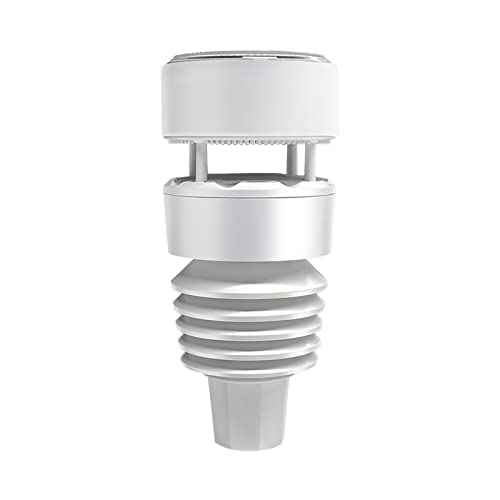
Ecowitt WS90 7-in-1 Weather Sensor

Ecowitt WS90 7-in-1 Weather Sensor

A fixed ultrasonic weather sensor that needs a gateway and a hub you already trust.

  • Collects temperature, humidity, wind speed and direction, light, UV, and rainfall
  • Haptic rainfall sensor with rain start and stop detection, no tipping bucket
  • IPX5 waterproof and thermal insulation construction
  • Transmits up to 150 m with obstacles and 300 m in open space at 915 MHz
View on Amazon Read Full Review→
Same sensor, different hub
Ecowitt WS90 with Bluetooth and Zigbee

Ecowitt WS90 with Bluetooth and Zigbee

The WS90 sensor again, this time with Bluetooth and Zigbee and a Shelly gateway requirement.

  • Dual Bluetooth and Zigbee connectivity for the same 7-in-1 sensor
  • Ultrasonic wind monitoring plus haptic rain detection
  • Temperature, humidity, UV, and illuminance tracking
  • IPX5, solar panel with backup batteries, up to 300 m open-space range
View on Amazon Read Full Review→
Most complete single unit
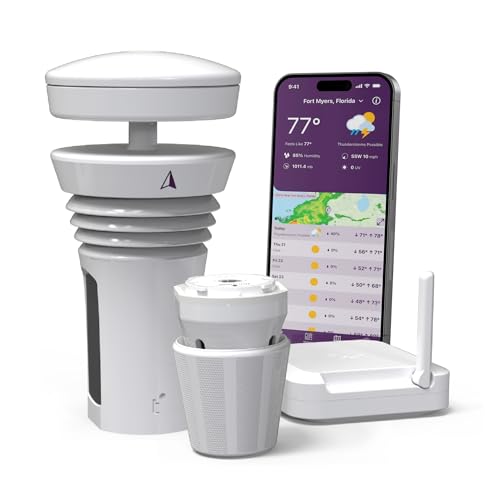
Tempest Weather Station

Tempest Weather Station

One outdoor device covering wind, rain, pressure, lightning, and forecasting.

  • Monitors temperature, humidity, barometric pressure, wind speed and direction, dew point, solar radiation, UV, lightning, and rainfall
  • Solar-powered outdoor sensor with wireless range stated as 1,000+ feet
  • Real-time updates every 3 seconds
  • App and Alexa enabled
View on Amazon Read Full Review→
Best pocket meter for shooters
Calypso Mini AB Wind Meter

Calypso Mini AB Wind Meter

A 1.69 inch ultrasonic anemometer that feeds a ballistic solver over Bluetooth.

  • Pocket-sized ultrasonic anemometer stated as 1.69 inches
  • Bluetooth link to Applied Ballistics for real-time wind speed and direction
  • Aimed at long-range shooting and hunting
  • Battery life stated as 150 hours
View on Amazon Read Full Review→
Best for sailing and field use
Calypso Solar Ultrasonic Anemometer

Calypso Solar Ultrasonic Anemometer

A solar self-charging pocket ultrasonic anemometer with app and Garmin support.

  • Integrated solar panel keeps the internal battery topped off
  • Ultrasonic sensor with zero moving parts, stated as maintenance free
  • Measures wind speed and direction
  • Syncs with the Garmin Connect platform and has iOS and Android apps
View on Amazon Read Full Review→
Best bare sensor for integrators
Veinasa Mini-C2A-RS485

Veinasa Mini-C2A-RS485

An IP65 RS485 ultrasonic wind sensor for meteorology and system builders.

  • Wind speed range stated as 0 to 45 m/s
  • Wind direction stated as 0 to 360 degrees
  • Digital RS485 output
  • Engineering plastics housing stated as resistant to sunshine and rain
View on Amazon Read Full Review→
Compact all-in-one for agriculture
Veinasa Mini-C5A Ultrasonic Wind Sensor

Veinasa Mini-C5A Ultrasonic Wind Sensor

A small combined wind speed and direction sensor aimed at agriculture and smart city use.

  • Wind speed stated as 0 to 45 m/s
  • Wind direction stated as 0 to 360 degrees
  • Described as an all-in-one compact weather station
  • Listed applications include meteorology, environment, transportation, and smart city
View on Amazon Read Full Review→

Comparison Table

View Full Comparison→
PickTypeWind speed rangeWind directionOutputPowerIngress rating
Pocket handheldUltrasonicNot statedMeasuredBluetoothBattery, 150 h statedNot statedView
Fixed sensorUltrasonicNot statedMeasured915 MHz to gatewaySolar with backup batteriesIPX5View
Fixed sensorUltrasonic0 to 45 m/s0 to 360 degreesRS485Not statedIP65View
Pocket handheldUltrasonicNot statedMeasuredBluetoothSolar self-chargingNot statedView
Fixed stationUltrasonicNot statedMeasuredWireless to appSolarNot statedView
Fixed sensorUltrasonicNot statedMeasuredBluetooth and ZigbeeSolar with backup batteriesIPX5View
Fixed sensorUltrasonic0 to 45 m/s0 to 360 degreesNot statedNot statedNot statedView

Cells marked Not stated are absent from the supplied listing text. Wind direction is listed as measured on units that publish direction data but do not give a numeric range. No accuracy figures were published for any of these products.

How to choose an ultrasonic anemometer

The right choice depends less on the sensor and more on what the rest of your system looks like.

Decide handheld or fixed first

A pocket meter answers a question at your location. A fixed sensor answers a question about a place. They are not substitutes.

Check what you already own

If you run an Ecowitt gateway, P2 fits. If you run Shelly, P10 fits. Buying the wrong one means buying a second hub.

Ask for the accuracy figure

Most listings here do not publish wind speed accuracy. If your application needs it, request the datasheet before purchase.

Match the output to your logger

RS485 sensors like P3 and P12 need a compatible data logger. Consumer stations like P2, P5, and P10 bring their own app.

Plan for the acoustic path

The transducer area is the part that fails or drifts. Mount it where you can reach it to clean it, and keep it clear of ice and debris.

Understand the power story

Solar self-charging reduces routine charging but does not remove the battery. Check what happens after a week of heavy overcast.

Frequently Asked Questions

View All FAQs→
What is an ultrasonic anemometer and how does it work?

It measures wind by timing sound pulses travelling between pairs of transducers. Wind along the path speeds up the pulse in one direction and slows it in the other. The difference gives wind speed, and comparing paths gives direction. There are no cups, vanes, or bearings.

Do ultrasonic anemometers have a starting threshold?

They do not have the mechanical starting threshold that a cup or vane anemometer has, because there is nothing to start moving. Very low speeds are limited by the resolution and noise floor of the electronics, not by friction. The listings here do not publish a minimum measurable speed.

What fails on an ultrasonic anemometer if there are no bearings?

The acoustic path. Dust, salt, pollen, insects, spider webs, and ice on or between the transducers can bias or block the reading. The transducer elements themselves can also fail electronically. Maintenance shifts from replacing bearings to keeping the sensor head clean and unobstructed.

Can I use an ultrasonic anemometer for official weather records?

Only if the instrument has a documented calibration and accuracy specification that meets the standard you are working to. None of the listings here publish a wind speed accuracy figure. For official records, request the calibration certificate and accuracy specification from the manufacturer.

Reviews

Ecowitt WS90 7-in-1 Weather Sensor

Ecowitt WS90 7-in-1 Weather Sensor Best for existing Ecowitt setups

The WS90 is a fixed outdoor sensor, not a station on its own. The listing states clearly that it cannot be used alone and needs a gateway and Wi-Fi configuration before data reaches the WS View Plus or Ecowitt app. If you already run an Ecowitt gateway, this is the sensor to add. If you do not, budget for the hub as part of the purchase.

The wind measurement is ultrasonic, so there are no cups to spin up and no vane to swing into position. That matters most at low wind speeds, where a mechanical anemometer has a starting threshold below which it reads zero. An ultrasonic sensor has no such threshold in the same sense, because there is nothing to start moving. What replaces bearing wear as the failure mode is the transducer surface and the acoustic path between the transducer pairs. Dust, salt, spider webs, and ice across that path can bias or block the reading, so the maintenance task shifts from oiling or replacing bearings to keeping the top of the unit clean and unobstructed.

The haptic rain sensor is the other departure from convention. Instead of a tipping bucket, it detects the impact of drops and interprets start and stop events. The listing says it does not vibrate and is not affected by harsh weather. That is a design claim, not a calibration guarantee, and the listing does not publish a rainfall accuracy figure. Treat the rain data as useful for trend and event detection rather than as a replacement for a certified gauge.

Strengths

  • Ultrasonic wind with no moving parts to wear or start moving
  • Haptic rain detection with start and stop events
  • Solar panel with backup batteries and long transmission range
  • Integrates with the Ecowitt app and WS View Plus ecosystem

Limitations

  • Cannot be used alone; a gateway is required
  • Rainfall accuracy is not stated in the listing
  • 915 MHz is region-specific and not usable everywhere
  • Ultrasonic path can be fouled by debris or ice
View on Amazon
Ecowitt WS90 with Bluetooth and Zigbee

Ecowitt WS90 with Bluetooth and Zigbee Same sensor, different hub

This is the same Ecowitt WS90 sensor described in P2, packaged for the Shelly ecosystem. The listing states it requires a gateway for use with the Shelly Smart Control app. The wind, rain, temperature, humidity, UV, and light measurements are the same, and the ultrasonic wind principle is the same: no cups, no vane, no bearings, and no mechanical starting threshold.

Because the two products are functionally identical at the sensor level, the decision is not about measurement quality. It is about which hub you already own or intend to buy. If you are in the Shelly ecosystem, this version is the one that fits. If you are in the Ecowitt ecosystem, P2 is the one that fits. The listing does not publish a wind speed accuracy figure for either, so do not assume one is more precise than the other on the basis of the marketing text.

The failure mode discussion carries over unchanged. The transducer path is the part that needs attention. In a coastal installation, salt deposits on the acoustic path are the practical concern. In a cold climate, ice bridging the path is the concern. Neither is a bearing problem, and neither is fixed by the kind of annual service a mechanical anemometer needs.

Strengths

  • Ultrasonic wind with no moving parts
  • Bluetooth and Zigbee for flexible integration
  • Haptic rain sensor with no tipping bucket
  • Long transmission range in open space

Limitations

  • Requires a gateway, not stated as included
  • Wind accuracy not stated in the listing
  • Zigbee and Bluetooth range depend on the hub location
  • Same acoustic-path fouling risk as any ultrasonic sensor
View on Amazon
Tempest Weather Station

Tempest Weather Station Most complete single unit

The Tempest is the closest thing here to a complete weather station in one housing. The listing states it measures wind speed and direction, rainfall, temperature, humidity, pressure, dew point, solar radiation, UV, and lightning strikes, and that it updates every three seconds. The wind sensor is built in and the unit is solar powered, so there is no separate masthead cable run for the anemometer.

The listing includes a claim that the product was featured in several magazines and is loved by more than 90,000 users. Those are marketing and popularity claims, not measurement specifications, and they should not influence a technical decision. The listing does not publish a wind speed accuracy figure, a wind speed range, or a rainfall accuracy figure. If you need documented accuracy for a regulatory or research application, this listing does not provide it.

For a homeowner or a school, the value is the integration. One device, one app, no separate rain gauge and anemometer to mount and wire. The ultrasonic wind sensor removes the bearing wear problem, and the three-second update interval is fast enough to see gusts rather than just averages. The lightning detection is a genuine addition that most consumer stations do not have. The trade is that you cannot service or replace the wind sensor separately from the rest of the unit, and the listing does not describe a calibration procedure.

Strengths

  • Wind, rain, pressure, lightning, and radiation in one device
  • Solar powered with no masthead wiring for wind
  • Three-second update interval
  • App and voice assistant integration

Limitations

  • Wind speed accuracy and range not stated in the listing
  • Popularity claims are not technical specifications
  • Sensor is not separately serviceable
  • Requires a stable wireless link to the indoor display or app
View on Amazon
Calypso Mini AB Wind Meter

Calypso Mini AB Wind Meter Best pocket meter for shooters

The Mini AB is a handheld ultrasonic anemometer built around a specific workflow: read the wind where you are, send it to a ballistic solver, and get a firing solution. The listing states it syncs wirelessly via Bluetooth to feed wind speed and direction into Applied Ballistics. That is the mechanism that matters. A handheld vane anemometer gives you a number on a screen that you then type in; this unit pushes the data into the solver directly.

At 1.69 inches it is small enough to live in a pocket or a pouch. The listing states 150 hours of battery life, which is long enough for a season of range trips if you are not leaving it on continuously. The ultrasonic sensor has no moving parts, so there is no impeller to clog with dust or to spin down between readings. The failure mode to watch is the acoustic path, which on a pocket device means keeping the sensor openings clear of lint, mud, and water.

The listing does not publish a wind speed range or an accuracy figure. For long-range shooting, the wind reading at the shooter's position is not the same as the wind at the target, so the value of the device is in giving the solver a better starting input than a guess. It does not measure downrange wind, and no handheld anemometer does. Treat it as a way to anchor the near-wind component, not as a complete wind solution.

Strengths

  • Ultrasonic sensor with no moving parts
  • Direct Bluetooth integration with Applied Ballistics
  • Very compact at 1.69 inches
  • 150 hour battery life stated

Limitations

  • Wind speed range and accuracy not stated in the listing
  • Measures wind at the shooter, not downrange
  • Requires a compatible phone or device for the solver link
  • Small sensor openings need regular cleaning
View on Amazon
Calypso Solar Ultrasonic Anemometer

Calypso Solar Ultrasonic Anemometer Best for sailing and field use

The Solar Ultrasonic Anemometer is the field-use version of the Calypso pocket concept. The listing states a 100 percent solar self-charging design, with an integrated panel keeping the internal battery topped off through the day. That removes the charging cable from the kit list, which matters on a boat or in a pack where cables get lost. It does not remove the need for a charged battery before a night or a heavily overcast day, and the listing does not state a runtime figure for those conditions.

The sensor is ultrasonic with zero moving parts, and the listing describes it as maintenance free and built to survive salt spray, heavy rain, and intense field use without recalibration. That is the manufacturer's claim. The practical maintenance is still keeping the acoustic path clear. Salt spray leaves residue, and residue on a transducer changes the acoustic path. A freshwater rinse after a saltwater outing is the kind of habit that keeps an ultrasonic sensor honest.

For sailors, the listing states instant apparent wind without masthead wiring, and Garmin Connect integration. Apparent wind is the wind you feel on the boat, which is what you need for sail trim. True wind requires boat speed and heading, which the app or the Garmin platform handles. The listing does not publish a wind speed range or accuracy figure, so if you need documented performance for racing rules or logging, ask the manufacturer for the datasheet.

Strengths

  • Solar self-charging removes routine charging
  • Ultrasonic sensor with no moving parts
  • Garmin Connect and iOS and Android app support
  • Designed for salt spray and field use

Limitations

  • Battery runtime in low light not stated in the listing
  • Wind speed range and accuracy not stated in the listing
  • Salt residue on the acoustic path still needs rinsing
  • Apparent wind only; true wind needs boat speed and heading
View on Amazon
Veinasa Mini-C2A-RS485

Veinasa Mini-C2A-RS485 Best bare sensor for integrators

The Mini-C2A is a component, not a consumer product. It outputs wind speed and direction over RS485, and the listing states an IP65 rating and an engineering plastics housing. There is no display, no app, and no gateway in the listing. You supply the data logger, the power, and the mounting. That is the point of this class of sensor: it goes on a mast, a rooftop, or a weather station frame, and it talks to whatever you already run.

The stated wind speed range is 0 to 45 m/s, which covers everything from calm to severe storm force. The direction range is 0 to 360 degrees. Because the sensor is ultrasonic, there is no starting threshold in the mechanical sense and no bearing to wear. The failure mode is the acoustic path, and in an outdoor installation that means the same things as any ultrasonic sensor: ice, debris, insects, and long-term contamination of the transducer faces.

The listing does not publish an accuracy figure, a resolution figure, an operating temperature range, or a power supply requirement. For an integrator, those are the numbers you need before committing. Ask the supplier for the Modbus register map and the accuracy specification. The IP65 rating means protected against dust and water jets, not immersion, so mount it where it will not sit in standing water.

Strengths

  • Stated 0 to 45 m/s wind speed range
  • RS485 output integrates with standard loggers
  • IP65 housing for outdoor mounting
  • Ultrasonic sensor with no moving parts

Limitations

  • No display, app, or gateway included
  • Accuracy and resolution not stated in the listing
  • Power supply and protocol details not stated
  • IP65 is not immersion rated
View on Amazon
Veinasa Mini-C5A Ultrasonic Wind Sensor

Veinasa Mini-C5A Ultrasonic Wind Sensor Compact all-in-one for agriculture

The Mini-C5A is another bare ultrasonic wind sensor, this time described as an all-in-one compact weather station for agriculture. The listing states wind speed from 0 to 45 m/s and wind direction from 0 to 360 degrees, and lists meteorology, environmental protection, transportation, smart city, and industrial testing as applications. Those are application categories, not specifications, and the listing does not state what else, if anything, the unit measures beyond wind.

Functionally, this sits in the same class as P3. Both are ultrasonic wind sensors with a stated 0 to 45 m/s range and a 0 to 360 degree direction range. The listing for P12 does not state the output type, the housing material, or the ingress protection rating, whereas P3 states RS485 and IP65. If you need a documented interface, P3 gives you more to work with. If you need a compact agricultural sensor and can confirm the interface with the supplier, P12 is a candidate.

The ultrasonic principle is the same. No cups, no vane, no bearings, no starting threshold. The maintenance task is keeping the acoustic path clear. In an agricultural setting, that means dust, pollen, and in some seasons insects. A periodic wipe of the transducer area is the whole service schedule, which is a genuine change from the annual bearing check a mechanical anemometer needs.

Strengths

  • Stated 0 to 45 m/s wind speed range
  • Stated 0 to 360 degree direction range
  • Compact all-in-one form factor
  • Ultrasonic sensor with no moving parts

Limitations

  • Output type not stated in the listing
  • Ingress protection rating not stated
  • Accuracy and resolution not stated
  • No display, app, or gateway included
View on Amazon

Buying Guide

Short answer: For a fixed weather station, P2 and P10 are the same Ecowitt WS90 sensor with different connectivity paths, so choose on which hub you already own. P5 is the most complete single outdoor unit if you want forecasting and lightning detection in one package. For a handheld or pocket meter, P1 and P4 are the two Calypso units, with P4 adding solar charging and P1 aimed at ballistic solvers. P3 and P12 are bare RS485 sensors for integrators, not consumer stations. The handheld vane anemometers P6, P7, P8, and P9 are not ultrasonic and were excluded.

What ultrasonic sensing changes about wind measurement

A cup anemometer measures wind by being pushed. The cups have mass, the spindle has friction, and below a certain speed the cups do not turn at all. That is the starting threshold. A vane anemometer has the same problem in a different axis. Both designs also have bearings, and bearings wear. After a few years in a coastal or dusty environment, the anemometer that read accurately when new starts reading low, and the owner often does not notice because the change is gradual.

An ultrasonic anemometer removes both problems at once. There is nothing to push, so there is no starting threshold in the mechanical sense. There are no bearings, so there is no bearing wear. The measurement is made by timing sound pulses along fixed paths between transducers. Wind along the path changes the transit time, and the difference between the two directions gives the speed. Multiple paths give direction.

What replaces bearing wear as the failure mode is contamination of the acoustic path. Anything that sits on a transducer face or spans the gap between a transducer pair changes the measurement. Salt crystals, dust, pollen, ice, and spider webs are the usual culprits. The service task changes from mechanical repair to cleaning, which is easier but must actually be done. If you cannot reach the sensor head safely, an ultrasonic anemometer will drift just as surely as a mechanical one, only for a different reason.

Reading the specifications that matter

Wind speed range tells you what the sensor can survive and what it can report. The Veinasa sensors here state 0 to 45 m/s, which covers calm through severe storm force. The consumer stations in this comparison do not publish a range at all. If you are mounting a sensor in an exposed location, the survival wind speed matters as much as the measurement range, and the listings here do not separate the two.

Accuracy is the specification most often missing. None of the listings in this comparison publish a wind speed accuracy figure. That is not unusual for consumer weather products, but it matters if you are using the data for anything beyond personal interest. For integration work, ask for the datasheet. For a home station, accept that the number is indicative rather than certified.

Output type decides what the sensor can talk to. RS485 sensors such as P3 and P12 are components: they need a data logger and a power supply, and they will not show you anything on their own. Consumer stations such as P2, P5, and P10 bring an app and a gateway requirement. Pocket meters such as P1 and P4 use Bluetooth to a phone. Match the output to the rest of your system before you buy, because an RS485 sensor with no logger is a paperweight. If you are building a broader monitoring setup, our guide to environmental data loggers for building monitoring covers the logging side.

The mistake buyers make with fixed ultrasonic sensors

The most common mistake is buying a sensor without the hub. The Ecowitt WS90 listings state plainly that the sensor cannot be used alone and needs a gateway. Buyers who miss that line end up with a sensor that powers up and transmits nothing they can see. The same applies to the Shelly-branded version, which requires a Shelly gateway for the app.

The second mistake is mounting the sensor where it cannot be cleaned. An ultrasonic anemometer on a high mast is maintenance free until the acoustic path fouls, and then it is a climbing job. If you have a choice, mount it at a height you can reach with a step ladder and a soft brush. The wind at ten metres is different from the wind at three metres, so there is a real trade between measurement quality and serviceability. For most home and farm installations, a reachable height with a clean fetch is a better compromise than an unreachable height with a perfect exposure.

The third mistake is assuming the rain sensor works like a tipping bucket. The haptic rain sensors in the Ecowitt units detect drop impacts and interpret start and stop events. They do not have a bucket to tip, and the listing does not publish a rainfall accuracy figure. Use them for event detection and trend, not for calibrated rainfall totals.

Maintenance nobody mentions

The cleaning schedule for an ultrasonic anemometer is short but real. Inspect the transducer area at the start of each season and after any major storm. Wipe the transducer faces with a soft cloth and fresh water. Do not use solvents on the plastic housing. If you are in a coastal location, rinse the head after salt spray events, because salt residue is the most common cause of a slow drift in readings.

In cold climates, ice is the concern. Ice bridging the acoustic path will block the measurement entirely, and the listing for none of these products states a heated transducer option. If you need year-round data in a location that ices up, plan for either a heated sensor from a different class of product or accept a data gap during icing events.

Battery and power behaviour is the other thing owners forget. The solar-charging units here, P4, P5, P10, and P2, rely on the panel to keep the internal battery topped off. That works well in summer and less well through a dark winter. The listings do not state a runtime for low-light conditions, so if you depend on continuous data, check the battery state through the first winter rather than assuming the panel covers it. For a broader look at how these sensors fit into a monitoring programme, see our guide to environmental monitoring devices.

Where an ultrasonic anemometer is the wrong answer

An ultrasonic anemometer is not an alarm. It reports wind speed and direction; it does not warn you when the wind exceeds a threshold unless the software you connect it to does that. If you need a shutdown signal for a crane, a greenhouse vent, or a turbine, the sensor is only one part of the system, and the alarm logic lives elsewhere.

It is also not a substitute for a certified instrument in a regulated application. None of the products here publish a wind speed accuracy figure, and none of the listings describe a calibration certificate. If your application requires traceable measurement, this class of consumer and prosumer sensor is the wrong starting point.

Finally, an ultrasonic anemometer is not automatically better than a mechanical one for every use. A cup anemometer with a documented calibration can outperform an uncalibrated ultrasonic sensor on accuracy, even though it has bearings and a starting threshold. The ultrasonic advantage is in low-wind response and in the absence of mechanical wear, not in guaranteed accuracy. If you need a general-purpose handheld for HVAC work rather than weather monitoring, a vane or hot wire meter is the right tool, and our airflow meters and anemometers guides cover those.
How We Research

This comparison covers ultrasonic anemometers intended for weather monitoring. Products were included only if the supplied listing describes ultrasonic wind sensing. The handheld vane and hot wire anemometers (BTMETER BT-100, HoldPeak 866B, TopTes TS-301, Testo 405i) were excluded because they do not use ultrasonic sensing. The D3LX0Z1 module was excluded because the listing gives no brand-level product detail beyond the title. Every specification in the table and the reviews is drawn from the supplied listing text. Where a listing does not publish a figure, the table says Not stated and the review says so. No laboratory testing was performed and no measurements of our own are published.

Read our full review methodology→