As an Amazon Associate, Akermin earns from qualifying purchases. Product links on this page are affiliate links.

ALLmeter · ALLmeter 2000W Solar Panel Tester, MPPT Solar Meter,3-90V 40A,MC4,Type-C | Rechargeable,Pmax Voc Isc Testing,Auto/Manual Modes,3.2-Inch LCD,Data Storage PV Installation and Maintenance
View on AmazonPrice and availability are shown on Amazon and can change at any time.
Verdict
The ALLmeter solar panel tester measures the thing that matters about a panel: how much power it can actually deliver. The listing states maximum power to 2000 W, open circuit voltage from 3 to 90 V, short circuit current from 0 to 40 A, built-in MPPT tracking, auto and manual modes, MC4 compatibility and a 3.2 inch LCD described as readable in direct sunlight. For anyone commissioning, troubleshooting or buying second hand panels, it answers questions a multimeter cannot.
Documented Specifications
| Item | Manufacturer listing |
|---|---|
| Maximum power | 2000 W |
| Open circuit voltage | 3 to 90 V |
| Short circuit current | 0 to 40 A |
| Method | Built-in MPPT tracking |
| Modes | Auto and manual |
| Connection | MC4 compatible |
| Display | 3.2 inch LCD, readable in direct sunlight |
The listing does not publish accuracy figures or a safety category rating. Confirm the rating before using it on any system beyond a small off-grid array.
Why Open Circuit Voltage Is Not Enough
Point a multimeter at a panel in daylight and you will get a voltage close to the label figure whether the panel is healthy or badly degraded. Open circuit voltage is remarkably insensitive to the things that actually reduce output: cell damage, delamination, a failed bypass diode, partial shading, corroded interconnects and general ageing.
Power is what changes. A tester that sweeps the load to find the maximum power point applies increasing current and watches the voltage collapse, then reports the peak of the product. That is the number that maps onto energy produced, and it is the number that can be compared with the panel’s own label.
A Sensible Test Procedure
- Test in good, steady sunlight. Readings in cloud or at low sun angles are meaningless as a comparison against a label figure rated at full sun.
- Note the conditions. Panel label ratings assume a standard irradiance and cell temperature, and real panels run hotter, so a healthy panel typically measures below its label figure.
- Measure irradiance if you can, with an instrument such as the Fluke IRR1, so results can be normalised rather than guessed at.
- Test panels against each other in the same conditions. A string where one panel produces noticeably less than its neighbours is a clear finding regardless of absolute accuracy.
- Keep the panel disconnected from the system while testing.
The Second Hand Panel Case
Used panels are sold constantly, and the seller’s claim about output is usually unverifiable. This kind of tester turns that into a measurement in a minute: connect via MC4, sweep, read Pmax, compare against the label and the conditions. For anyone buying used panels for an off-grid, van or shed installation, the tester pays for itself on the first batch you reject.
Understand the Voltage Limit
A ceiling of 90 V open circuit is comfortable for individual panels and short series strings, and it is well below what a grid-connected rooftop string produces, where several hundred volts is normal. Connecting a tester to a string beyond its rating risks damaging it and creating a hazard, and the listing publishes no safety category rating. Treat this as a panel and small array instrument. For full installation testing, the Fluke 283FC/PV kit and similar instruments carry a CAT III 1500 V rating.
Strengths
- Measures real maximum power rather than open circuit voltage.
- MC4 connection with no adapters.
- Sunlight readable display, which most meters are not.
- Auto and manual modes for quick checks or controlled sweeps.
Limitations
- No accuracy figures published.
- No safety category rating stated.
- 90 V ceiling rules out grid-connected strings.
- No irradiance or temperature measurement, so results cannot be normalised on their own.
How It Compares
The Fluke IRR1 measures the irradiance and temperature you need to interpret a power reading properly. For installation level testing, the Fluke solar tools kit adds insulation resistance testing. Our ranking is in the solar panel tester roundup.
How We Research
All figures come from the manufacturer listing. We did not run laboratory tests and publish no measurements of our own.
Recommended Tools
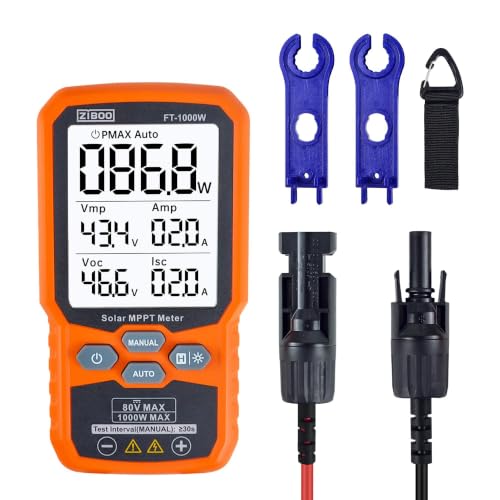

Products shown because their documented specifications fit this guide. Price and availability are on Amazon and can change.
Frequently Asked Questions
What does MPPT mean on a tester?
The tester sweeps the load on the panel to find the point where voltage multiplied by current is highest, which is the maximum power point. That gives a real power figure rather than an open circuit voltage that tells you almost nothing.
What are Voc and Isc?
Open circuit voltage is what the panel produces with nothing connected. Short circuit current is what it delivers into a short. Both are printed on the panel label, so measuring them is how you check the panel against its own specification.
What ranges does it cover?
The listing states Pmax to 2000 W, Voc from 3 to 90 V and Isc from 0 to 40 A. That covers individual panels and small strings, not a full commercial string at high voltage.
Does it need special leads?
The listing states MC4 compatibility, so it connects straight to standard PV connectors without adapters or stripped conductors.
Affiliate disclosure: Akermin earns a commission from qualifying Amazon purchases made through links on this page. Our editorial picks are based on documented specifications and owner feedback, not commissions.