As an Amazon Associate, Akermin earns from qualifying purchases. Product links on this page are affiliate links.

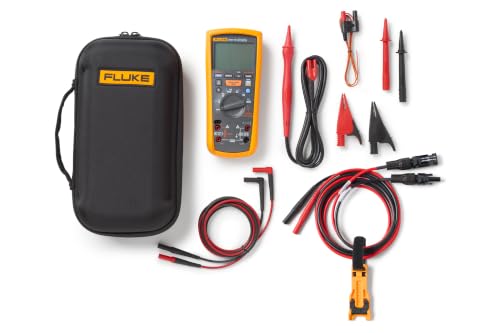
Fluke · Fluke 283FC/PV Kit - CAT III 1500V True-RMS Digital Multimeter with 60A Wireless AC/DC Current Clamp and MC4 Connectors (Pack of 1)
View on AmazonPrice and availability are shown on Amazon and can change at any time.
Verdict
The Fluke 283FC/PV kit is assembled around a single problem: photovoltaic systems run at voltages that ordinary test equipment is not rated for. The listing states a CAT III 1500 V and CAT IV 1000 V rated multimeter, a wireless current clamp measuring up to 60 A AC and DC for troubleshooting individual strings, CAT III 1500 V rated Staubli MC4 test leads and TL175-HV premium leads at the same rating. If you work on modern PV installations, this is what correctly rated test gear looks like.
Documented Specifications
| Item | Manufacturer listing |
|---|---|
| Safety rating | CAT III 1500 V, CAT IV 1000 V, multimeter, clamp and leads |
| Current | Up to 60 A AC and DC with the a283 FC wireless current clamp |
| PV leads | Staubli MC4, rated CAT III 1500 V |
| Premium leads | TL175-HV, CAT III 1500 V and CAT IV 1000 V |
| Connectivity | Fluke Connect wireless clamp |
Why the Category Rating Is the Whole Product
A category rating is not a maximum voltage. It describes the transient energy an instrument is built to survive at a defined point in an electrical system, and it exists because the failure mode is not a broken meter but an arc.
Photovoltaic systems make this acute for three reasons. String voltages have risen to 1500 V DC in commercial installations. DC arcs do not self extinguish at a zero crossing the way AC arcs do, so once started they persist. And a string in sunlight cannot be switched off; it is energised whenever there is light on the modules. Those three facts together are why correctly rated PV test equipment exists as a category and why improvising with general electrical gear is a bad idea.
The Leads Are Not an Accessory
This is the most commonly missed point in test equipment safety. The rating applies to the system: meter, leads and probes together. A CAT III 1500 V meter used with leads rated for 1000 V is a 1000 V system at best, and often less if the leads are worn.
The kit supplying both TL175-HV general leads and Staubli MC4 PV leads at the correct rating means the connection to the array is properly rated rather than improvised with alligator clips onto a connector. Anyone who has watched somebody prod a live MC4 connector with standard probes understands why this matters.
Wireless Current on a String
String current diagnosis means comparing strings against each other under the same conditions, and doing it while they are live. A wireless clamp can be placed on a conductor, left there, and read from a position that is not inside the enclosure. The stated 60 A AC and DC range is well matched to individual strings, where currents are typically well under 20 A.
The workflow benefit is the same as with any Fluke Connect instrument: the measurement can be taken from a safer position, recorded, and compared without transcription.
Practical Notes for PV Testing
- A string cannot be de-energised by switching. Cover the modules or work at night if a genuinely dead circuit is required.
- Never break a live DC connection under load. Open the circuit at a rated isolator, not by pulling a connector.
- Measure string currents on the same day, within minutes of each other, under stable sky conditions.
- Record irradiance and panel temperature alongside, using an instrument such as the Fluke IRR1, or the comparison is not valid.
- Inspect leads before every use. A damaged lead defeats the rating silently.
Strengths
- Correct CAT III 1500 V rating across meter, clamp and leads.
- MC4 leads supplied and rated, removing improvised connections.
- Wireless clamp allowing readings from a safer position.
- Assembled as a kit, so nothing in the chain is the weak link.
Limitations
- Expensive, and only justified by regular PV work.
- No insulation resistance testing, which installation work requires.
- No irradiance or temperature measurement included.
- Clamp range of 60 A suits strings rather than combined array conductors.
How It Compares
The Fluke solar tools kit with the 1587 FC adds insulation resistance testing, which is the other half of commissioning. For panel level output measurement, see the ALLmeter panel tester. Our ranking is in the solar multimeter roundup.
How We Research
All figures come from the manufacturer listing and Fluke’s published documentation. We did not run laboratory tests and publish no measurements of our own.
Recommended Tools

Products shown because their documented specifications fit this guide. Price and availability are on Amazon and can change.
Frequently Asked Questions
Why does 1500 V matter?
Modern commercial PV systems operate at string voltages up to 1500 V DC. Test equipment rated for 1000 V is not rated for that, and a category rating describes the transient energy the instrument is built to survive at that point in a system.
What does the wireless clamp add?
The listing states current measurements up to 60 A AC and DC for safely troubleshooting individual strings when using the a283 FC wireless current clamp. Wireless means the clamp can stay on the conductor while you read at a distance.
What are the MC4 leads for?
Connecting directly to standard PV connectors without improvising. The listing states CAT III 1500 V rated Staubli MC4 test leads, so the connection is part of the rated system rather than a weak point.
Are the leads part of the safety rating?
Yes, and this is the part people miss. A rated meter used with unrated leads is not a rated system. The kit supplies TL175-HV leads at CAT III 1500 V and CAT IV 1000 V for exactly this reason.
Affiliate disclosure: Akermin earns a commission from qualifying Amazon purchases made through links on this page. Our editorial picks are based on documented specifications and owner feedback, not commissions.