Best Solar Multimeters: 10 Reliable Picks for Professional PV Testing
A multimeter used on solar work needs a DC voltage ceiling that covers the string on the coldest morning of the year and a safety rating to match. This hub separates the rated handhelds from the MPPT panel testers that share the same search results, and compares what each listing publishes.
Independent Research
Verified Specifications
Honest Recommendations
Cold Morning Voltage
Is the Real Ceiling
Rate the Leads Too
As an Amazon Associate, Akermin earns from qualifying purchases. Product links on this page are affiliate links.
Our Top Picks
Two different instruments share this page and the Type column keeps them apart. A solar multimeter is a handheld with probes, rated for high DC voltage, that measures volts, amps, resistance and continuity anywhere in the system. An MPPT panel tester connects across one module, sweeps an electronic load and reports the maximum power point; it is not a multimeter and cannot do continuity or insulation work. Comparison is on stated DC voltage ceiling, current range, solar-specific functions and connectivity.
Best Overall
KPS DMM4500PV True RMS Solar Multimeter
The clearest published specification here: 2000 V DC, 1500 V AC and 10 A.
Six of these ten are MPPT panel testers rather than multimeters, and the Type column says which. They are included because they are sold and searched for as solar multimeters, but none of them has probes, a continuity function or a resistance range. All figures come from the manufacturer listings; no listing here publishes a measurement accuracy figure, and only the Fluke 87V Max kit states a CAT rating.
How to Choose a Solar Multimeter
Three checks, in this order:
Cold Voltage Ceiling
Open-circuit voltage rises as temperature falls, so the design figure is the coldest expected morning, not the nameplate. Choose a meter and leads rated comfortably above it.
Rate the Leads Too
Test leads carry their own voltage and category rating. A CAT III 1500 V meter with general-purpose leads is a general-purpose system. The kits here that include solar leads are sold that way for a reason.
Meter or Panel Tester
If the job is measuring circuits, you need probes, continuity and resistance. If the job is comparing modules, you need a load sweep. Six of the ten here can only do the second.
Does It Need Insulation Testing
Insulation resistance is a commissioning requirement and a standard multimeter cannot do it. Only the Fluke 1587 FC kit here states the capability.
On a single 12 V or 24 V module, usually yes. On a string, only if the meter and the leads are both rated above the highest voltage that string can present in cold conditions. Residential strings commonly exceed 400 V and commercial systems reach 1000 V or 1500 V, which is beyond most general-purpose handhelds. Never use a meter above its rating.
Why does open-circuit voltage go up when it gets cold?
Because the voltage of a photovoltaic cell has a negative temperature coefficient: as the cell cools, its output voltage rises. The nameplate figure is quoted at a 25 degree C cell temperature, so a clear cold morning with the array unloaded produces the highest voltage the system will ever present. That is the number the instrument has to be rated for, not the nameplate.
How do I measure short-circuit current safely?
On a single module, with the module isolated, using a meter whose current range covers the module short-circuit current, and by making the connection before exposing the module to full sun where that is practical. Do not short a string or a combiner output through a handheld meter: the 10 A ceiling typical of these instruments is far below what the aggregated circuit can deliver.
What is the difference between a solar multimeter and a PV tester?
A multimeter measures individual quantities anywhere in the system with probes. A PV tester runs the commissioning sequence, including insulation resistance, continuity and polarity, and may trace an I-V curve. An MPPT panel tester, confusingly sold under both names, does neither: it sweeps a load across one module and reports its maximum power point.
Do the test leads really matter?
Yes. Leads have their own voltage and category rating, and a system is rated at the weakest component. Solar-specific leads such as the Fluke TLPV1 are also built to mate with MC4 connectors, which means measurements can be taken without disassembling joints that then have to be re-made and re-tested.
Reviews
KPS DMM4500PV True RMS Solar Multimeter Best Overall
The DMM4500PV publishes the three numbers that decide whether a multimeter belongs on a photovoltaic system, and it publishes them on the listing rather than burying them in a datasheet. DC voltage to 2000 V, AC voltage to 1500 V and AC or DC current to 10 A, described by KPS as optimised for high-voltage solar systems and suitable for photovoltaic installation work.
The 2000 V DC figure is the one that matters. Utility-scale arrays standardise on 1500 V, and open-circuit voltage rises as cell temperature falls, so the real maximum a string can present is above its nameplate on a cold clear morning. A meter that stops at 1000 V is unusable on those systems, and a meter that stops at 600 V is limited to residential work. Headroom above the coldest-case voltage is not a luxury.
True RMS handles the distorted waveforms on the inverter output side, and Bluetooth allows readings to be captured away from the meter, which on a roof or inside a combiner enclosure is a safety feature as much as a convenience. The listing does not state a CAT rating, an accuracy figure or an ingress rating, and those are worth obtaining from KPS before the meter goes near a 1500 V string. The 10 A current ceiling is standard for a handheld and covers single-string current comfortably.
Strengths
2000 V DC and 1500 V AC ranges both stated
True RMS for inverter output work
Bluetooth for readings taken at a distance
Clearest published specification on the page
Limitations
CAT rating not stated on the listing
Accuracy not stated
10 A ceiling rules out combiner and battery bus current
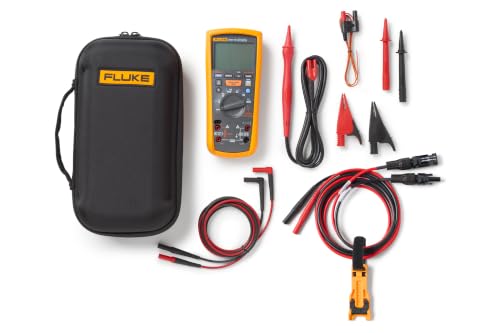
Fluke Solar Tools Kit with 1587 FC Insulation Multimeter Best for Insulation Testing
Insulation resistance is the photovoltaic test that a standard multimeter cannot perform. PV cabling spends decades outdoors in heat, cold, water and ultraviolet, and the first measurable sign of degradation is a fall in resistance between the array conductors and earth. Measuring it needs an instrument that applies a high test voltage of its own, and it is part of the Category 1 commissioning sequence.
This kit puts that capability and ordinary multimeter functions into one body, which removes a second instrument from the bag and a second set of connections from the procedure. Fluke supplies it with TLPV1 solar test leads, which matter more than they sound: leads carry their own voltage rating, and a correctly rated meter with under-rated leads is an under-rated system.
The listing publishes no numbers at all. There is no stated test voltage for the insulation function, no stated DC voltage ceiling for the multimeter function, no CAT rating and no accuracy figure, all of which Fluke documents separately. That is the trade this kit asks for: the widest capability on the page, presented with the least published detail, from a manufacturer whose datasheets are readily available. Get them before ordering if a specific string voltage has to be covered.
Strengths
Insulation resistance and multimeter in one instrument
Correctly rated solar test leads included
Covers a Category 1 commissioning test others cannot
ALLmeter Solar Panel Tester and PV Multimeter Best Value
This is the point where the category name becomes misleading and it is worth being blunt about it. The ALLmeter is sold as a photovoltaic multimeter and it is not a multimeter. It has no probes for general measurement, no continuity function, no resistance range and no insulation test. What it does is connect across a module, sweep an electronic load and report the maximum power point along with open-circuit voltage and short-circuit current.
For the job it actually does, it is the best-documented instrument of its kind here, stating a 3 to 90 V voltage window and a 0 to 40 A current window rather than only a headline wattage. Working module by module along a string it finds the underperforming panel quickly, and it reads down to 3 V so small 12 V modules are within range.
If what you need is to know which panel is failing, buy this. If what you need is to measure voltage at an isolator, prove continuity on an earth bond or test insulation resistance, this cannot do any of it and the two picks above can. Several more listings on this page are the same kind of instrument under different brands, and the Type column marks each one.
Strengths
Voltage and current windows both published
Finds the maximum power point per module
Reads from 3 V for small panels
Lowest tier instrument on the page
Limitations
Not a multimeter: no probes, continuity or resistance
No insulation testing
90 V ceiling limits it to modules and short strings
Short answer: the KPS DMM4500PV is the multimeter to buy for high-voltage PV work because it publishes a 2000 V DC and 1500 V AC ceiling on the listing; the Fluke 1587 FC solar kit is the one that adds insulation resistance testing, which no ordinary multimeter can do; and the ALLmeter MPPT tester is the value pick with an important caveat, because it is a panel tester rather than a multimeter and has no probes at all.
Six of these ten are not multimeters
This needs saying before anything else. Search results for solar multimeter return two quite different products, and six of the ten listings on this page belong to the second kind. An MPPT panel tester has two input leads, connects across one module, sweeps an electronic load and reports the maximum power point with open-circuit voltage and short-circuit current. It has no probes, no continuity buzzer, no resistance range and no way of measuring anything that is not a photovoltaic module. It is a useful instrument, it is sold honestly enough as a photovoltaic tester, and it is frequently bought by people who wanted a meter. The Type column above marks every one, and the three badged picks include one of each kind so the difference is visible rather than implied.
Cold-morning voltage is the specification that matters
Photovoltaic cells have a negative voltage temperature coefficient, so open-circuit voltage rises as the cells get colder. The nameplate Voc is quoted at a 25 degree C cell temperature, and a clear winter morning with the array unloaded and the sun just up produces the highest voltage that system will ever present. Design against that figure, not the label. A meter rated at 1000 V is not adequate for a string whose cold Voc reaches 1050 V, and the headroom should be real rather than marginal. On this page only the KPS publishes a DC ceiling, stating 2000 V, and only the Fluke 87V Max kit publishes a CAT rating, stating CAT III 1000 V. Everything else leaves the buyer to consult a datasheet, which for Fluke is straightforward and for several other brands is not. Our guide on measuring DC voltage covers the procedure and the 1500 V DC multimeter guide covers the high-voltage class specifically.
The leads are half the instrument
A voltage rating applies to the whole measuring system, and the weakest component sets it. A CAT III 1500 V meter fitted with generic probes rated at CAT II 600 V is a CAT II 600 V measurement system, whatever the display says. This is why two of the listings here are sold as kits with named solar leads, the Fluke 87V Max with a solar test lead kit and the 1587 FC with TLPV1 leads. Beyond the rating, solar leads are shaped for the job: they mate with MC4 connectors so a string can be measured without breaking a joint that then has to be remade, re-torqued and re-tested. Buying a rated meter and leaving the leads as an afterthought is one of the commonest and least visible mistakes in PV tooling.
What a multimeter cannot do on a solar array
Three commissioning measurements sit outside the reach of an ordinary handheld, however well rated. Insulation resistance requires the instrument to apply a high test voltage of its own between conductors and earth, which only the Fluke 1587 FC kit here states. Earth continuity at the current a standard requires is a specific test, not a continuity buzzer. And the I-V curve, which is the measurement that shows where along its characteristic a string is losing power, needs a curve tracer. A multimeter proves voltages and currents and finds open circuits, which is most of everyday fault-finding, but it will not produce a commissioning certificate on its own. Our solar PV tester guide covers the instruments that will.
Guides in This Category
The specific guides beneath this hub, and who each is for:
A meter rated for the strings you work on, with leads rated to match, covers the large majority of solar fault-finding. Add a DC-capable clamp when you need current without breaking the circuit, and an irradiance meter when readings have to be comparable between visits. Add an insulation tester when you start signing for installations rather than repairing them. And buy an MPPT panel tester when the job is deciding which of twenty modules is the problem, understanding clearly that it replaces none of the above.
How We Research
Instruments were compared on manufacturer listing text: stated DC and AC voltage ranges, stated current ranges, CAT rating where published, insulation resistance capability, true RMS, connectivity and any bundled solar test leads. Products that are MPPT panel testers rather than multimeters are labelled as such in the Type column instead of being compared as if they were meters. We ran no tests, measured no arrays and publish no figures of our own. Where a specification appears only in a manufacturer datasheet and not on the listing, the table reads Not stated. Amazon data supplies images, availability and links only.
A solar insulation resistance tester that works on energised PV strings up to DC 1000 V, with test voltages of 125, 250, 500 and 1000 V, a range to 4000 megohms, automatic discharge, 1000 stored result sets and USB or Bluetooth transfer.
A 12 volt battery, cranking and charging system tester covering 100 to 2000 CCA that reports state of health, state of charge, voltage, current and CCA, drawing its own power from the battery under test.
A handheld solar irradiance meter reading 0 to 1999 watts per square metre or 0 to 634 BTU per square foot per hour, with a selectable 199.9 or 1999 scale, maximum and minimum tracking, data hold and manual zeroing.