As an Amazon Associate, Akermin earns from qualifying purchases. Product links on this page are affiliate links.
Choose a digital multimeter in this order. First, the safety category for where you will use it: CAT III 600 V with certified input protection for anything near a panel or fixed wiring; CAT II for outlets and appliances; CAT I for bench and battery work. Second, True-RMS, because modern loads distort waveforms. Third, auto-ranging and at least 4000 to 6000 counts. Fourth, the functions your work needs: non-contact voltage, LoZ, capacitance, frequency, temperature, diode test, min/max. Fifth, leads with proper caps, a backlight, a kickstand and a case. Then match the budget tier to how often you will use it.
Step 1: Safety category and protection
The CAT rating describes the transient energy the meter’s inputs survive at a location in the installation. CAT III 600 V covers household panels and fixed wiring; CAT II covers plug-in equipment. Look for an independent certification mark (UL, CSA, TÜV, ETL), proper HRC fuses on the current inputs, and leads rated to the same category with finger guards and probe caps. See what a CAT rating is and how to understand CAT ratings.
Step 2: True-RMS
Averaging meters read distorted AC (dimmers, LED drivers, drives, inverters) 10 to 40 percent wrong. True-RMS costs little now; insist on it. See what True RMS is.
Step 3: Ranging and counts
Auto-ranging picks the scale for you and gives the best resolution; manual ranging is cheaper and faster for experienced users who know the expected value. Counts (2000, 4000, 6000, 20000) set display resolution: 6000 counts shows 12.43 V on a battery where 2000 shows 12.4. See resolution in a digital meter.
Step 4: Functions
| Function | Who needs it |
|---|---|
| AC/DC voltage, resistance, continuity | Everyone; check the continuity beeper is fast |
| Non-contact voltage detection | Anyone touching household wiring |
| LoZ (low impedance) mode | Anyone proving circuits dead; rejects ghost voltage |
| Capacitance | HVAC, appliance and motor work |
| Frequency and duty cycle | Generators, drives, automotive sensors |
| Temperature (K-type) | HVAC, automotive, appliance diagnosis |
| Diode test | Electronics and automotive |
| Min/max/average, hold | Intermittent faults, voltage drop under load |
| Micro-amp DC | Flame sensors, electronics |
| Milliamp AC/DC and 10 A | Automotive drain, bench; fused inputs essential |
Step 5: Build and accessories
- Silicone leads with CAT-rated caps; alligator clips.
- Backlight, large digits, a bar graph for trends.
- Kickstand, magnetic hanger, holster.
- Drop rating and battery access without removing the fuse cover.
- Battery life of hundreds of hours.
Budget tiers
| Tier | Typical spec | Examples | Suits |
|---|---|---|---|
| Budget | True-RMS, auto-ranging, 6000 counts, ceramic fuses; verify CAT claims | AstroAI TRMS 6000 | Automotive, bench, hobby |
| Mid | True-RMS, CAT III 600 V certified, temperature, capacitance, Lead-Alert or NCV | Klein MM420, Fluke 115 | Homeowners, HVAC, general trade |
| Professional | Above plus LoZ, NCV, robust protection, long battery life | Fluke 117, Fluke 179 | Electricians, industrial |
| Industrial | CAT IV 600 V / CAT III 1000 V, 20000 counts, high accuracy | Fluke 87V | Industrial, drives, calibration |
Picks by use
Home electrical: see choosing a multimeter for home electrical work. Automotive: choosing a multimeter for automotive diagnostics. Solar: choosing a multimeter for solar panels. Head-to-head comparisons are in best multimeters for home and DIY.
Recommended Tools

Fluke 117 Digital Multimeter, Non-Contact AC Voltage Detection, Measures Resistance/Continuity/Frequency/Capacitance/Min
View on Amazon


Products shown because their documented specifications fit this guide. Price and availability are on Amazon and can change.
Frequently Asked Questions
What multimeter features matter most?
A genuine CAT III 600 V rating with proper fuses if you will work near mains, True-RMS for modern loads, auto-ranging for convenience, and non-contact voltage detection as a safety check. Counts and extra functions come after.
Are expensive multimeters worth it?
For mains and panel work, the safety design, input protection and lead quality of established brands justify the price. For batteries, electronics and automotive, a mid-priced True-RMS meter is fine.
How many counts do I need?
6000 counts is a comfortable standard; 4000 is adequate; 2000 limits resolution on battery and low-voltage work. More than 6000 is for bench and calibration use.
Affiliate disclosure: Akermin earns a commission from qualifying Amazon purchases made through links on this page. Our editorial picks are based on documented specifications and owner feedback, not commissions.
Related Guides

Fluke 1AC II VoltAlert Review: Two Detection Thresholds in One Listing
A pocket sized non contact voltage tester whose tip glows red and beeper sounds when voltage is detected, with a continuous self test and a choice of audible or silent operation.
Read More→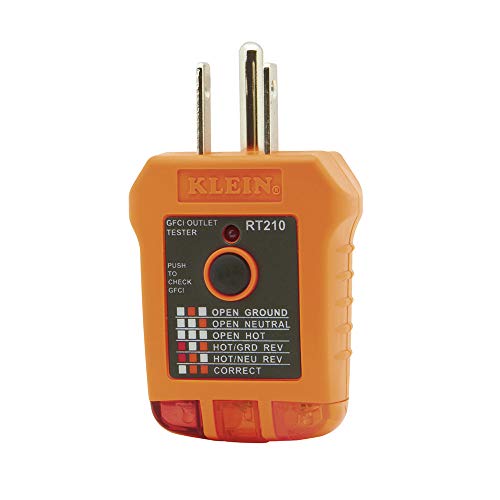
Klein Tools RT210 Review: A Fault Finder That Does Not List Its Faults
A three wire receptacle tester for standard and GFCI North American outlets, specified for 110 to 125 volts AC at 50 or 60 Hz, a 6.6 foot drop and an operating range of 32 to 140 degrees Fahrenheit.
Read More→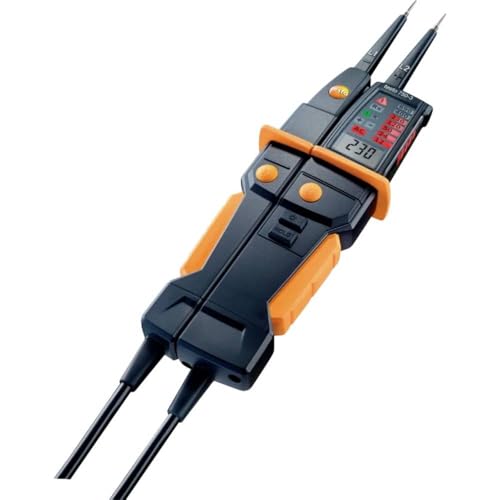
Testo 750-3 Review: Four Bullets, and No Published Category Rating
A two pole voltage tester with a three digit LCD showing measured voltage, a patented LED voltage bar viewable from any angle, polarity detection on DC and a GFCI test function for AC outlets.
Read More→