As an Amazon Associate, Akermin earns from qualifying purchases. Product links on this page are affiliate links.
For automotive diagnostics choose a 6000-count or better auto-ranging meter with 1 mV DC resolution for voltage drop tests, DC current ranges from microamps or milliamps to 10 A with proper fuses for parasitic drain, min/max and ideally peak capture for cranking and charging voltage, frequency and duty cycle for sensors and PWM circuits, a diode test, and a temperature input. Add a DC clamp meter for drain and starter current without breaking circuits. CAT rating matters less than on mains work; CAT II or III at 300 to 600 V is plenty.
What automotive testing needs
| Test | Measurement | Meter requirement |
|---|---|---|
| Battery state and charging | 12.6 V rest, 13.8 to 14.7 V charging | DC volts, 10 mV resolution |
| Cranking voltage | Minimum during cranking (above about 9.6 V) | Min/max or peak capture |
| Voltage drop across cables and grounds | 0.05 to 0.5 V under load | 1 mV resolution, DC millivolt range |
| Parasitic drain | 20 to 50 mA normal; over 100 mA a fault | mA DC in series, or a DC clamp with mA resolution |
| Starter current | 100 to 300 A | DC clamp meter, 400 A or more |
| Sensor signals (crank, cam, ABS) | Frequency, duty cycle, AC voltage | Hz, duty cycle, AC mV |
| Injectors, solenoids, PWM fans | Duty cycle, pulse width, resistance | Duty cycle, ms pulse width on some meters, ohms |
| Alternator ripple | AC mV on the DC output | AC volts, True-RMS helpful |
| Diodes and rectifiers | Forward drop | Diode test |
| Coolant and intake temperature | °C | K-type input |
Specifications to look for
- 6000 counts minimum, auto-ranging, with a DC millivolt range. See resolution in a digital meter.
- DC current: µA, mA and 10 A ranges with fuses; a 10 A range that tolerates 20 A for 30 seconds is useful.
- Min/max/average with fast capture (under 250 ms); peak capture (1 ms) for spikes.
- Frequency to at least 10 kHz, duty cycle, and pulse width if available.
- Input impedance of 10 MΩ so sensors are not loaded.
- Temperature via K-type thermocouple.
- Rugged case, holster, backlight, long leads and back-probe pins.
The DC clamp meter
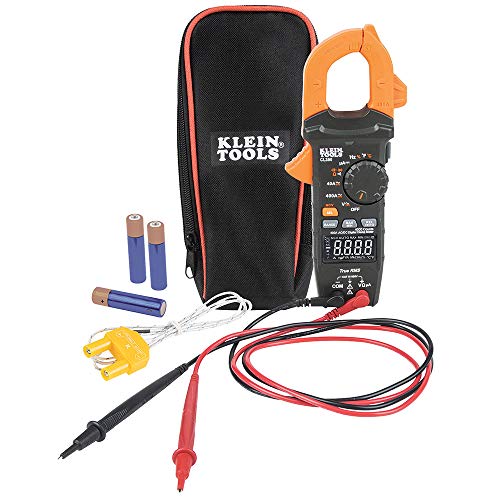
A Hall-effect clamp measures DC current through the insulation: starter current, alternator output, fan and pump draws, and parasitic drain (with a low-range clamp or a mini clamp) without disconnecting the battery and resetting modules. Klein CL390 and Fluke 325 class clamps cover the range; mini clamps resolve milliamps. See how to choose a clamp meter.
Picks
| Tier | Meter | Notes |
|---|---|---|
| Budget | AstroAI TRMS 6000 | 6000 counts, DC mV, mA and 10 A, frequency, duty cycle, temperature; ceramic fuses |
| Mid | Klein MM420 | Auto-ranging True-RMS with temperature, capacitance, frequency |
| Professional | Fluke 179 | True-RMS, temperature, min/max, 6000 counts, rugged; the shop standard |
| Add-on | DC clamp (Klein CL390, Fluke 325) | For starter, charging and drain currents |
Accessories
Back-probe pins for connectors, alligator clips, a set of jumper leads, an inductive RPM pickup where the meter supports it, and a battery load tester (TOPDON BT100, ANCEL BA101 class) for battery and alternator health beyond what a meter shows. See how to test a 12 V battery with a multimeter and how to measure parasitic battery drain. General selection is in how to choose a digital multimeter.
Recommended Tools


Products shown because their documented specifications fit this guide. Price and availability are on Amazon and can change.
Frequently Asked Questions
Do I need True-RMS for automotive work?
Rarely; vehicle systems are DC. It helps for measuring alternator AC ripple and some sensor outputs, and most decent meters include it anyway.
How do I measure parasitic battery drain?
With the meter in series on the 10 A range between the battery post and the disconnected cable, waiting for modules to sleep, then switching to the mA range; or with a DC clamp meter around the battery cable, which is safer and does not reset modules.
What resolution do I need for voltage drop tests?
1 mV, which a 6000-count meter gives on its 6 V range. Acceptable drops are 0.1 to 0.3 V, so 10 mV resolution is marginal and 100 mV is useless.
Affiliate disclosure: Akermin earns a commission from qualifying Amazon purchases made through links on this page. Our editorial picks are based on documented specifications and owner feedback, not commissions.
Related Guides

How to Choose a Plug-In Electricity Usage Monitor
Accurate to a watt, a kWh counter that survives unplugging, the right plug and rating, and an app only if you will use it.
Read More→How to Measure Appliance Power Consumption
A plug-in meter for anything with a plug, a clamp for anything hard-wired, and a day of logging for anything that cycles.
Read More→
How to Test Continuity With a Multimeter
Circuit dead, continuity mode, probes on the two ends, listen for the beep. Ten common tests and what silence means.
Read More→