As an Amazon Associate, Akermin earns from qualifying purchases. Product links on this page are affiliate links.
For home electrical work choose a multimeter rated CAT III 600 V with independent certification and HRC fuses, True-RMS so dimmers and LED drivers read correctly, a built-in non-contact voltage detector for the first check on any wire, and a LoZ mode to prove circuits dead without ghost-voltage false alarms. Continuity with a fast beeper, resistance and capacitance cover appliance and motor faults. Auto-ranging and a backlight make it easier. Current measurement through the meter is rarely useful at home; a clamp meter is the tool for that.
What home electrical work actually involves
- Confirming an outlet, switch or light is live or dead.
- Proving a circuit dead before replacing a fixture or outlet.
- Finding which breaker feeds a circuit.
- Checking a fuse, a heating element, a thermostat or a switch for continuity.
- Diagnosing an appliance: motor winding resistance, capacitor, door switch.
- Checking a battery or a low-voltage doorbell or thermostat circuit.
The four essentials
| Feature | Why |
|---|---|
| CAT III 600 V, certified | Panels and fixed wiring can deliver transients a CAT II meter cannot survive. See what a CAT rating is |
| True-RMS | Modern household loads distort waveforms; averaging meters misread them. See what True RMS is |
| Non-contact voltage detector | The safe first check on every conductor. See what non-contact voltage detection is |
| LoZ mode | Distinguishes a dead wire showing ghost voltage from a live one. See why ghost voltage appears |
Useful functions
- Continuity with a fast beeper, for fuses, elements and switches. See how to test continuity.
- Resistance for elements and windings.
- Capacitance for motor run capacitors in fans, pumps and HVAC.
- AutoVolt or automatic AC/DC selection, to avoid wrong-function errors.
- Min/max for catching a voltage dip when a motor starts.
Functions you can skip
High-current measurement through the meter (impractical on mains; use a clamp), Bluetooth, thermocouple input unless you do HVAC, and very high counts. Spend the money on the safety design and leads instead.
Leads and accessories
Silicone leads with CAT III caps, alligator clips for hands-free readings, a magnetic hanger for panel work. Replace leads that crack; the lead is part of the safety chain.
Recommendations
| Budget | Meter | Notes |
|---|---|---|
| Mid | Klein MM420 | True-RMS, CAT III 600 V, temperature and capacitance; add a separate NCV pen |
| Mid | Fluke 115 | True-RMS, CAT III 600 V, capacitance, min/max; no NCV or LoZ |
| Professional | Fluke 117 | All four essentials in one meter; the electrician’s residential standard |
Safe practice
- Non-contact check first.
- Prove the meter on a known live source, test the circuit in LoZ, prove the meter again.
- Leads in the voltage jacks before touching a live circuit.
- One hand in a pocket at the panel; keep fingers behind guards.
- If unsure, a licensed electrician; panel work is regulated in many places.
Full comparisons are in best multimeters for home and DIY; the general selection method in how to choose a digital multimeter.
Recommended Tools

Fluke 117 Digital Multimeter, Non-Contact AC Voltage Detection, Measures Resistance/Continuity/Frequency/Capacitance/Min
View on Amazon

Products shown because their documented specifications fit this guide. Price and availability are on Amazon and can change.
Frequently Asked Questions
Is a CAT II multimeter enough for home use?
For outlets and plug-in appliances only. As soon as you open the panel or work on fixed wiring, CAT III 600 V is the appropriate rating, and most homeowners end up doing that eventually.
Do I need a clamp meter as well?
Only if you want to measure how much current an appliance or circuit draws. For voltage, continuity and fault-finding, the multimeter alone is enough.
What is the most useful safety feature?
A non-contact voltage detector built into the meter, used before every touch, followed by a LoZ mode to prove a circuit dead without ghost-voltage confusion.
Affiliate disclosure: Akermin earns a commission from qualifying Amazon purchases made through links on this page. Our editorial picks are based on documented specifications and owner feedback, not commissions.
Related Guides

Fluke 1AC II VoltAlert Review: Two Detection Thresholds in One Listing
A pocket sized non contact voltage tester whose tip glows red and beeper sounds when voltage is detected, with a continuous self test and a choice of audible or silent operation.
Read More→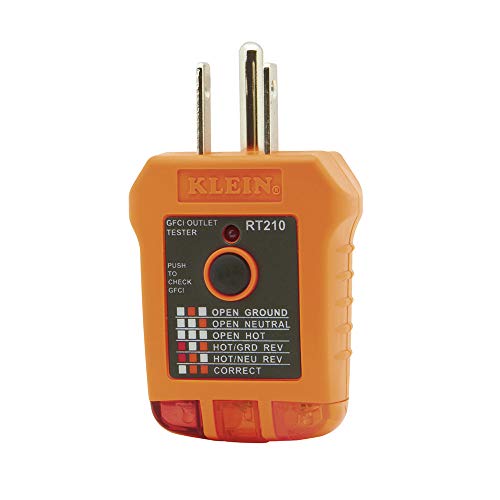
Klein Tools RT210 Review: A Fault Finder That Does Not List Its Faults
A three wire receptacle tester for standard and GFCI North American outlets, specified for 110 to 125 volts AC at 50 or 60 Hz, a 6.6 foot drop and an operating range of 32 to 140 degrees Fahrenheit.
Read More→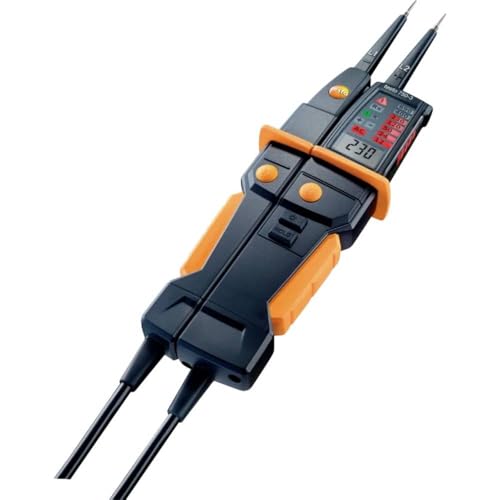
Testo 750-3 Review: Four Bullets, and No Published Category Rating
A two pole voltage tester with a three digit LCD showing measured voltage, a patented LED voltage bar viewable from any angle, polarity detection on DC and a GFCI test function for AC outlets.
Read More→