As an Amazon Associate, Akermin earns from qualifying purchases. Product links on this page are affiliate links.
Non-contact voltage detection senses the alternating electric field that surrounds any conductor carrying AC voltage. A small metal plate in the tester’s tip forms a capacitor with the conductor through the insulation; the field induces a tiny current that the electronics amplify into a light and a beep. No bare metal is touched. It tells you that AC voltage is probably present, which is the right first check before working on anything, and it cannot tell you how much, whether it is DC, or with certainty that a silent wire is dead.
How it works
Alternating voltage on a conductor creates an alternating electric field in the space around it, reaching through plastic insulation and a few centimeters of air. The tester’s tip is one plate of a capacitor; the conductor is the other; the user’s hand and body provide the reference to ground. The induced current is microamps, enough for a high-gain amplifier to detect. Sensitivity is set so that a mains conductor triggers at about 10 to 30 mm; some testers have a low-sensitivity mode for finding which of several cables is live and a high-sensitivity mode for tracing.
What it can do
- Confirm an outlet, switch, cable or lamp holder is energized before touching it.
- Find which cable in a bundle is live.
- Trace a live cable behind drywall roughly.
- Check that a breaker actually killed the circuit you think it did.
- Detect a broken conductor in an extension lead by tracing where the field stops.
What it cannot do
- Measure voltage. It indicates presence, not level.
- Detect DC.
- Detect voltage through metal conduit, armored cable or shielding.
- Reliably identify the neutral conductor, which is near ground potential and often gives no indication.
- Prove a circuit dead. A silent tester may have a flat battery, be outside its sensitivity range, or be looking at a shielded conductor.
False positives and false negatives
| Situation | Indication | Truth |
|---|---|---|
| Dead wire beside a live one | May beep (induced field) | Dead; see ghost voltage |
| Live conductor in metal conduit | Silent | Live |
| Neutral conductor of a live circuit | Usually silent | Can be live if the neutral is open elsewhere |
| Static from clothing or carpet | Brief beep | Nothing |
| Tester battery low | Silent or weak | Unknown |
Safe use
- Test the tester on a known live outlet before and after.
- Hold it by the insulated body with the tip near the conductor or outlet slot.
- Treat a beep as live. Treat silence as “not yet proven dead”.
- Prove dead with a contact meter, preferably in a low-impedance mode, before working.
- Do not use it as a voltage measurement or on DC.
Built-in NCV
Many multimeters (Fluke’s VoltAlert on the 117, Klein and others) and most clamp meters include a non-contact sensor at the top of the case. It saves carrying a separate pen and encourages the correct first-check habit. Multimeters with it are compared in best multimeters for home and DIY; for the safety rating of the meter itself, see what a CAT rating is.
Recommended Tools

Fluke 117 Digital Multimeter, Non-Contact AC Voltage Detection, Measures Resistance/Continuity/Frequency/Capacitance/Min
View on Amazon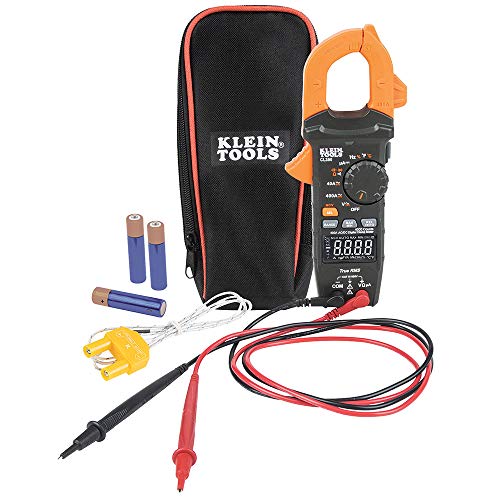
Products shown because their documented specifications fit this guide. Price and availability are on Amazon and can change.
Frequently Asked Questions
Can a non-contact tester detect DC?
No. It senses the alternating electric field of AC. Batteries, solar DC and vehicle wiring do not trigger it; use a meter with test leads.
Why does it beep near a wire that is switched off?
Capacitive coupling from a live neighbor, or a switched neutral leaving the conductor live. Sensitive testers pick up induced fields; a low-impedance meter test resolves it.
Why does it not beep near a live wire?
Shielded or armored cable, metal conduit, a neutral conductor (near ground potential), deep burial in a wall, or a dead battery in the tester. Always prove the tester on a known live source first.
Affiliate disclosure: Akermin earns a commission from qualifying Amazon purchases made through links on this page. Our editorial picks are based on documented specifications and owner feedback, not commissions.