As an Amazon Associate, Akermin earns from qualifying purchases. Product links on this page are affiliate links.
Put the black lead in COM and the red lead in the V jack. Select AC volts (V~), auto-range or a range above the expected voltage. Do a non-contact check first. Touch black to neutral or ground and red to live, keeping fingers behind the guards, and read: about 120 V or 230 V depending on region. Live to ground should match; neutral to ground should be near zero. A reading of tens of volts on a supposedly dead circuit is probably ghost voltage; confirm with LoZ. Test the meter on a known live source before trusting a zero.
Setup
- Inspect leads for damage; caps on for CAT III work.
- Black lead in COM; red lead in the V (VΩ) jack, never in A or 10 A.
- Function: AC volts (V with a wave symbol). Auto-ranging meters pick the range; on manual meters select 600 V or 750 V for mains.
- Verify the meter on a known live outlet before and after any dead test.
Outlet measurements
| Probes | Expected (120 V system) | Expected (230 V system) | If not |
|---|---|---|---|
| Live to neutral | 110 to 125 V | 220 to 240 V | Low: overloaded circuit or poor connection; zero: no supply |
| Live to ground | Same as above | Same as above | Zero with live-neutral normal: open ground |
| Neutral to ground | 0 to 3 V | 0 to 3 V | Higher: loaded or poor neutral; over 10 V: fault |
Insert the probe tips into the slots firmly; some outlets have shutters. A plug-in outlet tester gives the wiring pattern faster; the meter gives the numbers.
Switches and fixtures
- Across a closed switch: near 0 V (a few volts under load means a failing contact). Across an open switch with the load connected: full voltage.
- At a lamp holder or fixture: live to neutral, full voltage with the switch on.
- At a thermostat or control circuit: 24 V AC between R and C; use the 60 V range on manual meters.
Voltage drop under load
Measure at the panel and at the outlet with a heavy load (a heater) plugged in. A drop of more than about 5 percent indicates undersized wiring, long runs or a poor connection. The connection that drops voltage also heats up; a thermal camera finds it. See choosing a thermal camera for electrical work.
Ghost voltage
A high-impedance meter shows 20 to 90 V on a disconnected conductor running beside a live one. Switch to LoZ, or use a solenoid tester: real voltage remains, ghost voltage disappears. Never dismiss a reading as ghost without that test. See why ghost voltage appears.
Interpreting distorted supplies
On generators, inverters and circuits with heavy electronic loads, only a True-RMS meter reads correctly. An averaging meter can be 10 to 40 percent off. See what True RMS is.
Safety
- Non-contact check before touching; see non-contact voltage detection.
- Meter rated CAT III 600 V for panels and fixed wiring; see CAT ratings.
- One hand where possible; no jewelry; dry hands and floor.
- Connect the ground or neutral probe first, live second; remove in reverse.
- Never probe with leads in the current jacks.
Meters suited to this work are in best multimeters for home and DIY; the DC procedure is in how to measure DC voltage.
Recommended Tools

Fluke 117 Digital Multimeter, Non-Contact AC Voltage Detection, Measures Resistance/Continuity/Frequency/Capacitance/Min
View on Amazon
Products shown because their documented specifications fit this guide. Price and availability are on Amazon and can change.
Frequently Asked Questions
What should a wall outlet read?
About 110 to 125 V in 120 V regions and 220 to 240 V in 230 V regions between live and neutral. Live to ground should read the same; neutral to ground a few volts or less.
Which jack does the red lead go in for AC volts?
The jack marked V (often VΩmA or VΩ). Never the A or 10 A jack; measuring voltage with the lead in a current jack shorts the circuit through the meter.
Why does the meter show 40 V on a wire that should be off?
Ghost voltage from capacitive coupling. Switch to LoZ mode or use a solenoid tester; real voltage stays, ghost voltage collapses.
Affiliate disclosure: Akermin earns a commission from qualifying Amazon purchases made through links on this page. Our editorial picks are based on documented specifications and owner feedback, not commissions.
Related Guides

Fluke 1AC II VoltAlert Review: Two Detection Thresholds in One Listing
A pocket sized non contact voltage tester whose tip glows red and beeper sounds when voltage is detected, with a continuous self test and a choice of audible or silent operation.
Read More→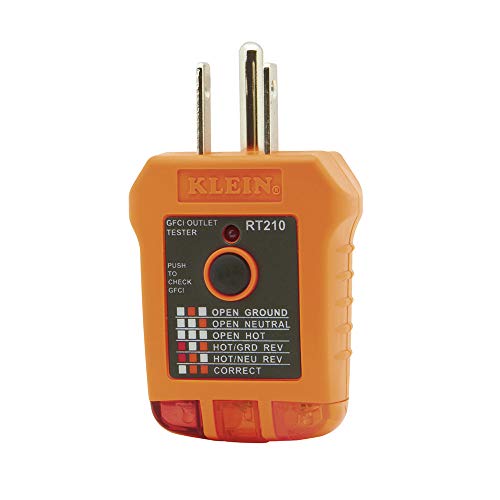
Klein Tools RT210 Review: A Fault Finder That Does Not List Its Faults
A three wire receptacle tester for standard and GFCI North American outlets, specified for 110 to 125 volts AC at 50 or 60 Hz, a 6.6 foot drop and an operating range of 32 to 140 degrees Fahrenheit.
Read More→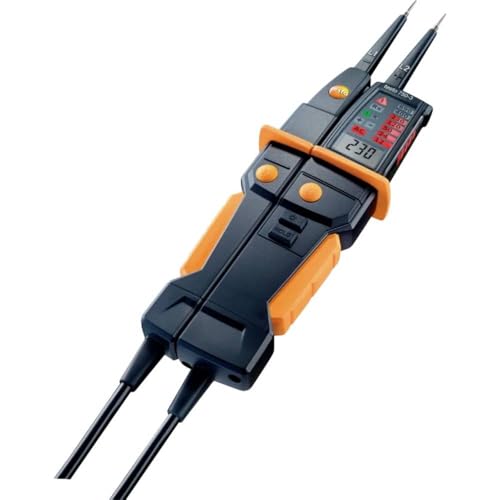
Testo 750-3 Review: Four Bullets, and No Published Category Rating
A two pole voltage tester with a three digit LCD showing measured voltage, a patented LED voltage bar viewable from any angle, polarity detection on DC and a GFCI test function for AC outlets.
Read More→