As an Amazon Associate, Akermin earns from qualifying purchases. Product links on this page are affiliate links.
Black lead in COM, red lead in the V jack, function set to DC volts (V with a straight line, sometimes V⎓). Touch red to the positive point and black to the negative point and read; a negative sign means the leads are reversed, and the value is still correct. Use auto-ranging or the lowest manual range above the expected voltage for resolution: 1 mV on a 6 V range, 10 mV on 60 V. For batteries, compare with the state-of-charge table; for circuits, measure across connections under load to find voltage drops.
Setup
- Black in COM, red in V (VΩ).
- Select DC volts. Some meters have AutoVolt that picks AC or DC automatically.
- Auto-range, or manual: 6 V for cells and USB, 60 V for 12/24/48 V systems, 600 V or more for solar strings.
- Red to positive, black to negative or ground.
Batteries
| Battery | Full (rested) | Half | Replace or recharge |
|---|---|---|---|
| Alkaline AA/AAA | 1.55 to 1.6 V | 1.3 V | Under 1.2 V |
| NiMH AA | 1.35 to 1.4 V | 1.25 V | Under 1.1 V |
| Lithium-ion cell (3.7 V nominal) | 4.2 V | 3.7 V | Under 3.3 V |
| 9 V alkaline | 9.5 V | 8 V | Under 7 V |
| 12 V lead-acid (car) | 12.6 to 12.8 V | 12.2 V | Under 12.0 V |
| 12 V LiFePO4 | 13.4 to 13.6 V | 13.2 V | Under 12.8 V |
Rest a lead-acid battery for a few hours after charging or driving before reading state of charge. See how to test a 12 V battery.
Vehicles
- Charging: 13.8 to 14.7 V at idle with the engine running; below 13.5 V suspect the alternator; above 15 V the regulator.
- Cranking: use min/max; the battery should stay above about 9.6 V while the starter turns.
- Voltage drop: meter across a cable or connection (positive to positive, or ground to ground) while the circuit carries current. Under 0.2 V on a main cable, under 0.1 V on a ground strap; more means corrosion or a loose terminal.
Solar and DC systems
Panel open-circuit voltage: disconnect the panel and read across its terminals in sun; expect Voc from the label, higher when cold. String Voc can exceed 600 V; the meter and leads must be rated for it. See how to measure solar panel open-circuit voltage. Battery banks at 24 and 48 V read about 25 to 29 V and 50 to 58 V depending on chemistry and charge.
Electronics and USB
USB should read 4.75 to 5.25 V; fast-charge modes 9, 12 or 20 V. Power supply outputs within 5 percent of their label. Use the meter’s high input impedance (10 MΩ) as an advantage: it does not load the circuit. Do not use LoZ on electronics.
Resolution matters
Battery state and voltage drop tests need the last digit. A 6000-count meter on its 6 V range resolves 1 mV; on the 60 V range 10 mV. Let auto-ranging choose or select the lowest range that fits. See resolution in a digital meter.
Errors and safety
- Leads in the current jacks while measuring voltage: shorts the source through the meter and blows the fuse. Check every time.
- Reading a battery under load versus at rest: different numbers; note which.
- High-voltage DC (solar strings, EV systems): treat with the same care as mains and more; DC arcs sustain.
Meters for DC work are covered in choosing a multimeter for automotive diagnostics and best multimeters for home and DIY; AC measurement in how to measure AC voltage.
Recommended Tools


Fluke 117 Digital Multimeter, Non-Contact AC Voltage Detection, Measures Resistance/Continuity/Frequency/Capacitance/Min
View on AmazonProducts shown because their documented specifications fit this guide. Price and availability are on Amazon and can change.
Frequently Asked Questions
What does a negative DC reading mean?
The leads are reversed: red is on the more negative point. The magnitude is still correct; swap the leads or note the sign.
What should a 12 V car battery read?
About 12.6 to 12.8 V fully charged at rest, 12.2 V at half charge, under 12.0 V discharged. With the engine running, 13.8 to 14.7 V.
Which range for a AA battery?
On a manual meter, the 2 V or 6 V range for resolution; a fresh alkaline reads about 1.55 to 1.6 V, a used one under 1.3 V. Auto-ranging meters select it.
Affiliate disclosure: Akermin earns a commission from qualifying Amazon purchases made through links on this page. Our editorial picks are based on documented specifications and owner feedback, not commissions.
Related Guides
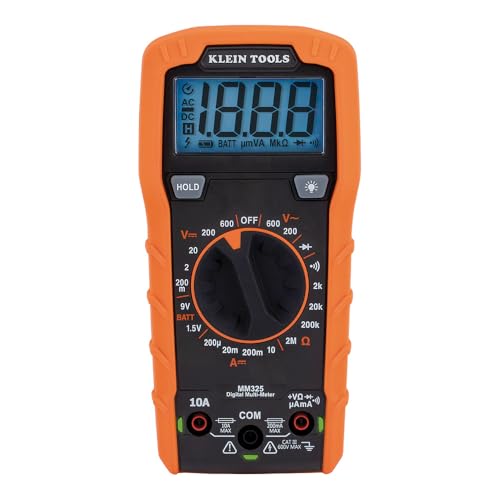
Klein Tools MM325 Review: Lead Alert LEDs Target the One Mistake That Wrecks a Meter
A manual ranging digital multimeter reading AC and DC voltage to 600 V, 10 A of direct current and resistance to 2 megohms, with continuity, diode and battery test modes, a backlit screen, a kickstand and LEDs that warn about test lead placement.
Read More→
Klein Tools CL445 Review: The DC Microamp Range Is the Furnace Function Hiding in a List
An auto ranging True RMS HVAC clamp meter that reads AC current, inrush current and non contact voltage through the jaw, and voltage, resistance, continuity, frequency, duty cycle, DC microamps, diodes and capacitance through the test leads.
Read More→
Klein ET450 and RT390 Kit Review: Four Bullets for One Tool, One for the Other
A two instrument bundle pairing the ET450 circuit breaker finder and wire tracer, which works on energized and non energized circuits, with the RT390 circuit analyzer reporting wiring faults, GFCI and AFCI trip time and voltage drop on a colour display.
Read More→