As an Amazon Associate, Akermin earns from qualifying purchases. Product links on this page are affiliate links.

Thermal Master · Thermal Master P1 Thermal Camera for USB-C iOS/Android, 320x240 Resolution | -4°F to 1112°F, ±3.6℉ Accuracy Thermal Imaging Camera for Home, HVAC, Electrical and Auto Inspections (P1 Grey)
View on AmazonPrice and availability are shown on Amazon and can change at any time.
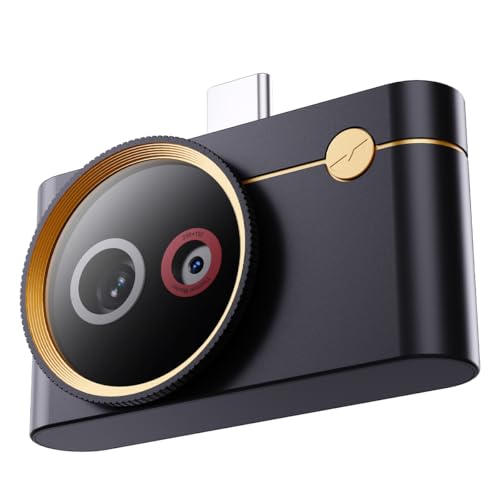
The P1 is a 17 gram USB-C thermal attachment measuring 59 by 27 by 17.2 mm, drawing 0.32 W for five to eight hours of use. Its listing states X3 IR technology upgrading resolution from 160 x 120 to 320 x 240, a 25 Hz refresh, detection of differences as small as 0.04 C, a minus 4 F to 1112 F range at plus or minus 3.6 F, 15 times zoom, high and low alarms, isotherm mode and adjustable emissivity. The detector is the smallest here. The emissivity control is the most useful thing in the group.
Size is the specification nobody lists as one
At 17 grams and 59 mm long, the P1 is smaller than a car key fob. That is not a comfort feature, it is a capability feature, and it works in one specific way: it changes how often the camera is present when a question comes up.
A thermal camera in a case in the van gets used when you have already decided to use it. A camera that lives in a trouser pocket alongside the phone it plugs into gets used the moment someone says the breaker feels warm. Most thermal findings are incidental, noticed while doing something else, and an instrument you are not carrying finds nothing.
The 0.32 W figure supports the same argument. Very low draw means plugging it in does not visibly cost you phone battery, so there is no reason to unplug it between checks. The listing states five to eight hours of continuous operation.
The detector is 160 by 120, and that is the honest number
The resolution bullet states that X3 IR technology upgrades its IR resolution from 160 x 120 to 320 x 240, delivering sharper and clearer images.
The information is there, but the verb does work the buyer should undo. Upgrades sounds like an improvement to the detector. What has happened is that a 19,200 element sensor is processed into a 76,800 pixel image. The elements did not change. Compare this with the sibling P4, whose listing says upscaled outright, and the softer wording here is noticeable.
So judge the P1 as a 160 by 120 camera. That is a real constraint. At a typical arm’s length working distance, each detector element covers a patch of the target several millimetres across, which is fine for finding which breaker in a panel is warm and not fine for finding which pin on a connector is warm. The listing also publishes no field of view in degrees, which means you cannot do that arithmetic properly for yourself. For work that needs resolved detail, our higher resolution comparison is the right place to look.
Adjustable emissivity is the feature that earns its place
The listing states adjustable emissivity along with ambient temperature and distance settings. In a group of cameras where most listings never mention emissivity at all, this is the specification that separates a measuring instrument from a picture taker.
Here is why it matters, in the situation electricians meet constantly. Emissivity is the efficiency with which a surface emits infrared relative to a perfect emitter. Matt paint sits around 0.95 and reads nearly true. Bright polished copper can sit near 0.05, meaning it radiates almost nothing at its own temperature and instead reflects the room. Point a fixed emissivity camera at a shiny copper busbar at 80 C and it may report something closer to 40 C. The bar is not cool. The camera is being lied to by the surface.
A camera with an emissivity setting lets you enter the right value, or in practice lets you put a patch of electrical tape on the metal and read that instead. Without the setting, neither workaround gives you a correct number. For anyone inspecting bare metal terminations, this single feature is worth more than doubling the pixel count.
The ambient temperature and distance settings work alongside it. The camera has to subtract the radiation the target is reflecting from its surroundings, and that correction needs to know the surroundings.
Isotherm and the alarms change how you sweep
Two of the listed functions change the method rather than the numbers. High and low temperature alarms let you set thresholds and be told, instead of watching. Isotherm mode colours only the pixels inside a chosen band and leaves everything else grey.
Isotherm is the one worth learning. Sweeping a row of twelve identical motor terminals in normal palette means reading twelve numbers and comparing them in your head. In isotherm, you set the band just above what a healthy terminal reads and the only thing that lights up is the one in trouble. It converts a measurement task into a spot the difference task, which humans do much faster and more reliably.
Specifications and caveats
| Specification | Published in the listing |
|---|---|
| Native detector | 160 x 120 |
| Processed output | 320 x 240 via X3 IR |
| Smallest detectable difference | 0.04 C |
| Refresh rate | 25 Hz |
| Range and accuracy | Minus 4 F to 1112 F, plus or minus 3.6 F |
| Emissivity, ambient, distance | Adjustable |
| Modes | Isotherm, high and low alarms, 15 times zoom |
| Physical | 59 by 27 by 17.2 mm, 17 g, 0.32 W, 5 to 8 hours |
| Compatibility | USB-C phones and computers, iOS, Android, Windows |
| Field of view | Not stated in the listing bullets |
| NETD as a specification | Not stated as such, 0.04 C given as detectable difference |
Two caveats belong in plain sight. The Lightning adapter for older iPhones is sold separately according to the listing, so an iPhone user without USB-C has an extra purchase and an extra thing to lose. And the 0.04 C figure is phrased as an ability to detect differences rather than as a NETD specification. It amounts to 40 mK, which is a good number, but a stated NETD is a tighter claim than a stated detectable difference and the distinction is worth noting.
What it is genuinely best at
The P1 is the right choice for someone who wants a thermal camera present at all times and whose work involves metal. The combination of pocket size, negligible power draw and adjustable emissivity is unusual, and it is aimed at electrical and mechanical inspection where the surfaces are shiny and the question is which of these is running hot.
It is the wrong choice where spatial detail decides the outcome, because 160 by 120 is the smallest detector in this group and no processing changes that. It is also awkward for an older iPhone, and it gives you no field of view figure to plan with. Within those limits it is the camera most likely to be in your pocket when you need one, which is a real advantage that no specification sheet captures.
Recommended Tools

Products shown because their documented specifications fit this guide. Price and availability are on Amazon and can change.
Frequently Asked Questions
What is the real detector resolution?
The listing states that X3 IR technology upgrades its IR resolution from 160 x 120 to 320 x 240. Read plainly, the detector is 160 x 120, which is 19,200 elements, and 320 x 240 is the processed output. The listing does say this, which is more than many do, but the phrasing upgrades its IR resolution is softer than the word upscaled and it is easy to miss.
Is adjustable emissivity worth caring about?
It is the difference between a reading and a guess on metal. Emissivity is how efficiently a surface radiates infrared. Matt paint radiates well and reads close to true. Polished copper or aluminium radiates poorly and can read tens of degrees low. A camera with adjustable emissivity lets you correct for that. The listing states adjustable emissivity, ambient temperature and distance settings, and for electrical work that is a more valuable specification than any pixel count.
What does isotherm mode do?
It paints only the pixels inside a temperature band you choose and leaves the rest greyscale. Instead of interpreting a rainbow, you set a band and anything inside it lights up. It is the fastest way to sweep a row of identical components looking for the odd one out.
How small is it really?
The listing states 59 by 27 by 17.2 mm and 17 grams, with 0.32 W power consumption and five to eight hours of continuous operation. At that weight it lives in a pocket permanently, which is the practical argument for it: the camera you have with you beats the better camera in the van.
What are its limits?
The 160 by 120 detector is the real constraint on spatial detail, and the listing publishes no field of view figure, so you cannot calculate what a pixel covers at a given distance. The iPhone Lightning adapter is sold separately. And with 0.04 C sensitivity stated as a detectable difference rather than a NETD specification, it is close to but not the same as a published NETD figure.
Affiliate disclosure: Akermin earns a commission from qualifying Amazon purchases made through links on this page. Our editorial picks are based on documented specifications and owner feedback, not commissions.