As an Amazon Associate, Akermin earns from qualifying purchases. Product links on this page are affiliate links.
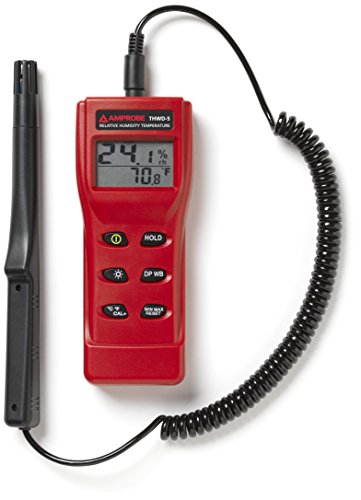
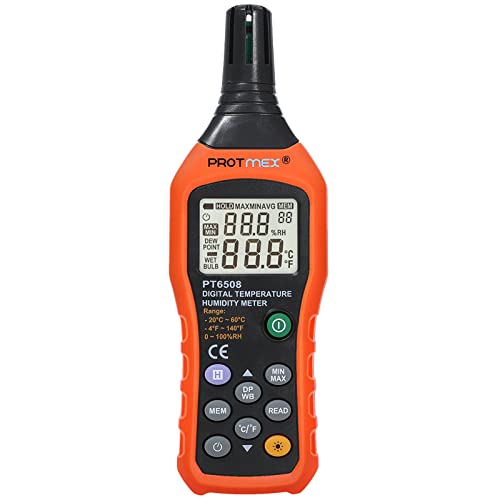
Short answer: For coating work on steel, the most useful pick here is P1, the Extech RH600, because it publishes a dew point range of -50 to +30 Ctd and a sensor that withstands condensation, which is the condition you meet when you push a probe toward cold steel. P2, the Amprobe THWD-5, is the practical alternative if you want one handheld that also gives wet bulb and relative humidity with an extended probe for reaching the surface. P3, P4 and P5 publish dew point measurement but do not publish accuracy figures, so they are better suited to monitoring a space than to signing off a blast and paint job.
What dew point actually tells you
Dew point is the temperature at which the air can no longer hold its water vapour, and condensation begins. It is a property of the air, not of the surface. If the air has a dew point of 12 °C and a steel plate is at 10 °C, water will condense on that plate. If the plate is at 20 °C, it will not.
That is the whole calculation in coating work. You measure two things: the dew point of the air at the surface, and the temperature of the surface itself. The difference between them is the margin. Coating specifications typically require the surface to be at least 3 °C above the dew point, and many call for more. The reason for the margin is that condensation is not a sudden event at a single temperature. As the surface approaches the dew point, the risk of a moisture film rises, and a moisture film under a coating causes adhesion failure.
This is why a dew point meter alone is not enough for coating inspection. You need the surface temperature as well. Some instruments on this page combine both functions; others give you the dew point only, and you pair them with a contact thermometer. If you are monitoring a space rather than inspecting steel, a room instrument such as the one in P5 is adequate, and a broader environmental monitoring setup may suit you better, as covered in environmental monitoring devices.
The specification that matters most, and the one that is usually missing
The number you want from a dew point meter is accuracy, expressed in degrees. Accuracy tells you how close the displayed value is to the true dew point. It is the figure that lets you decide whether the instrument is good enough for the job you are doing.
Most of the listings on this page do not publish accuracy. P1 publishes a range and a condensation tolerance but no accuracy figure. P2, P3, P4 and P5 publish no accuracy figure at all. P3 publishes a resolution of 0.01, which is a different thing entirely. Resolution is the smallest change the display will show; accuracy is how close the reading is to the truth. A meter can display 0.01 while being several degrees away from the real dew point. When a listing gives you resolution and not accuracy, the resolution tells you nothing about measurement quality.
The second figure that is usually missing is response time. A dew point sensor takes time to equilibrate with the air it is sampling, and the time depends on whether the sensor is dry or wet, warm or cold. P1 addresses this with a purge feature that the listing says stabilises readings in a short period, but no figure in seconds is published. If you are taking many readings across a large structure, response time determines how long the job takes.
Why the sensor has to survive condensation
A dew point sensor that is brought near cold steel, or that samples compressed air, will meet condensation. This is not an accident; it is the condition the instrument is designed to measure. A sensor that cannot tolerate it will drift, and a drifted sensor gives you a reading that looks plausible and is wrong.
P1 is the only pick on this page whose listing states that the sensor withstands condensation, and it pairs that with a purge feature. The purge clears the sensor after exposure so the next reading starts from a known state. If you are working in a cold store, an outdoor structure in winter, or on a compressed air line, this is the specification to look for.
The probe geometry matters for the same reason. A sensor on a cable, as in P2 and P3, can be placed at the surface while you hold the display. A body-mounted sensor, as in P5, reads the air around the instrument, which includes your own body heat and breath. For surface work, the probe on a cable is the correct geometry. For compressed air, you need a meter rated for the line pressure, which P1 states at 20 bar.
The maintenance nobody mentions
Dew point sensors are affected by contamination. In a coating shop the air carries solvent vapour, overspray, dust from blasting, and oil aerosol from compressors. Any of these can deposit on the sensing element and change its response. A sensor that read correctly when new can drift within a season of site use.
The practical routine is to keep the sensor capped when not in use, to avoid storing the meter in the same room where painting happens, and to check the reading against a known condition periodically. Some meters offer a calibration adjustment; the listings here do not describe one, so you should assume the instrument is sent for service or replaced if it drifts. That is a cost of ownership point worth weighing before purchase.
Battery choice is a smaller maintenance point but a real one on site. P4 runs on four AA cells, which are available anywhere. Meters with internal rechargeable cells need a charger and a mains supply. On a cold morning in a site cabin, that difference decides whether you take a reading at all. For more on how humidity instruments behave in different environments, see the comparison of digital hygrometers and the guide to humidity meters.
Where a dew point meter stops being the right answer
A dew point meter tells you about moisture in the air. It does not tell you whether the steel is contaminated with salt, whether the blast profile is correct, or whether the coating is mixed to specification. Those are separate checks with separate instruments.
It also does not measure the moisture inside the substrate. If you are coating concrete rather than steel, the relevant measurement is moisture content in the slab, not dew point in the air, and the instruments are different. The comparison of moisture meters for concrete covers that case.
Finally, a dew point meter is not an alarm and not a safety device. It will not warn you that conditions have changed while you are working unless it has an alarm function, and only P5 on this page states one. If your specification requires continuous monitoring with a record, you need a data logger rather than a handheld spot-check meter. The guide to environmental data loggers for building monitoring explains what those instruments add. Choose the instrument for the decision you are actually making, and accept that one meter rarely covers the whole job.