Best Humidity Meters: 8 Accurate Picks for Reliable Moisture Monitoring
Relative humidity on its own is a moving target, because the same amount of water in the air reads differently at different temperatures. The instruments that earn their place are the ones that also give dew point or wet bulb, or that log the reading so a pattern can be seen. This hub compares the current humidity meters on those terms and links down to the measurement guides on this site.
Independent Research
Verified Specifications
Honest Recommendations
RH Moves With Temp
Dew Point Is Fixed
Let It Settle
As an Amazon Associate, Akermin earns from qualifying purchases. Product links on this page are affiliate links.
Our Top Picks
Instruments were compared on what each listing states: whether relative humidity is named, whether dew point and wet bulb are calculated, whether readings can be logged or exported, and the physical form. Several entries in this category are multi-parameter air quality instruments whose listings do not publish a humidity specification; those are marked Not stated rather than guessed at.
Best Overall
Fluke 971 Temperature Humidity Meter
Backlit dual display of humidity and temperature in a professional handheld.
Listing states a backlit dual display of humidity and temperature
Single-handed handheld format built for field work
Both readings visible together without switching modes
Fluke instrument line intended for HVAC and building diagnostics
Figures come from each manufacturer own listing text. The last two rows are multi-parameter air quality instruments listed in this category whose listings do not publish a humidity specification, so their humidity columns read Not stated. Relative humidity readings are only comparable when taken at a stated temperature.
How to Choose a Humidity Meter
Four things separate the useful from the decorative:
Dew Point, Not Just RH
Relative humidity changes with temperature even when the water content does not. Dew point stays put, which is why it is the number for comparing rooms or diagnosing condensation.
Response and Settling Time
A humidity sensor moved from a cold van into a warm room can take several minutes to settle. A meter you read too quickly gives a confident wrong answer.
Spot Reading or Log
Damp is a pattern, not a moment. If the question involves overnight, weekends or seasons, buy a logger with CSV export rather than a handheld.
Wet Bulb for Cooling Work
Wet bulb is the limit of evaporative cooling and part of the psychrometric calculation. It is essential for cooling tower and air conditioning work and irrelevant for a bedroom.
Why do two humidity meters in the same room disagree?
Usually because one has not settled. Humidity sensors respond over minutes, not seconds, and a meter carried in from a cold car or a warm pocket is reading its own microclimate for a while. Beyond that, inexpensive relative humidity sensors commonly carry several percentage points of error and drift with age, so a three or four point difference between two consumer meters is ordinary rather than a fault.
What is the difference between relative humidity and dew point?
Relative humidity is a percentage of saturation at the current temperature, so it rises when air cools even though nothing has been added. Dew point is the temperature at which that same air would start condensing, and it does not move when the air is warmed or cooled. For comparing two rooms, or indoor against outdoor, dew point is the honest comparison.
What indoor humidity should I be aiming for?
Most comfort and building guidance puts indoor relative humidity in a broad band around 40 to 60 percent in occupied rooms. Below that band, static and dry airways become complaints; above it, condensation, dust mites and mould become risks, particularly on cold surfaces. The useful check is not the room number but whether any surface in the room is below the dew point of the room air.
Do humidity meters need calibrating?
Relative humidity sensors drift, and a meter that has spent a year in a workshop is not the meter that left the factory. The traditional field check is the saturated salt test, which holds a sealed container at a known relative humidity so a meter can be compared against it. Our hygrometer calibration guide walks through it. Instruments used for reports should follow the manufacturer calibration interval instead.
Does a humidity meter tell me if a wall is wet?
No. It measures the air, not the material. A wall can be soaked while the room air reads normal, and room air can be very humid with every wall dry. To measure the material you need a moisture meter with pins or a pinless scanning head, which is a different instrument; our pin versus pinless guide covers the choice. Air humidity and surface temperature together tell you whether condensation will form, which is the related question.
Reviews
Fluke 971 Temperature Humidity Meter Best Overall
The 971 is the instrument most building and HVAC technicians reach for, and the reason is unglamorous: it shows humidity and temperature at the same time on a backlit screen, in one hand, without menu diving. Humidity work is comparative by nature. You take a reading at the supply grille, another in the occupied zone, another at the return, another outdoors, and the conclusion comes from the differences. Anything that slows a reading down slows the whole survey.
Fluke publishes very little on this particular listing. The one specification it commits to is the backlit dual display, so the comparison table carries Not stated for accuracy, response time and dew point on this row. That is a gap in the listing rather than a gap in the instrument, and the manufacturer datasheet carries the figures if a specification is needed for a report.
What you are paying for is consistency and the fact that the reading is trusted by other trades. Relative humidity sensors are cheap to make and easy to make badly, and a meter that reads three points high across a survey quietly changes every conclusion. If humidity readings are going into a report that someone else will act on, buy the instrument whose brand you are willing to defend.
Strengths
Humidity and temperature on one backlit display
Fast single-handed readings for survey work
Professional instrument line for building diagnostics
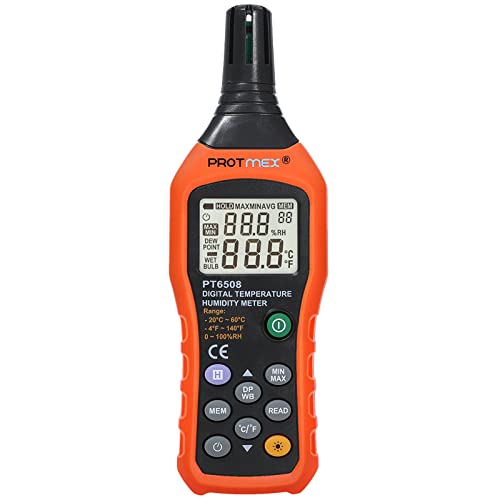
Protmex PT6508 Temperature Humidity Meter with Wet Bulb Best for Dew Point and Wet Bulb
Relative humidity is the least useful of the four numbers this meter gives you, and that is exactly why a psychrometer is worth having. Relative humidity tells you how close the air is to saturation at its current temperature, so it changes the moment the temperature changes even when not a single molecule of water has moved. Dew point does not. Dew point is the temperature at which that air would begin to condense, and it stays put as the air warms and cools, which makes it the right number for comparing two rooms, or indoor air against outdoor air.
Protmex states that the PT6508 combines a humidity meter, a temperature meter, wet bulb and dew point, and is designed for indoor and outdoor use. Wet bulb is the third useful value: it is what evaporative cooling can achieve, which matters for cooling tower and swamp cooler work, and it is part of the psychrometric calculation for air conditioning loads.
The listing gives no accuracy figure, no response time and no logging capability, so this is a spot-reading instrument rather than a documenting one. For condensation diagnostics, where the question is whether a surface is below the dew point of the room air, spot readings are exactly what you need.
Strengths
Dew point and wet bulb as well as humidity
The right numbers for condensation and comfort diagnostics
TEKCOPLUS USB Temperature Humidity and Barometric Data Logger Best for Logging
Damp problems are almost never visible in a single reading. A wall that is wet in February reads normally in June, a store room that ruins stock does it overnight when the heating goes off, and a customer who says the house is damp is describing a pattern rather than a moment. A logger is the instrument that answers those questions, and this one publishes the two things that make a logger actually usable: PDF and CSV output over USB.
CSV is the important one. It means the record can go into a spreadsheet, be plotted, be overlaid against heating times or outdoor conditions, and be handed to someone else without them needing the same software. PDF matters for the other half of the job, which is producing something a client or a landlord will read. The listing also states barometric pressure alongside humidity and temperature, which is more useful than it looks: pressure changes track weather fronts, and weather fronts are what drive most seasonal indoor humidity swings.
The listing publishes no accuracy figure, no logging interval range and no memory capacity, so check those with the manufacturer if the record has to stand up to scrutiny. For understanding what a building actually does across a week, it is the cheapest useful instrument here.
Strengths
PDF and CSV report generation stated
Barometric pressure alongside humidity and temperature
Short answer: the Fluke 971 is the professional handheld for fast survey readings with humidity and temperature on one backlit screen; the Protmex PT6508 adds dew point and wet bulb, which are the numbers condensation and cooling work actually run on; and the TEKCOPLUS USB logger is the one to buy when the question is about a pattern over days rather than a reading right now.
Relative humidity is a ratio, and that is the whole problem
A humidity meter showing 60 percent is not telling you how much water is in the air. It is telling you that the air is holding 60 percent of what it could hold at its current temperature. Warm the same air by ten degrees and the reading drops without a single molecule of water moving; cool it and the reading climbs until, at the dew point, it reaches 100 percent and water condenses on the nearest cold surface. This is why a bathroom mirror fogs, why a cold external wall grows mould while the room feels dry, and why two readings taken in different rooms of the same house are not directly comparable unless you also record the temperature. Every instrument on this page measures relative humidity; the better ones convert it into something that does not move.
Dew point and wet bulb: what the psychrometers add
The Protmex PT6508 and the ERAY psychrometer both state four values: humidity, temperature, wet bulb and dew point. Dew point is the temperature at which the air would begin to condense, and it is a property of the air itself, so it can be carried from room to room and compared directly. That makes it the correct number for condensation diagnostics: measure the dew point of the room air, measure the temperature of the suspect surface, and if the surface is colder, water will form there. Wet bulb is the temperature air would reach if cooled by evaporating water into it, which is the theoretical limit of an evaporative cooler and an input to air conditioning calculations. Our guide on calculating dew point shows the relationship if your meter only gives relative humidity.
Settling time, and the reading you should not trust
Humidity sensors are slow. The sensing element has to reach equilibrium with the air around it, which takes minutes rather than seconds, and it also has to reach the air temperature before the relative humidity conversion is right. A meter taken out of a cold van and read immediately in a warm house will show a low figure that has nothing to do with the room. The discipline is simple: put the instrument where you want the reading, wait until the number stops moving, and only then write it down. Anyone taking a series of readings across a building should carry the meter in the open rather than in a pocket, because body heat skews it in the same way.
Spot readings, logs, and the question you are actually asking
A handheld gives you a number now. That is the right tool for a survey, a commissioning check or a quick diagnosis, and it is why the Fluke 971 and the psychrometers exist in that form. But most residential damp complaints are about a pattern: the back bedroom in winter, the utility room overnight, the storage unit at weekends when the heating is off. Only a logger answers those, and the value depends entirely on what it can export. The TEKCOPLUS unit states PDF and CSV reports over USB, which means the record can be plotted, compared against heating schedules and given to a third party. A logger with no export is a device that knows something and will not tell you.
Multi-parameter instruments in this category
Several devices sold under environmental monitoring report humidity as one channel among many: the SunRADON luft alongside radon and carbon dioxide, the HoldPeak weather meter alongside wind speed and dew point, the ZYKYCX chlorine detector alongside gas concentration. These are convenient, and the humidity channel is genuinely useful context for whatever else the instrument is measuring, since humidity affects particle readings, some gas sensors and human comfort alike. What they do not do is publish a humidity specification. If humidity is the reason you are buying, a dedicated meter is the better purchase, and the multi-parameter unit is a bonus reading rather than a measurement. Where the instrument is really for airflow, see the anemometer hub; for whole-room air quality, see the indoor air quality hub.
Air humidity is not material moisture
The most common misuse of a humidity meter is pointing it at a problem it cannot see. These instruments measure water vapour in air. They say nothing about whether plaster, timber or screed is wet. A wall carrying rising damp, a leaking pipe behind a cupboard or a slab that was never allowed to dry will all read normally on an air humidity meter in a well-ventilated room. Material moisture needs a moisture meter with pins driven into the material or a pinless head that senses below the surface, and the two instruments answer different halves of the same investigation. Our pin versus pinless guide covers that side, and the sensible workflow is to use both: air humidity and surface temperature to predict condensation, a moisture meter to confirm where water has already arrived.
Instruments were compared on manufacturer listing text: whether relative humidity is named, whether dew point and wet bulb are calculated, stated accuracy where published, logging and export capability, power and physical form. Owner feedback was reviewed for recurring comments on settling time and disagreement between units. We did not run laboratory tests, did not place any meter in a reference humidity chamber and publish no measurements of our own. Amazon data supplies images, availability and links only.
A comparison of seven psychrometers for HVAC humidity measurement, covering digital meters that calculate wet bulb and dew point and two sling psychrometers that derive them from wet and dry bulb temperatures.