As an Amazon Associate, Akermin earns from qualifying purchases. Product links on this page are affiliate links.
Relative humidity (RH) is the amount of water vapor in the air expressed as a percentage of the maximum amount the air can hold at its current temperature. At 100 percent the air is saturated and water condenses; at 50 percent it holds half of what it could. Because warm air can hold much more vapor than cold air, the same amount of water gives a different RH at different temperatures. RH is the right measure for comfort, mold and materials, and a poor measure of how much water is actually present.
Saturation and temperature
| Air temperature | Saturation (100% RH) | Water at 50% RH |
|---|---|---|
| 0 °C | 4.8 g/m³ | 2.4 g/m³ |
| 10 °C | 9.4 g/m³ | 4.7 g/m³ |
| 20 °C | 17.3 g/m³ | 8.7 g/m³ |
| 30 °C | 30.4 g/m³ | 15.2 g/m³ |
Saturation roughly doubles every 10 °C. That single fact explains most of what confuses people about humidity: why winter indoor air is dry even when it is damp outside (cold outdoor air holds little water; warm it up indoors and RH plummets), and why RH peaks at dawn. See why humidity changes throughout the day.
RH, absolute humidity and dew point
- Relative humidity (%): how close to saturation. Depends on temperature.
- Absolute humidity (g/m³): the actual mass of water per volume. Independent of temperature.
- Dew point (°C): the temperature at which the air would reach saturation. Also independent of temperature, and the most useful single number for tracking moisture. See what dew point is.
Why RH is the number for comfort and materials
Skin, wood, paper, textiles and mold spores respond to the humidity of the air in contact with them relative to saturation. Wood swells and shrinks with RH; static builds below about 30 percent; dust mites and mold thrive above about 60 percent; the human sense of dryness or stickiness tracks RH. Building guidance therefore uses RH: 30 to 50 percent for comfort and health, and keeping surface RH below 80 percent to prevent mold.
How sensors measure it
Almost all consumer hygrometers use a capacitive sensor: a thin polymer film absorbs water in proportion to RH, changing its electrical capacitance. Good modules (Sensirion SHT series, Bosch BME series) state ±2 to 3 percent RH; cheap dial and digital units are often ±5 percent or worse. All drift slowly and read wrong after condensation on the sensor. Placement matters too: a hygrometer on a cold outside wall reads higher than one in the middle of the room, because the air beside the cold surface is cooler.
Checking a hygrometer
Put a small dish of table salt with just enough water to make a slush into a sealed bag or box with the hygrometer for 8 to 12 hours. The air above saturated salt settles at 75.3 percent RH at room temperature. A reading within 3 points is fine; adjust or note the offset otherwise. The humidity checker converts any RH and temperature to dew point and a comfort band.
Recommended Tools

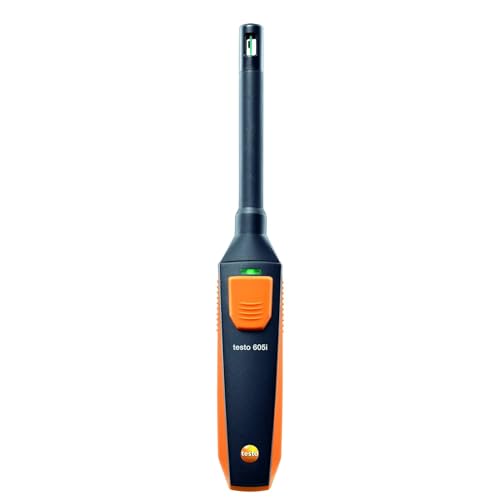
Products shown because their documented specifications fit this guide. Price and availability are on Amazon and can change.
Frequently Asked Questions
What is a comfortable relative humidity?
Most guidance places indoor comfort between 30 and 50 percent RH, with 40 to 60 percent acceptable. Below 30 feels dry; above 60 encourages mold and dust mites.
Can relative humidity exceed 100 percent?
Briefly and only in special conditions (supersaturation in clean air). In practice, reaching 100 percent means condensation: dew, fog or water on a surface.
How accurate are cheap hygrometers?
Typically ±3 to ±5 percent RH, and some are much worse. A salt test (75.3 percent RH over saturated table salt in a sealed container) checks one in a day.
Affiliate disclosure: Akermin earns a commission from qualifying Amazon purchases made through links on this page. Our editorial picks are based on documented specifications and owner feedback, not commissions.