As an Amazon Associate, Akermin earns from qualifying purchases. Product links on this page are affiliate links.
Choose a humidity meter with a capacitive sensor and a stated accuracy of ±3 percent RH or better (±2 percent for instruments, humidors and damp surveys), a dew point or comfort readout, a response time under a few minutes, and min/max memory so you can see overnight peaks. Check any meter with a salt test: a sealed container with a slush of table salt settles at 75.3 percent RH at room temperature, and a meter reading within 3 points is fine. Place it away from cold walls, windows and heat sources for a room reading.
Sensor and accuracy
Nearly all digital hygrometers use a capacitive polymer sensor. Good modules (Sensirion SHT3x/SHT4x, Bosch BME280, Silicon Labs Si7021) state ±2 to 3 percent RH over 20 to 80 percent, worse at the extremes. A meter that names its module or states a figure is more trustworthy than one that does not. See what relative humidity is.
Features worth having
| Feature | Why |
|---|---|
| Dew point display | The moisture number that does not swing with temperature; predicts condensation. See what dew point is |
| Min/max memory | Overnight and daily peaks matter more than the moment you look |
| Comfort indicator | Quick read of the 30 to 50 percent band |
| Fast response (under 5 min) | For carrying between rooms and checking cold corners |
| Logging or Bluetooth | To see the daily cycle and shower or laundry spikes; see why humidity changes through the day |
| Calibration offset | To correct after a salt test |
| External probe | For inside a humidor, a cabinet or a wall cavity |
Types by use
- Room monitors (TempPro, Govee, Qingping): display units for living rooms, bedrooms and nurseries; buy several and compare them.
- Probe thermohygrometers (testo 605i, Extech): a sensor on a stem for HVAC checks, ducts, cold corners and building surveys; fast response; often compute dew point and wet bulb.
- Data loggers (Elitech, HOBO): record for weeks; for damp investigations and storage. See how to choose a temperature and humidity data logger.
- Humidor and instrument-case hygrometers: small, ±2 percent, with calibration.
The salt test
- Put a tablespoon of table salt in a small cup and add a few drops of water to make a damp slush, not a solution.
- Place the cup and the hygrometer in a sealed bag or box at room temperature.
- Wait 8 to 12 hours.
- The air settles at 75.3 percent RH. Note the meter’s error and apply an offset if it allows.
See how to calibrate a hygrometer.
Placement
For a room reading: mid-room shelf, 1 to 1.5 m, away from windows, exterior walls, radiators, bathrooms and kitchens. For a problem spot (mold corner, window reveal): exactly there, and read the local value as local. See why placement changes measurements.
What to do with the reading
30 to 50 percent RH is the comfort and health band; above 60 percent sustained encourages mold. The humidity checker gives dew point and a verdict for any reading. Hygrometers and probes are in the environmental monitoring category.
Recommended Tools

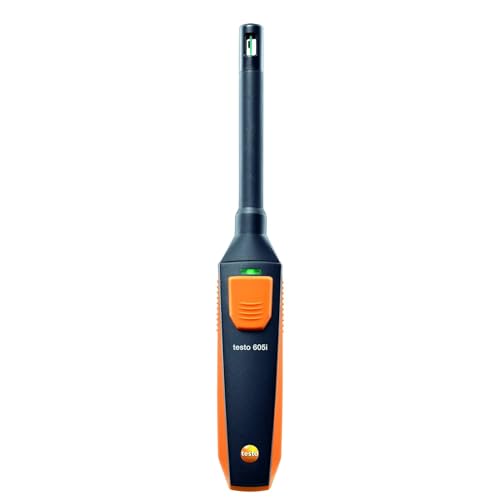

Products shown because their documented specifications fit this guide. Price and availability are on Amazon and can change.
Frequently Asked Questions
How accurate should a humidity meter be?
±3 percent RH or better for household use; ±2 percent for instruments, humidors and building diagnostics. Many cheap units are ±5 percent or worse and some do not state a figure at all.
Are analog dial hygrometers accurate?
Hair and coil dial hygrometers can be ±5 to 10 percent and drift. Some can be adjusted after a salt test. Digital capacitive units are generally better and cheaper.
Does a humidity meter need calibration?
Capacitive sensors drift about 1 percent a year. A salt test (75 percent RH over saturated table salt) every year or so checks it; some meters allow an offset adjustment.
Affiliate disclosure: Akermin earns a commission from qualifying Amazon purchases made through links on this page. Our editorial picks are based on documented specifications and owner feedback, not commissions.
Related Guides

CPS LS790B Leak-Seeker Review: Non Combustible Is the Deciding Word
An ion pump refrigerant leak detector individually calibrated to find a leak rate better than a quarter of an ounce per year, with ten selectable sensitivity ranges, a water vapour filter and a bar graph plus tone display.
Read More→
BW Clip BWC2-H Review: Alarm Points Set Before the Clock Starts
A single gas hydrogen sulfide detector with one button operation, hibernation mode, automatic logging of the 35 most recent gas events and bump test results, and compatibility with IntelliDoX and MicroDock II docking.
Read More→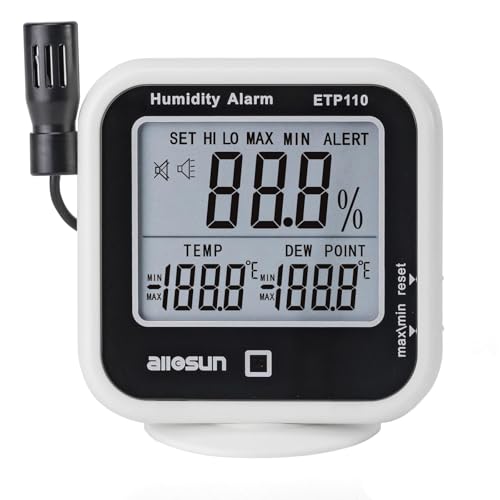
ALLOSUN Thermometer Hygrometer Review: Half a Metre of Lead and No Tolerance
A battery powered thermometer and hygrometer showing temperature, relative humidity and dew point, with a settable humidity alarm, a sensor on a lead of about 50 cm, maximum and minimum memory and a large LCD.
Read More→