As an Amazon Associate, Akermin earns from qualifying purchases. Product links on this page are affiliate links.
Calibrate a hygrometer with a saturated salt test: put a damp slush of table salt in a small open cup, seal it with the hygrometer in an airtight bag or box at room temperature, and wait 8 to 12 hours. The air settles at 75.3 percent relative humidity. Compare the meter’s reading; the difference is its error at that point. Apply the meter’s calibration offset if it has one, or record the correction and apply it to readings. Repeat yearly; capacitive sensors drift about a point a year.
Why saturated salts work
A saturated solution of a salt in contact with air holds the air at a fixed relative humidity that depends on the salt and only weakly on temperature. Sodium chloride gives 75.3 percent RH at 25 °C (75.5 at 20 °C); it is the standard single-point check because table salt is in every kitchen. Other salts give other points for a two-point check.
| Salt | RH at 20 to 25 °C | Availability |
|---|---|---|
| Magnesium chloride | About 33% | Pharmacies, online |
| Potassium carbonate | About 43% | Chemical suppliers |
| Sodium chloride (table salt) | 75.3% | Kitchen |
| Potassium chloride | About 85% | Salt substitute, pharmacies |
Method
- Put two to three tablespoons of salt in a small cup or bottle cap. Add water a few drops at a time until it is a wet slush with no free liquid on top. Undissolved salt must remain; a clear solution is not saturated.
- Place the cup and the hygrometer in a zip-seal bag or a small airtight box. The sensor must not touch the salt or water.
- Seal it. Keep it at steady room temperature away from sun and drafts.
- Wait at least 8 hours; overnight is ideal.
- Read the hygrometer through the bag or immediately on opening. The reference is 75.3 percent.
- Record the error: reading minus 75.3.
Applying the result
- Meter with calibration mode: follow the manual to set the reading to 75 (some use 75.3) while still in the bag.
- Dial hygrometer with adjustment screw: turn to 75 while still sealed.
- Meter with no adjustment: write the offset on a label; add or subtract it from readings. See calibration vs adjustment.
- Error over 5 points: for anything that matters (instruments, humidors, damp investigations), replace the meter.
Two-point check
An error at 75 percent does not guarantee accuracy at 35 percent; capacitive sensors can have a gain error as well as an offset. A second test with magnesium chloride at 33 percent shows whether the error is constant. Two points allow a simple linear correction.
Things that go wrong
- Too much water: a dilute solution gives higher RH than 75. Keep it a slush.
- Leaky container: room air dilutes the reference.
- Too short: the sensor has not equilibrated. See why sensors need time to stabilize.
- Temperature swings during the test shift the equilibrium and the sensor.
- Opening the bag and waiting before reading; the sensor starts drifting toward room air within a minute.
How often
Yearly for household meters, every six months for instruments and humidors, and whenever two meters disagree by more than a few points. For selecting a meter worth calibrating, see how to choose a humidity meter. The humidity checker converts corrected readings to dew point.
Recommended Tools

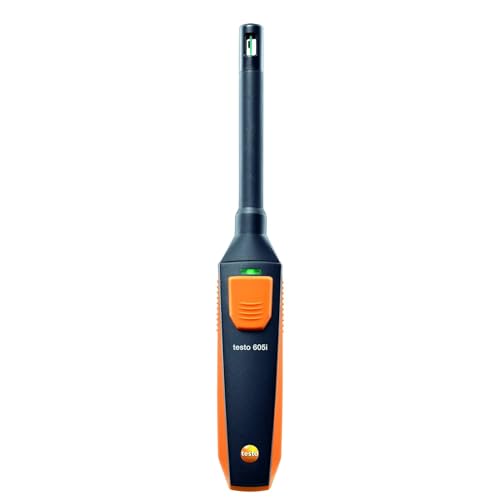
Products shown because their documented specifications fit this guide. Price and availability are on Amazon and can change.
Frequently Asked Questions
What humidity does the salt test produce?
Saturated sodium chloride (table salt) holds the air above it at 75.3 percent RH at 20 to 25 °C. Magnesium chloride gives 33 percent and potassium carbonate 43 percent for a second point.
How long does the salt test take?
At least 8 hours for the air and the sensor to equilibrate; overnight is convenient. Small sealed bags settle faster than large boxes.
My hygrometer reads 70 percent in the salt test. Is it broken?
It reads 5 points low. Many meters allow an offset adjustment; otherwise note the correction and add 5 to its readings, or replace it if accuracy matters.
Affiliate disclosure: Akermin earns a commission from qualifying Amazon purchases made through links on this page. Our editorial picks are based on documented specifications and owner feedback, not commissions.
Related Guides

CPS LS790B Leak-Seeker Review: Non Combustible Is the Deciding Word
An ion pump refrigerant leak detector individually calibrated to find a leak rate better than a quarter of an ounce per year, with ten selectable sensitivity ranges, a water vapour filter and a bar graph plus tone display.
Read More→
BW Clip BWC2-H Review: Alarm Points Set Before the Clock Starts
A single gas hydrogen sulfide detector with one button operation, hibernation mode, automatic logging of the 35 most recent gas events and bump test results, and compatibility with IntelliDoX and MicroDock II docking.
Read More→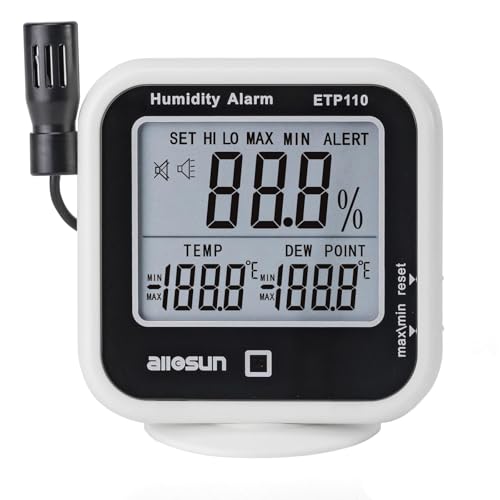
ALLOSUN Thermometer Hygrometer Review: Half a Metre of Lead and No Tolerance
A battery powered thermometer and hygrometer showing temperature, relative humidity and dew point, with a settable humidity alarm, a sensor on a lead of about 50 cm, maximum and minimum memory and a large LCD.
Read More→