As an Amazon Associate, Akermin earns from qualifying purchases. Product links on this page are affiliate links.
Measure relative humidity with a hygrometer you have checked against a salt test, placed where it samples the air you actually want to know about (mid-room for a room average; at the surface for a condensation question), left for 15 minutes to equilibrate, kept away from your breath, hands and heat sources, and read together with the temperature at the same spot. Convert to dew point if you need a number that does not swing with temperature. A single well-taken reading beats a dozen careless ones.
Step 1: A trustworthy instrument
Use a capacitive digital hygrometer with a stated ±3 percent RH or better, and check it with the salt test within the last year. See how to choose a humidity meter and how to calibrate a hygrometer.
Step 2: Decide what you are measuring
| Question | Where to measure |
|---|---|
| Is the room comfortable / in the 30 to 50% band? | Mid-room, 1 to 1.5 m up, away from walls, windows, heaters, kitchen and bathroom doors |
| Will this wall or window get condensation? | Within a few centimeters of the surface, or measure the surface temperature and compare with the room dew point |
| Is the bedroom too humid overnight? | Bedside shelf, logged through the night; read the morning peak |
| Is the bathroom extract working? | Bathroom, logged through a shower and the hour after |
| Is the crawl space or basement damp? | In the space, logged for a week |
Step 3: Let it settle
A hygrometer moved between rooms reads its old environment for minutes. Both the temperature sensor and the humidity polymer must equilibrate; 10 to 15 minutes in still air, longer for enclosed housings and large temperature changes. Watch the display; when two readings a minute apart agree, it has settled. See why sensors need time to stabilize.
Step 4: Avoid contamination
- Do not breathe on the sensor; breath is warm and near-saturated.
- Do not hold it in your hand; skin warms it and lowers the RH reading.
- Keep it out of sun and away from lamps, radiators and electronics.
- Keep it out of the direct stream of vents, fans and open windows unless that is the point.
Step 5: Record temperature and compute dew point
Write down RH and temperature together, with time and location. Convert to dew point with the humidity checker or the meter’s own function. Dew point lets you compare readings taken at different temperatures and tells you which surfaces are at condensation risk. See what dew point is.
Step 6: Repeat
Humidity changes through the day and with activity. For a room verdict, take readings at two or three times of day, or log for 24 hours and read the range. For a comparison between rooms, measure them within the same hour with the same instrument. See why humidity changes throughout the day.
Interpreting
| Room RH | Meaning |
|---|---|
| Under 30% | Dry; static, dry skin, cracking wood |
| 30 to 50% | Comfort and health band |
| 50 to 60% | Acceptable; watch cold surfaces |
| Over 60% sustained | Mold and dust mite risk; find the source; ventilate or dehumidify |
A surface reading above 80 percent RH, or a surface temperature below the room dew point, means condensation and mold risk at that spot regardless of the room average. For the theory, see what relative humidity is.
Recommended Tools
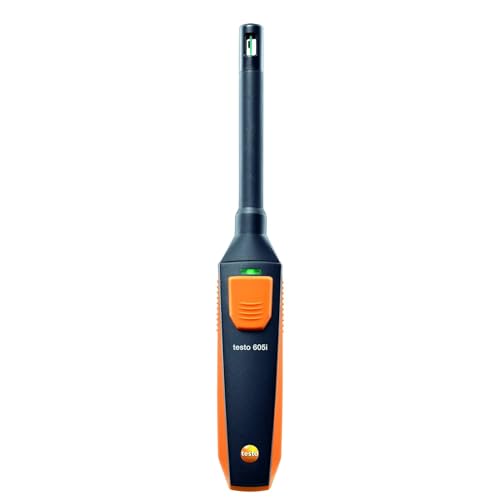

Products shown because their documented specifications fit this guide. Price and availability are on Amazon and can change.
Frequently Asked Questions
How long should a hygrometer sit before reading?
At least 10 to 15 minutes after moving it, and 20 to 30 minutes if it came from a much warmer or colder place. Watch until the reading stops changing.
Should I record temperature with humidity?
Always. RH depends on temperature; without it the reading cannot be converted to dew point or compared with readings taken at another temperature.
Why does my hygrometer read differently near the window?
The air beside cold glass is cooler and its relative humidity is higher for the same moisture content. It is a correct local reading, not the room average.
Affiliate disclosure: Akermin earns a commission from qualifying Amazon purchases made through links on this page. Our editorial picks are based on documented specifications and owner feedback, not commissions.