As an Amazon Associate, Akermin earns from qualifying purchases. Product links on this page are affiliate links.
Dew point from temperature (T, °C) and relative humidity (RH, %) uses the Magnus formula: γ = ln(RH ÷ 100) + (17.62 × T) ÷ (243.12 + T), then dew point = (243.12 × γ) ÷ (17.62 − γ). For 22 °C and 55 percent RH: γ = ln(0.55) + (17.62 × 22) ÷ 265.12 = −0.598 + 1.462 = 0.864; dew point = (243.12 × 0.864) ÷ (17.62 − 0.864) = 210.1 ÷ 16.76 = 12.5 °C. For a quick estimate, dew point ≈ T − (100 − RH) ÷ 5, which gives 13 °C here. The humidity checker does the full calculation.
The Magnus formula
With T in °C and RH in percent:
- γ = ln(RH ÷ 100) + (b × T) ÷ (c + T)
- Dew point = (c × γ) ÷ (b − γ)
Constants b = 17.62 and c = 243.12 °C (Sonntag 1990) are accurate to about 0.3 °C across indoor and outdoor conditions. Older constants (b = 17.27, c = 237.7) appear in many references and give nearly identical results.
Worked example
| Step | Calculation | Value |
|---|---|---|
| Inputs | T = 22 °C, RH = 55% | |
| ln(RH/100) | ln(0.55) | −0.598 |
| b × T ÷ (c + T) | 17.62 × 22 ÷ 265.12 | 1.462 |
| γ | −0.598 + 1.462 | 0.864 |
| Dew point | 243.12 × 0.864 ÷ (17.62 − 0.864) | 12.5 °C |
Rule of thumb
For RH above about 50 percent: dew point ≈ T − (100 − RH) ÷ 5. Each 5 points of RH below 100 lowers the dew point about 1 °C. At 20 °C and 70% RH: 20 − 6 = 14 °C (Magnus gives 14.4). At 24 °C and 40% RH: 24 − 12 = 12 °C (Magnus gives 9.6; the rule drifts at lower RH).
Lookup table (°C)
| Temp RH | 30% | 40% | 50% | 60% | 70% | 80% |
|---|---|---|---|---|---|---|
| 16 °C | −1.5 | 2.4 | 5.6 | 8.2 | 10.5 | 12.5 |
| 18 °C | 0.2 | 4.2 | 7.4 | 10.1 | 12.4 | 14.5 |
| 20 °C | 1.9 | 6.0 | 9.3 | 12.0 | 14.4 | 16.4 |
| 22 °C | 3.6 | 7.8 | 11.1 | 13.9 | 16.3 | 18.4 |
| 24 °C | 5.4 | 9.6 | 12.9 | 15.8 | 18.2 | 20.3 |
| 26 °C | 7.1 | 11.4 | 14.8 | 17.6 | 20.1 | 22.3 |
Fahrenheit
Convert °F to °C: (°F − 32) × 5 ÷ 9. Calculate. Convert back: °C × 9 ÷ 5 + 32. At 72 °F (22.2 °C) and 55% RH the dew point is 12.7 °C, or 54.9 °F.
Using the result
Any surface colder than the dew point will collect condensation; surfaces within 2 to 3 °C of it are at mold risk from high surface humidity. Measure a suspect surface with an infrared thermometer and compare. Because dew point ignores temperature, a rising dew point means water is being added to the air, which points to the source. See what dew point is and why condensation forms on windows. For measuring the inputs properly, see how to measure relative humidity correctly.
Recommended Tools
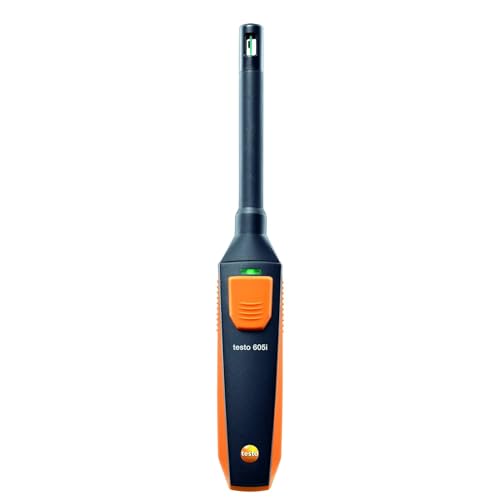

Products shown because their documented specifications fit this guide. Price and availability are on Amazon and can change.
Frequently Asked Questions
What is the simplest dew point formula?
Rule of thumb: dew point ≈ temperature − (100 − RH) ÷ 5, in °C. At 22 °C and 55% RH: 22 − 9 = 13 °C. Accurate to about a degree between 50 and 100% RH.
How accurate is the Magnus formula?
Within about 0.3 °C for temperatures from −40 to 50 °C and RH from 1 to 100 percent, which is far better than the hygrometer feeding it.
Can I calculate dew point in Fahrenheit?
Convert temperature to Celsius first, calculate, and convert the result back: °F = °C × 9/5 + 32.
Affiliate disclosure: Akermin earns a commission from qualifying Amazon purchases made through links on this page. Our editorial picks are based on documented specifications and owner feedback, not commissions.