As an Amazon Associate, Akermin earns from qualifying purchases. Product links on this page are affiliate links.
Yes, if it is an ultrasonic humidifier running on tap water. Ultrasonic units shake water into a fine mist; when each droplet evaporates it leaves behind the minerals that were dissolved in it as a solid particle a fraction of a micrometer across. A laser particle sensor counts those as PM2.5, and readings of 50 to 200 µg/m³ in the room are common with hard water. Evaporative (wick) and steam humidifiers do not do this. Separately, very high humidity makes any laser sensor read a little high because particles swell with absorbed water.
How ultrasonic humidifiers make particles
A piezoelectric disc vibrating at ultrasonic frequency breaks water into droplets of a few micrometers. The droplets carry everything dissolved in the water: calcium, magnesium, sodium, silica. Within seconds of leaving the unit the water evaporates and the mineral load is left as a dry particle, typically 0.1 to 1 µm. Hard water with 300 mg/L of dissolved solids produces far more than soft water at 50 mg/L. The visible sign is white dust on furniture and electronics near the unit; the particle monitor sees the airborne fraction long before it settles.
What a monitor shows
| Humidifier type | Water | Typical PM2.5 effect in a bedroom |
|---|---|---|
| Ultrasonic | Hard tap water | Rise to 100 to 300 µg/m³ while running |
| Ultrasonic | Soft tap water | Rise to 30 to 80 µg/m³ |
| Ultrasonic | Distilled or deionized water | Little or no rise |
| Evaporative (wick and fan) | Any | No rise; minerals stay in the wick |
| Steam (warm mist) | Any | No rise; minerals stay in the tank as scale |
Does it matter?
The particles are inorganic minerals rather than combustion soot, and their toxicity is likely lower per microgram. But the concentrations are high, they are in the size range that reaches deep into the lungs, and bedrooms are where humidifiers usually run for eight hours a night, often near an infant. Several studies have measured exposures above outdoor air quality guidelines. Given that distilled water or a different humidifier type removes the problem entirely, avoiding it is the sensible default.
Humidity and the sensor itself
Laser particle sensors measure scattered light. Above roughly 70 percent relative humidity, salt and organic particles absorb water and grow, scattering more light and reading higher than their dry mass. Reference monitors dry the air sample first; consumer sensors do not. A room at 80 percent RH can read 20 to 50 percent high on PM2.5. This is a smaller effect than ultrasonic mineral dust but worth knowing when readings rise on humid nights. The humidity checker shows where a reading sits.
Fixes
- Use distilled or deionized water in an ultrasonic humidifier, or fit the demineralization cartridge some models offer.
- Switch to an evaporative or steam humidifier.
- Aim for 40 to 50 percent RH; higher adds mold risk and sensor error for no comfort gain.
- Do not treat a humidifier-driven PM2.5 rise as outdoor pollution; check whether the reading falls when the unit is off.
Related: why particle sensors disagree with each other and PM2.5 vs PM10.
Recommended Tools
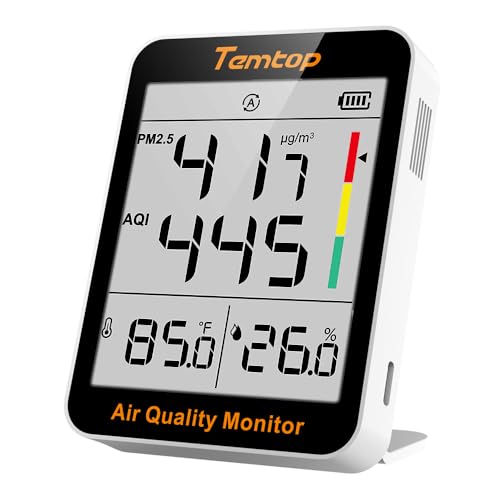
Products shown because their documented specifications fit this guide. Price and availability are on Amazon and can change.
Frequently Asked Questions
Why does my air quality monitor go up when the humidifier runs?
Ultrasonic humidifiers atomize water droplets; when they evaporate, the dissolved minerals remain as fine particles that a laser sensor counts as PM2.5. Hard tap water produces the most.
Is humidifier dust harmful?
It is mineral particulate in the PM2.5 size range, and studies have measured levels well above outdoor guidelines. The health significance is still debated, but there is no reason to breathe it when distilled water or an evaporative unit avoids it.
Can high humidity alone raise a particle reading?
Yes, slightly. Above about 70 percent RH, hygroscopic particles absorb water and scatter more light, so laser sensors read higher for the same dry mass.
Affiliate disclosure: Akermin earns a commission from qualifying Amazon purchases made through links on this page. Our editorial picks are based on documented specifications and owner feedback, not commissions.