As an Amazon Associate, Akermin earns from qualifying purchases. Product links on this page are affiliate links.
Particle sensors disagree because none of them measures mass directly. A laser sensor counts particles by the light they scatter, estimates each particle’s size from the flash intensity, and converts counts to micrograms per cubic meter using an assumed density and shape. Each manufacturer calibrates against its own test aerosol and applies its own humidity correction, or none. Put two units in the same air and a 10 to 30 percent difference is normal; a larger gap usually means humidity, a dirty sensor or a different particle mix than the one the sensor was calibrated for.
How a laser particle sensor works
- A small fan draws air past a laser beam.
- Each particle scatters light; a photodiode records a pulse.
- Pulse height is mapped to particle size using a calibration curve.
- Particles are sorted into size bins (0.3 to 0.5 µm, 0.5 to 1 µm, and so on).
- Bin counts are converted to mass using an assumed density and a spherical shape.
Steps 3 and 5 are where the assumptions live. Reference instruments avoid them by weighing collected particles or measuring beta-ray attenuation, which is why they cost thousands.
Sources of disagreement
- Calibration aerosol. Sensors are factory-calibrated against a standard dust or smoke. Real cooking oil, candle soot and mineral dust scatter light differently, so two sensors calibrated against different standards diverge in real rooms.
- Density assumption. Soot is light, mineral dust is dense. A sensor assuming one density misreports the other.
- Humidity. Above about 70 percent RH particles absorb water and grow. Sensors with humidity correction read lower than those without. See can a humidifier affect particle monitor readings.
- Lower detection limit. Most consumer sensors cannot see particles under 0.3 µm and extrapolate. Smoke, which is mostly below that, is handled differently by each firmware.
- Fan flow and aging. Dust on the lens and a slowing fan reduce counts over months.
- Averaging. One unit reports a 10-second value, another a 1-minute mean. Spikes look different.
How much disagreement is normal
| Condition | Typical difference between two consumer units |
|---|---|
| Moderate levels (20 to 100 µg/m³), dry air | 10 to 30% |
| Very low levels (under 10 µg/m³) | A few µg/m³ either way; percentages meaningless |
| Humid air (over 70% RH) | Up to 50% |
| Wood or wildfire smoke | 20 to 60%; smoke is mostly sub-0.3 µm |
| One unit over a year old, uncleaned | Growing gap as it undercounts |
Comparing units fairly
- Place them together, away from drafts, for an hour.
- Compare on a calm day with windows open against the nearest official outdoor monitor.
- Compare trends rather than absolute values: both should spike during cooking and fall afterward at similar rates.
- Clean the intake and check the fan on any unit that reads persistently low.
What this means for decisions
Consumer particle sensors are excellent at showing change and adequate at absolute levels. Use them to find sources, check a hood or a purifier, and spot smoke events. Do not use them to argue that a room is at 12 rather than 15 µg/m³. The same logic applies to CO₂ monitors; see why two CO₂ monitors show different readings.
Recommended Tools

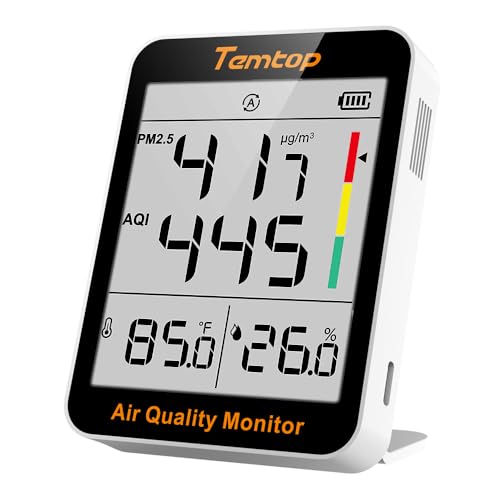
Products shown because their documented specifications fit this guide. Price and availability are on Amazon and can change.
Frequently Asked Questions
How much should two particle monitors agree?
Two consumer laser sensors side by side typically agree within 10 to 30 percent on PM2.5 at moderate levels. Larger gaps appear at very low readings, in humid air, or when one unit is aging or dirty.
Which one is right?
Neither is a reference instrument. Compare both with the nearest official outdoor monitor on a calm day with windows open; the one closer to it has the better calibration for your local particle mix.
Why does a cheap sensor read higher than an expensive one?
Often because it is calibrated against a different test aerosol or applies no humidity correction. Higher price buys better calibration and correction, not a different measurement principle.
Affiliate disclosure: Akermin earns a commission from qualifying Amazon purchases made through links on this page. Our editorial picks are based on documented specifications and owner feedback, not commissions.