As an Amazon Associate, Akermin earns from qualifying purchases. Product links on this page are affiliate links.

Sacnahe · Air Quality Monitor, Dual Chip Multi-Functional Air Quality Detector for AQI, CO2, PM2.5, HCHO & TVOC Testing, Suitable for Home, Office and Indoor Air Monitoring – Black
View on AmazonPrice and availability are shown on Amazon and can change at any time.
This monitor displays AQI, CO2, PM2.5, PM1.0, PM10, TVOC and HCHO alongside temperature and humidity, logs to the Smart Life and Tuya Smart apps over 2.4 GHz WiFi, and runs seven to fifteen hours on a 3000 mAh battery. The app logging is genuinely useful. The problem is that across five bullets the listing never names one sensor technology and never publishes one accuracy figure, so there is no way to judge whether any of those seven numbers means anything.
Seven readings, and no stated way of getting them
An air quality monitor is not a display. It is a set of sensors with a display attached, and the sensors are what you are buying. Two units can show identical looking numbers for CO2 while one responds to carbon dioxide and the other responds to whatever happens to be in the air.
This listing describes all round monitoring, professional tracking and upgraded architecture. It does not say NDIR. It does not say electrochemical. It does not say laser scattering. For seven separate measurements there is not one sensor technology named.
That absence has a direction. A manufacturer who has fitted an NDIR CO2 sensor says so, because it costs more and it is the main reason to choose their unit over a cheaper one. A manufacturer who has fitted a metal oxide element tends to write about smart monitoring instead. We cannot state which is inside this one, and that is exactly the problem: the listing leaves a buyer guessing on the only question that matters. Our explainer on how the two sensing methods differ sets out what changes in practice.
Dual chip is an answer to a different question
The architecture bullet is the most technical text in the listing: an upgraded dual chip design with one chip focused on precise sensor data collection and analysis and the other handling display and interaction, described as ensuring fast response, reliable detection and stable real time data output.
Splitting acquisition from interface is genuinely good engineering. It stops the screen from stuttering while a sample is taken and it keeps sampling regular when someone is pressing buttons. It is the reason cheap monitors sometimes freeze for a second when you change pages.
What it cannot do is improve a measurement. Reliable detection in this sentence means the data path is reliable, not that the sensor is accurate. If a metal oxide element reports a number that is two hundred parts per million out, a second processor delivers that wrong number promptly and stably. This bullet is about responsiveness, and it is being positioned as though it were about precision.
The logging is the real feature
Where this listing does deliver is the record. It states effortless connection to 2.4 GHz WiFi, operation with the Smart Life and Tuya Smart apps, remote checking of air indicators and battery level in real time, automatic saving of historical data, real time air updates and support for remote parameters.
A single live reading answers almost nothing. A week of readings answers most of the useful questions. Does the bedroom CO2 climb to an uncomfortable level by morning with the door closed. Does the particle count in the kitchen spike at every meal and clear in twenty minutes or two hours. Does the workshop recover after the extraction is switched off. None of that is visible on a screen you glance at.
Two caveats belong with the praise. The record lives in a third party app ecosystem, so its longevity is not in your hands, and exportability is not described. And the WiFi is 2.4 GHz only, which is worth checking against your router before you commit, since without the network the logging simply does not happen.
Battery and physical behaviour
| Specification | Published in the listing |
|---|---|
| Measurements displayed | AQI, CO2, PM2.5, PM1.0, PM10, TVOC, HCHO, temperature, humidity |
| Connectivity | 2.4 GHz WiFi, Smart Life and Tuya Smart |
| Logging | Automatic historical data in the app |
| Battery | 3000 mAh, approximately 7 to 15 hours, Type-C |
| Display | LCD with colour coded status bars, auto brightness, screen off monitoring |
| Sensor technology, any channel | Not stated in the listing bullets |
| Accuracy, any channel | Not stated in the listing bullets |
| Measurement range, any channel | Not stated in the listing bullets |
| Calibration procedure | Not stated in the listing bullets |
The seven to fifteen hour battery range is wide, and the listing attributes the spread to a low power chip design without saying what moves it. The likely drivers are screen brightness and WiFi activity. Screen off monitoring is the feature that matters for overnight logging, since it lets the unit keep sampling in a dark bedroom without lighting it up.
The missing calibration note deserves attention. NDIR CO2 sensors normally need either a manual fresh air calibration or an automatic baseline routine that assumes the room reaches outdoor levels periodically. Without knowing which applies, you cannot tell whether a reading that has drifted can be corrected.
The verdict on an unspecified instrument
As a device for watching relative change over time in one room, with a graph you can pull up on a phone, this is a reasonable and well connected unit. Trends are robust to accuracy problems. If a number doubles when you close a door and halves when you open a window, that tells you something true even if the absolute figure is off.
As a measuring instrument it cannot be assessed, because the listing gives nothing to assess. No sensor type, no accuracy, no range, no calibration. If you need a number you can defend, choose a monitor that names its CO2 sensor and publishes a tolerance. Our air quality monitor comparison shows which listings do, and the gap between them and this one is the whole point.
Recommended Tools

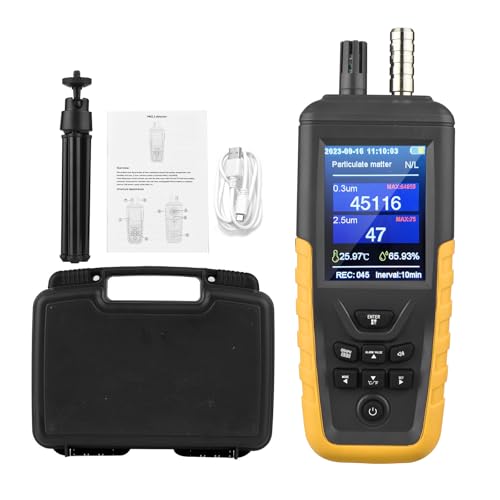
Products shown because their documented specifications fit this guide. Price and availability are on Amazon and can change.
Frequently Asked Questions
Which sensor measures the CO2?
Not stated in the listing bullets. This is the decisive omission. Carbon dioxide can be measured by NDIR infrared absorption, which responds to CO2 itself, or estimated by a metal oxide element that infers it from general air chemistry. The second kind spikes when you spray cleaner and drifts over months. Since the listing does not say, a buyer cannot tell which they are getting, and the honest default assumption for an unnamed sensor is the cheaper one.
What does the dual chip architecture do for the readings?
Nothing directly. The listing describes one chip for sensor data collection and analysis and another for display and interaction. That is a sensible way to keep a screen responsive while sampling continues, and it is a statement about the computer, not about the sensors. A fast, stable display of an inaccurate number is still an inaccurate number.
Is the app logging useful?
Yes, and it is the strongest practical feature here. The listing states 2.4 GHz WiFi with Smart Life and Tuya Smart, automatic historical data storage, remote checking and real time updates. A graph over days tells you things a live number cannot, such as whether a bedroom climbs every night. The dependency is that your record lives in a third party app ecosystem.
Why does 2.4 GHz only matter?
Because some routers present only a 5 GHz network by default, or combine both under one name in a way that confuses simple devices. The listing states 2.4 GHz. Before buying, confirm your router broadcasts a 2.4 GHz band you can join, or the WiFi features and therefore the logging will not work at all.
Can I compare its formaldehyde reading against a guideline?
No. With no sensor type and no accuracy figure published for HCHO, a displayed value has no stated tolerance. Use it to see whether a number goes up after bringing new furniture into a room and comes down with ventilation. Do not use it to decide that a room is within or outside a published limit.
Affiliate disclosure: Akermin earns a commission from qualifying Amazon purchases made through links on this page. Our editorial picks are based on documented specifications and owner feedback, not commissions.