Best H2S Gas Detectors: 6 Picks for the Gas That Disables Your Sense of Smell
Hydrogen sulfide smells unmistakable at low concentrations and then paralyses the olfactory nerve as levels rise. People conclude the gas has cleared when it has actually got worse. That single fact is why this measurement is made by instrument and never by nose.
As an Amazon Associate, Akermin earns from qualifying purchases. Product links on this page are affiliate links.
Our Top Picks
Detectors were sorted by whether the listing describes a single gas or multi gas instrument, the stated detection range, the alarm channels offered, battery and sensor life, and what the manufacturer states about bump testing and calibration. We did not run laboratory tests and publish no measurements of our own. Where a listing gives no figure, the entry reads Not stated.
Best Overall
BW Clip BWC2-H Single Gas H2S
A maintenance-free single gas clip with event logging and pre-set alarm points.
Single gas hydrogen sulfide detector
Hibernation mode with a case accessory or IntelliDoX
Automatic logging of the 35 most recent gas events and bump test results
High and low alarm set points configurable before activation
A single gas H2S detector does not satisfy confined space entry requirements on its own, because oxygen and combustible gas must also be monitored. Treat the single gas units as personal supplements to a four gas instrument.
How to Choose an H2S Detector
Hydrogen sulfide rarely arrives alone, and the instrument has to survive the way it will actually be used.
Single Gas Is Never Enough Alone
Sewers, slurry and digesters produce H2S alongside methane and oxygen depletion. Confined space entry needs all four gases. A single gas clip supplements that, it does not replace it.
Vibration Beats Volume
An 85 decibel alarm is inaudible next to a pump or under ear defenders. If you work in noise, a vibration channel is not a luxury.
Bump Test Before Every Use
Electrochemical cells fail silently. A bump test with known gas proves the sensor and the alarm respond. It does not prove accuracy, which is what calibration is for.
Match Runtime to the Shift
A monitor that dies at hour ten of a twelve hour shift is worse than useless. The stated figures here run from 14 to 18 hours on the multi gas units.
Logging Is What a Supervisor Needs
For one person, a display is enough. For a crew, event and bump test records are how you prove the equipment was working and tested.
A Pump Tests Before You Enter
Diffusion detectors read where they are. Pre-entry testing of a vault or tank from outside needs a pumped instrument and a sample line.
Because its warning property fails as the danger rises. At low concentrations the rotten egg smell is obvious. At higher concentrations it paralyses the sense of smell, so the smell disappears and people believe the hazard has cleared. Nothing about human perception protects against this, which is why an instrument is required.
Can I use a single gas H2S detector for confined space entry?
No. Entry procedures require oxygen, combustible gas and toxic gas monitoring together, because the same conditions that produce H2S commonly also displace oxygen and generate methane. Use a four gas instrument for entry and treat a single gas clip as an additional personal warning.
What is the difference between a bump test and calibration?
A bump test applies gas to confirm that the sensor responds and the alarm operates. Calibration adjusts the instrument against a known concentration so the reading is correct. A bump test proves it is alive; calibration proves it is right. Both are needed, on different schedules.
Why do maintenance-free clips have a fixed life?
Electrochemical cells age from manufacture, whether or not they are used, so the manufacturer seals the unit and states a service life rather than selling replacement sensors. Hibernation modes exist to stop that life being consumed while the detector sits unused in a locker.
Where should the detector be worn?
In the breathing zone, on the upper body, where you would actually inhale the gas. A detector in a toolbag or a back pocket is measuring the wrong air. Hydrogen sulfide is heavier than air and pools in low points, which is another argument for pre-entry testing at several depths.
Do any of these come calibrated?
None of these listings states traceable calibration. If your work is audited or regulated, look for a detector whose manufacturer states the calibration standard and supplies a certificate, and plan for calibration gas as an ongoing cost.
Reviews
BW Clip BWC2-H Single Gas H2S Best Overall
The design idea behind a clip like this is that nothing about it should require a decision. It is switched on, worn, and replaced at end of life, and in between there is no charging, no sensor swap and no configuration to get wrong. For a workforce rather than an individual, that is worth far more than a feature list.
Two details in the listing raise it above the generic clips. Automatic logging of the 35 most recent gas events and bump test results means an incident can be reviewed rather than remembered, and a supervisor can confirm that bump testing actually happened. Hibernation mode with a case or a docking station means the service life is not consumed while the detector sits in a locker between shifts, which on a seasonal or intermittent job can be most of the year.
Strengths
No charging or sensor maintenance during its life
Event and bump test logging built in
Hibernation preserves service life between jobs
Docking station support for fleet management
Limitations
No measurement range published in the listing bullets
Single gas only, so not sufficient for confined space entry alone
If hydrogen sulfide is present, the other three confined space hazards usually are too. The same biological processes that generate H2S in sewers, slurry stores and digesters also consume oxygen and produce methane, so a single gas detector covers one third of a problem that arrives as a set.
This listing publishes more than most in its class: a 0.5 second response, named DDS sensors with a stated five year oxygen cell life, USB export and an 18 hour battery. A stated sensor life is unusually useful, because electrochemical cells age whether or not the instrument is used and the failure is invisible. The trend curves on the colour screen are the other genuinely practical feature, since a rising trend is more informative than a single value when you are deciding whether to stay or leave.
Forsensal 4 Gas Monitor with Pump Best for Pre-Entry Testing
A pump is the difference between testing the air you are standing in and testing the air you are about to enter. Confined space procedure calls for the atmosphere to be tested from outside, at several depths, before entry, and a diffusion-only instrument cannot do that because it has to be physically in the space to read it.
That makes a pumped instrument a procedural tool rather than a personal one. It samples through a line lowered into a vault, a tank or a pit, checks the top, middle and bottom, and produces the reading that authorises or refuses entry. Many teams carry both: a pumped unit for the pre-entry test and a personal monitor worn by whoever goes in. The listing does not publish ranges, accuracy or battery life, so confirm those against your entry procedure.
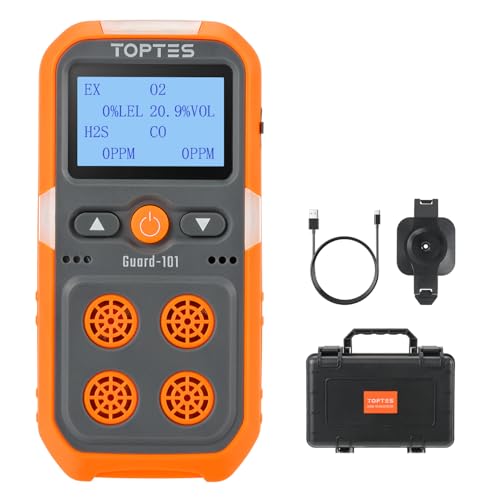
TopTes Guard-101 4 Gas Monitor Best Value Multi Gas
The cheapest route to the full four gas set, and the vibration alarm is the feature that justifies it over a single gas clip in noisy work. A buzzer next to a running compressor or under hearing protection reaches nobody; a vibrating unit clipped to your belt reaches you every time.
The listing also states that the alarm continues until levels return to normal rather than sounding once, which is the correct behaviour and not universal at this price. Alarm record storage lets an event be reviewed afterwards. What the listing does not state is any measurement range, accuracy, sensor life or calibration interval, so plan your own bump test and calibration routine and budget for the gas.
Strengths
Full four gas coverage at the lowest cost here
Vibration alarm for noisy environments
Latching alarm behaviour
Stored alarm records
Limitations
No ranges, accuracy or sensor life published
No traceable calibration claim
Password protection defaults are published, so change them
This is the only single gas pick here that publishes both a range and an accuracy figure, which for a safety instrument is the minimum a buyer should expect and is oddly rare. A 0 to 100 ppm range covers the levels at which hydrogen sulfide goes from noticeable to immediately dangerous.
What you are giving up compared with the BW Clip is the surrounding system: there is no event logging, no bump test record and no docking support described, and no sensor life is stated. For an individual working around slurry, drains or wastewater who wants a personal warning device and will bump test it themselves, it does the job. For a managed workforce where somebody has to prove the detectors were tested, the logging on the BW Clip is what you are paying for.
Two adjustable alarm points is the right structure for a toxic gas instrument: a lower level that means take action, and a higher one that means leave now. Sites often have their own action levels that differ from a manufacturer default, and an instrument that can be set to match the procedure is more useful than one that forces the procedure to match the instrument.
One caution is worth stating plainly. The listing states the buzzer can be switched off, and no vibration alarm is mentioned. A safety instrument with its only audible alarm disabled is not a safety instrument, so if you work in noise, choose a detector with a vibration channel instead. The data hold function is a practical touch for recording a reading taken somewhere you cannot comfortably read the screen.
Strengths
Two adjustable alarm thresholds
Backlit display with data hold
Named electrochemical sensor type
Inexpensive personal monitor
Limitations
Buzzer can be switched off and there is no vibration alarm
Short answer: the BW Clip BWC2-H is the best single gas choice because it logs gas events and bump tests and needs no maintenance during its life; the TopTes Guard-863Pro is the best multi gas instrument, with named sensors and a stated five year oxygen cell; and the Forsensal pumped unit is the one that lets you test a confined space before anybody climbs into it.
The gas that switches off your warning system
Most workplace hazards either announce themselves or do not. Hydrogen sulfide does both, in the wrong order. At a few parts per million it smells strongly of rotten eggs. As the concentration climbs, it deadens the olfactory nerve, and the smell fades. The documented pattern of incidents follows from that: somebody notices the smell, keeps working, notices it has gone, concludes the problem has passed, and is overcome. No amount of experience protects against a sense that has been switched off, which is why this is one of the few hazards where an instrument is genuinely mandatory rather than merely sensible.
It almost never arrives alone
Hydrogen sulfide is produced by anaerobic decomposition, and the same process consumes oxygen and generates methane. That is why sewers, slurry stores, digesters, tanks and wells present the full confined space hazard set rather than a single gas. A single gas clip tells you about one third of the problem, and the missing two thirds include oxygen deficiency, which kills more people in confined spaces than anything else and gives no warning at all. Our page on single gas versus multi gas detectors sets out the decision in full.
Diffusion or pump
A personal monitor is a diffusion instrument: gas reaches the sensor by moving through a membrane, so the detector reads the air it is sitting in. That is exactly right for a device worn on your chest and exactly wrong for testing a space before entry, because the instrument would have to be inside the space already. A pumped instrument draws a sample through a line, which lets you test a vault at the top, the middle and the bottom from outside. Both approaches are needed, and many teams own both.
The routine matters more than the brand
Every sensor in every device on this page drifts, and the failure is silent. An electrochemical cell that has aged out reads zero in the presence of gas just as convincingly as it reads zero in clean air. The defence is procedural rather than technical: a fresh air zero at the start of a shift in air you are confident about, a bump test with known gas before use to prove the sensor and alarm respond, and full calibration at the manufacturer’s stated interval. The difference between those last two is explained in calibration versus adjustment. Budget for calibration gas from the start, because a detector without it is a detector you are trusting on faith.
Wear it where you breathe
A monitor in a bag is measuring the inside of a bag. Hydrogen sulfide is heavier than air and settles in low points, so the concentration at floor level in a pit can be far higher than at head height, which is an argument for pre-entry testing at several depths rather than one reading at the hatch. Clip the personal monitor in the breathing zone on the upper body, and use the pumped instrument for the procedural test. Related reading: the four gas detector roundup and gas detectors for confined spaces.
How We Research
Instruments were compared on gases covered, published detection range and accuracy, alarm channels including vibration, stated battery and sensor life, event and bump test logging, and whether pumped sampling is supported. Single gas and multi gas devices are listed together because buyers searching for an H2S detector are choosing between them, and the page states plainly where a single gas unit is insufficient. We did not run laboratory tests and publish no measurements of our own.
A practical comparison of ammonia detectors and general combustible gas sniffers, covering sensor type, cross sensitivity, calibration and the cases where neither instrument is the right answer.