As an Amazon Associate, Akermin earns from qualifying purchases. Product links on this page are affiliate links.
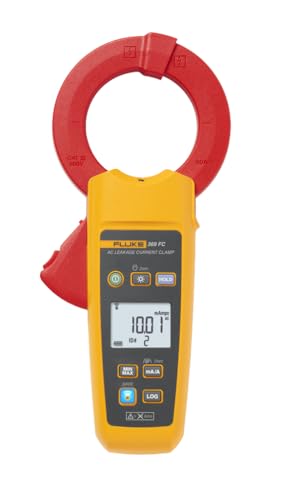
Fluke · Fluke FLUKE-369 FC Wireless Leakage Current Clamp Meter, 61 mm Jaw
View on AmazonPrice and availability are shown on Amazon and can change at any time.
The Fluke FLUKE-369 FC is a specialised leakage current clamp meter. Its listing states a 61 mm jaw, 1 microamp minimum resolution, 60 amp maximum current measurement, true-RMS measurement, a selectable filter, and Fluke Connect compatibility. It does not publish an accuracy specification, a CAT safety rating, a jaw opening tolerance, a battery type or life, or a full list of what the Fluke Connect app displays. If you need those figures before buying, this listing will not give them to you. For leakage work where a large jaw and fine resolution matter, it is a credible candidate; for anything requiring a published accuracy or safety rating, you will need to look beyond this page. Compare it with other leakage current clamp meters only after you have the missing figures in hand.
The Current Range and Resolution, and the Accuracy Figure That Is Missing
The listing gives two current figures: a minimum resolution of 1 microamp (1 µA) and a maximum current measurement of 60 amps. Those two numbers define the instrument’s working window. A 1 µA resolution is fine enough to see small leakage currents on a conductor, which is the whole point of a leakage clamp. A 60 A maximum is modest by general clamp meter standards, but leakage measurement rarely needs more.
What the listing does not publish is an accuracy specification. Accuracy tells you how close the displayed value is to the true current, usually expressed as a percentage of reading plus a number of counts. Without it, you cannot say whether a displayed 3 µA is truly 3 µA or somewhere else entirely. For leakage work, where the numbers are small, accuracy matters more than resolution. A fine resolution on an inaccurate instrument is a false comfort. The listing is also silent on the accuracy at each range and on any crest factor limit for true-RMS measurement. If accuracy is central to your decision, ask the supplier for the full specification sheet before you buy.
The 61 mm Jaw and What the Listing Does Not Say About It
The jaw opening is stated as 61 mm. That is a large jaw, intended for thick cables and bundled conductors. A larger jaw lets you clamp around a cable without disconnecting it, which is the practical advantage of any clamp meter. The listing does not publish the jaw’s maximum conductor diameter in millimetres, only the jaw length. It also does not state whether the jaw is shielded against adjacent conductor interference, a detail that matters when you clamp near other live cables.
Nor does the listing give a CAT safety rating. The CAT rating tells you the transient overvoltage environment the meter is designed to survive. Without it, you cannot judge whether the instrument is suitable for work on distribution panels or only on low-energy circuits. This is a significant omission for a tool aimed at electrical work. If you plan to use it on live panels, confirm the CAT rating from the manufacturer’s datasheet, not from this listing. For background on why that rating matters, see what a CAT rating means on an electrical meter.
True-RMS, the Selectable Filter, and the Noise the Listing Does Not Quantify
The listing states true-RMS measurement, which means the meter responds to the heating equivalent of a complex waveform rather than to an average. That is the correct choice for leakage currents that are not clean sine waves, such as those from switched-mode power supplies or variable-speed drives. The listing also states a selectable filter function that removes unwanted noise. It does not say what frequency the filter removes, how much attenuation it provides, or whether the filter affects the accuracy specification. Those are the details an engineer would want. In practice, a filter is useful when high-frequency noise rides on the leakage current, but without published filter characteristics you cannot predict its effect on your measurement. Treat the filter as a stated feature, not a quantified one.
The listing also mentions max/min/average readings and a hold function. These are useful for capturing a fluctuating leakage current over time. The averaging period and the update rate are not published. If you need to know how the average is computed, the listing will not tell you.
Fluke Connect, the Work Light, and the App Details Left Unstated
The meter is described as Fluke Connect compatible. The listing says to download the free Fluke Connect app from iTunes or Google Play to enable graphs for trending. That is the extent of the published detail. The listing does not state the wireless range, the battery type or life, whether the app supports exporting data, or how many readings the meter can store internally. Those are practical questions for anyone who wants to log leakage over time. The work light and backlit display are stated as aids for dark wiring cabinets. The listing does not give a brightness figure or a battery consumption figure for the light. If you plan to rely on the wireless trending, confirm the app’s capabilities and the meter’s storage from the manufacturer before purchase. The same Fluke Connect ecosystem appears on other models, so a comparison with the Fluke 374 FC may help you see what is common across the range, though that model is a general clamp meter rather than a leakage specialist.
Where the Silence Changes the Buying Decision
Three missing figures are decisive. First, accuracy: without it, you cannot know whether the 1 µA resolution is meaningful. Second, CAT rating: without it, you cannot judge suitability for live panel work. Third, battery life and type: without them, you cannot plan for a day in the field. The listing also does not publish a warranty period, a calibration interval, or whether a calibration certificate is included. For a professional instrument, those are normal expectations. Their absence from the listing does not mean they do not exist, but it does mean you cannot rely on this page to confirm them. If your work demands documented accuracy and safety, treat the Fluke 369 FC as a candidate that requires further verification, not as a fully specified purchase. For a broader view of what to look for, see how to choose a clamp meter.
The Fluke 369 FC as a Candidate, Not a Confirmed Choice
The Fluke FLUKE-369 FC has a useful combination of a large 61 mm jaw, 1 µA resolution, true-RMS measurement, and a noise filter. Those stated features suit leakage current work where fine resolution and a big jaw are needed. But the listing omits accuracy, CAT rating, battery details, and app specifics. Those omissions are not trivial; they are the figures that let you decide whether the instrument is safe and accurate enough for your work. If you can obtain those figures from the manufacturer and they meet your needs, the 369 FC is worth considering. If you cannot, or if the published figures fall short, look elsewhere. This review is based solely on the listing and general domain knowledge; no testing was performed.
Recommended Tools


Products shown because their documented specifications fit this guide. Price and availability are on Amazon and can change.
Frequently Asked Questions
Does the Fluke 369 FC measure DC current?
The listing does not state DC current measurement. It describes a leakage current clamp meter with true-RMS measurement, which typically implies AC measurement. Do not assume DC capability without confirmation from the manufacturer.
What is the accuracy of the 1 µA resolution?
The listing does not publish an accuracy specification. Resolution is not accuracy; a 1 µA display step does not mean the reading is accurate to 1 µA. You need the accuracy figure to interpret the resolution.
Is the Fluke 369 FC safe for live panel work?
The listing does not state a CAT safety rating. Without that rating, you cannot determine the transient overvoltage environment the meter is designed for. Confirm the CAT rating from the manufacturer before using it on live panels.
What batteries does it use and how long do they last?
The listing does not state the battery type or battery life. This is a gap if you plan long days in the field. Check the manufacturer's specification for details.
Does the Fluke Connect app record data for later analysis?
The listing says the app enables graphs for trending, but it does not state whether data can be exported, how many readings are stored, or the wireless range. Confirm the app's data handling from the manufacturer.
Can this meter replace a general clamp meter?
The listing gives a maximum current measurement of 60 A, which is low for general electrical work. It is designed for leakage current, not for high-current load measurements. For general use, a dedicated clamp meter with a higher range is more appropriate.
Affiliate disclosure: Akermin earns a commission from qualifying Amazon purchases made through links on this page. Our editorial picks are based on documented specifications and owner feedback, not commissions.
Related Guides

HiLetgo LCR-T4 Component Tester Review: The First Hour
A first-hour review of the HiLetgo LCR-T4 kit, covering what it measures, what the listing leaves out, and when a different instrument is the better answer.
Read More→
Klein Tools CL900 Clamp Meter Review: What the Listing Leaves Out
A specification-by-specification review of the Klein Tools CL900 that flags every gap in the published listing.
Read More→
Southwire GFCI Receptacle Tester Review: One Button, Seven Checks, and the Cost of Getting It Wrong
The Southwire GFCI receptacle tester is a compact seven-mode wiring checker whose real cost is in the button, the leads and the reference it does not ship with.
Read More→