As an Amazon Associate, Akermin earns from qualifying purchases. Product links on this page are affiliate links.
A hygrometer measures humidity, the water vapour content of air, usually as relative humidity in percent. A hydrometer measures the specific gravity or density of a liquid, used for battery electrolyte, brewing, and antifreeze checks. If your question is about damp air, condensation, or mould risk, you want a hygrometer. If your question is about the strength of a liquid, you want a hydrometer. The products on this page are hygrometers, because that is the instrument category this site covers.
One letter, two different physical measurements
The confusion is understandable. Both words come from Greek roots, and both instruments end in the same suffix. But they answer different questions about different states of matter.
A hygrometer measures water vapour in a gas, normally air. The output is usually relative humidity, expressed as a percentage: the amount of water vapour present compared with the maximum the air could hold at that temperature. Some hygrometers also report dew point or absolute humidity. The sensor is exposed to air, and the reading changes as the air changes.
A hydrometer measures the density of a liquid relative to water. You float the instrument in the liquid, and it sinks to a depth that depends on how dense the liquid is. The scale reads specific gravity, or sometimes degrees Brix, Plato, or a battery-specific scale. The instrument is glass or plastic, weighted at the bottom, and it must be immersed in a sample of the liquid to work.
That is the whole distinction. One reads air. One reads liquid. If you remember nothing else, remember that a hygrometer has no float and a hydrometer has no sensor.
What each instrument actually reads, and in what units
Hygrometers report humidity in several ways, and the choice of unit matters for the job. Relative humidity is the most common: a percentage that tells you how close the air is to saturation at its current temperature. Dew point is an absolute temperature: the temperature to which the air must cool for condensation to form. Absolute humidity is the mass of water vapour per unit volume of air.
For building diagnostics, relative humidity is the usual headline figure, but dew point is often more useful because it tells you whether a cold surface will sweat. A hygrometer that reports only relative humidity forces you to do the dew point arithmetic yourself, or to estimate. The better consumer units report both. For example, the Govee WiFi Thermometer Hygrometer H5179 publishes temperature accuracy of plus or minus 0.54 degrees Fahrenheit and humidity accuracy of plus or minus 3 percent relative humidity, with a refresh every 2 seconds. Those figures come from the listing. The listing does not publish a dew point range.
Hydrometers report specific gravity, which is dimensionless, or a related scale. A battery hydrometer might read from 1.100 to 1.300 specific gravity. A brewing hydrometer might read from 0.990 to 1.120, sometimes with a Brix scale alongside. The reading depends on the temperature of the liquid, so most hydrometers are calibrated at a stated reference temperature, often 20 degrees Celsius or 60 degrees Fahrenheit. If the sample is not at that temperature, you apply a correction. The correction tables are published by the manufacturer or in standard references.
There is no conversion between the two instruments. You cannot use a hygrometer to measure the strength of battery acid, and you cannot use a hydrometer to measure the humidity in a basement. They are not different scales on the same quantity. They are different quantities.
Where the wrong word sends buyers to the wrong product
Search for a hygrometer and you will find consumer devices with screens and apps. Search for a hydrometer and you will find glass floats, often sold for brewing or automotive use. The two product categories barely overlap in retail, which is why the mistake is usually caught quickly. But the mistake still costs time, and occasionally it costs a wrong diagnosis.
Consider a damp basement. The owner suspects high humidity and searches for a hydrometer. They find brewing equipment and conclude the search results are wrong, or they buy a hydrometer and discover it cannot be used on air at all. The correct instrument is a hygrometer, and the relevant reading is relative humidity or dew point. A unit such as the Govee Smart Bluetooth Thermometer Hygrometer H5074 measures air temperature and humidity and stores 20 days of data on board, which lets you see whether the basement humidity follows outdoor weather or stays high regardless. That pattern is more useful than a single spot reading.
Consider a battery bank. The owner wants to check state of charge and searches for a hygrometer. They find air sensors and conclude the search results are wrong. The correct instrument is a hydrometer, specifically one with a battery scale. It measures the specific gravity of the electrolyte, which falls as the battery discharges. No consumer air sensor can do this.
The same split applies to soil. A soil moisture meter is neither a hygrometer nor a hydrometer in the usual consumer sense, though the physics of water content is related. A hygrometer measures water vapour in air, not liquid water in soil. If you insert a hygrometer probe into soil, you will get a meaningless reading or a damaged sensor.
The instruments this site covers, and why they are all hygrometers
Every product referenced on this page is a hygrometer. That is the category this site monitors: instruments that measure the air in buildings, stores, and process spaces. The hydrometer belongs to a different trade, and we do not cover it here.
The consumer hygrometer market has converged on a few patterns. A small sensor package measures temperature and humidity, a microcontroller logs the values, and a radio or WiFi link sends them to a phone. The accuracy figures are usually modest: plus or minus 0.3 to 0.5 degrees Celsius for temperature and plus or minus 2 to 3 percent relative humidity for humidity. Those figures are adequate for comfort monitoring and for spotting damp trends. They are not adequate for calibration laboratories or for pharmaceutical storage, where calibrated reference instruments are required.
The GoveeLife 2.0 WiFi Hygrometer Thermometer with Gateway illustrates the multi-sensor pattern: a gateway connects to WiFi and pairs with up to 10 sensors, each publishing temperature and humidity with the same plus or minus 0.3 degrees Celsius and plus or minus 3 percent relative humidity figures as the single-sensor units. The value here is coverage, not accuracy. You can place sensors in several rooms and see which one is drifting.
The Temtop S1+ Smart Air Quality Monitor adds particulate measurement to the same package. It reports PM2.5 and an air quality index alongside temperature and humidity. That is useful when the question is not only humidity but overall air quality. The humidity sensor in such a combined unit is usually a standard capacitive element, and the listing does not publish a separate humidity accuracy figure. Not stated in the listing bullets.
A comparison table for the two instrument families
The table below sets out the practical differences. It is not a product comparison. It is a category comparison, because the two instruments are not substitutes for one another.
| Property | Hygrometer | Hydrometer |
|---|---|---|
| What it measures | Water vapour in air | Density of a liquid |
| Typical unit | Percent relative humidity, dew point, absolute humidity | Specific gravity, Brix, Plato, battery scale |
| How it is used | Sensor exposed to air, reading continuous or spot | Instrument floated in a liquid sample |
| Common applications | Building damp checks, HVAC, storage, comfort | Battery state of charge, brewing, antifreeze strength |
| Consumer form | Digital sensor with screen or app | Glass or plastic float with scale |
| Accuracy figures | Often plus or minus 2 to 3 percent relative humidity on consumer units | Depends on scale readability and temperature correction |
| Calibration | Salt reference or calibrated chamber | Reference liquid of known density |
Notice that the two columns share no unit and no method. That is the clearest sign that the words describe different things.
How to remember which is which, and when neither is the answer
The mnemonic that works for most people is the second letter. Hygrometer contains a Y, and so does the word drY. A hygrometer tells you how dry or damp the air is. Hydrometer also contains a Y, which breaks the mnemonic, so use a different one: hydrometer contains the word hydro, meaning water, and it measures a water-based liquid. The hydro link is the reliable one.
Neither instrument answers every question. A hygrometer tells you the humidity at the sensor. It does not tell you whether the wall is wet, whether the leak is active, or where the water is coming from. For those questions you need a moisture meter for building materials, sometimes a pin-type resistance meter and sometimes a capacitance meter. The comparison between a Protimeter and a hygrometer explains where each one fits in a damp investigation.
A hydrometer tells you the density of the liquid sample you provide. It does not tell you the liquid level, the temperature, or the chemical composition beyond density. For battery maintenance, you also need a temperature reading and a voltage reading. For brewing, you need temperature control and a clean sample. The hydrometer is one instrument in a set, not a complete diagnostic.
If you are unsure which word applies to your task, describe what you want to measure. If the answer is air, you want a hygrometer. If the answer is a liquid, you want a hydrometer. If the answer is a solid material such as wood or plaster, you want a moisture meter, which is a third category with its own terminology and limits.
The one-sentence distinction to carry with you
A hygrometer measures water vapour in air; a hydrometer measures the density of a liquid. The words are close, the instruments are not, and the products on this site are hygrometers. If you need to check humidity, buy a hygrometer and read the accuracy figures carefully. If you need to check a liquid, buy a hydrometer and read the temperature correction table. Neither instrument substitutes for the other, and no amount of careful shopping will change that.
Frequently Asked Questions
Is a hygrometer the same as a humidity sensor?
In consumer products, yes. A hygrometer is the instrument; the humidity sensor is the component inside it that produces the electrical signal. Listings often use the two terms interchangeably. The distinction matters only when you are buying a bare sensor for integration into your own device.
Can I use a hydrometer to check the humidity in my basement?
No. A hydrometer measures the density of a liquid sample. It has no sensor for water vapour and cannot be used on air. For basement humidity you need a hygrometer, ideally one that logs data over time so you can see whether the humidity is persistent or weather-driven.
Why do some cheap hygrometers claim very high accuracy?
A consumer hygrometer claiming plus or minus 0.5 percent relative humidity is probably quoting display resolution rather than measurement accuracy. Resolution is the smallest change the display can show. Accuracy is how close the reading is to the true value. Good consumer units publish figures around plus or minus 2 to 3 percent relative humidity. Figures tighter than that on a low-cost unit should be treated with suspicion.
Do I need a hygrometer if I already have a thermostat with a humidity display?
Possibly not, if the thermostat is in the room you care about and you only need a spot check. A separate hygrometer is worth having when you need to log data over time, place the sensor in a different location such as a crawlspace, or receive an alert when humidity crosses a threshold. The case for a separate hygrometer depends on those needs, not on the accuracy of the thermostat.
What is the difference between a hygrometer and a moisture meter?
A hygrometer measures water vapour in air. A moisture meter measures water content in a solid material such as wood, plaster, or concrete. They answer different questions. In a damp investigation you often need both: the hygrometer tells you the air conditions, and the moisture meter tells you whether the material itself is wet. The terminology page sets out the family of related instruments.
Are the products on this page hydrometers or hygrometers?
All of them are hygrometers. They measure air temperature and humidity. None of them measures liquid density. If you arrived here looking for a hydrometer, you are on the wrong page, and the table above explains why the two categories do not overlap.
Related Guides
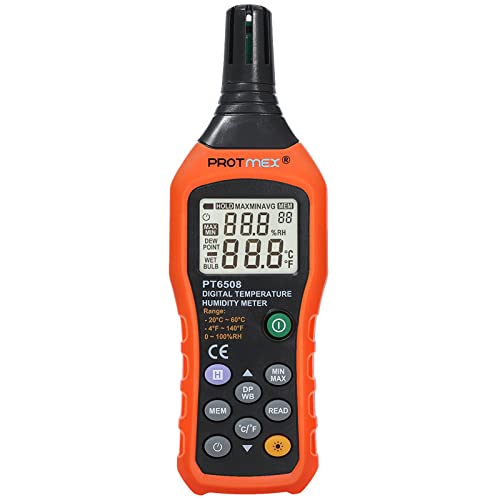
Protmex PT6508 Temperature Humidity Meter Review: One Instrument, Four Numbers
A single-product review of the Protmex PT6508, explaining what its four measurements mean in practice, where the design forces a compromise, and who should buy a different kind of instrument.
Read More→Bluetooth Logger or WiFi Logger for a Cellar: Which One Actually Works
This article explains how Bluetooth and WiFi data loggers differ in a cellar, what each can and cannot do, and how to pick the one that matches your building and your alarm requirements.
Read More→
Testo 510i Differential Pressure Manometer: A Single Product Review
A mechanism-first review of the Testo 510i differential pressure manometer, based only on the manufacturer listing.
Read More→