Best 4-Gas Detectors: 7 Rugged Picks for Reliable Workplace Monitoring
A four-gas monitor watches oxygen, carbon monoxide, hydrogen sulfide and combustibles at the same time, which is the standard combination for confined space entry. This hub compares seven of them plus two single-gas instruments for gases a quad does not cover, using only the figures the manufacturers publish.
As an Amazon Associate, Akermin earns from qualifying purchases. Product links on this page are affiliate links.
Our Top Picks
Seven four-gas monitors and two single-gas instruments, compared on the gases each one states, whether it samples by diffusion or by pump, what the listing says about calibration, and what it does not say. Calibration and bump testing are the responsibility of the owner, and no purchase removes that. We did not test these instruments.
Best Overall
Forensics Detectors 4 Gas Monitor, NIST Calibrated
The one listing here that states traceable calibration.
O2, CO, H2S and combustibles (LEL) on electrochemical sensors
USA NIST traceable calibration stated on the listing
Seven of these nine are four-gas instruments. The last two are single-gas monitors included because they cover gases a standard quad does not, and their Gases column says so plainly. All figures come from the manufacturer listings.
How to Choose a Workplace Gas Monitor
Four decisions, in this order:
Diffusion or Pump
A diffusion monitor reads the air around it and suits personal monitoring. A pumped monitor with a probe tests a space before entry from outside it. Confined space work needs the pump.
Calibration Traceability
Sensors drift. A stated NIST traceable calibration gives you a documented starting point. Only two listings here state one, and no purchase removes your duty to bump test and recalibrate.
The Right Four Gases
The standard quad is oxygen, carbon monoxide, hydrogen sulfide and combustibles. If the hazard is sulfur dioxide, chlorine or hydrogen, a quad will not see it and a single-gas instrument is the answer.
Sensor Life and Runtime
Electrochemical sensors are consumables with a finite life. Only the MSA listing states one, at four years. Ask for sensor life and shift runtime before standardizing a fleet.
Oxygen, carbon monoxide, hydrogen sulfide and combustible gas measured as a percentage of the lower explosive limit. That combination covers the common hazards of confined space entry: oxygen deficiency or enrichment, a toxic byproduct of combustion, a toxic byproduct of decay, and a flammable atmosphere.
What is the difference between a bump test and a calibration?
A bump test applies a known gas briefly to confirm the sensors and alarms respond at all, and is done before each use. A calibration adjusts the instrument against a certified concentration so the readings are accurate, and is done on a schedule. A bump test is not a substitute for calibration.
Do I need a pump for confined space entry?
For pre-entry testing, yes in practice. A pumped monitor with a probe lets you sample the atmosphere at several depths from outside the space, which is the whole point of testing before entry. A diffusion monitor is for the person once they are inside.
Why is oxygen on a gas monitor?
Because both directions are dangerous. Displacement by another gas, rust consuming oxygen in a steel vessel or decay in a sewer can drop the level below the safe range, and an enriched atmosphere makes ordinary materials burn far more readily. Oxygen is also the reading that tells you whether the combustible sensor can be trusted, since catalytic LEL sensors need oxygen to work.
How long do the sensors last?
Electrochemical sensors are consumables, typically rated in years by the manufacturer. Only the MSA listing on this page states a figure, four years expected. For every other instrument here the sensor life is not published, so ask the manufacturer before committing to a fleet.
Reviews
Forensics Detectors 4 Gas Monitor, NIST Calibrated Best Overall
Calibration is the thing that separates a gas monitor from a gadget, and this is the listing that addresses it. Forensics Detectors states high quality electrochemical sensors with USA NIST traceable calibration, covering oxygen, carbon monoxide, hydrogen sulfide and combustibles. Every instrument on this page drifts with age; only a documented calibration traceable to a standard gives you a defensible starting point for the drift.
In use it is a diffusion instrument, meaning it reads the air where the monitor is clipped. That is the correct behavior for personal monitoring, where the point is to know what the wearer is breathing, and it is why this unit is the right shape for a worker who spends a shift in an environment rather than testing one before entering it.
USB recharging is a practical detail on a tool that lives in a gang box. The listing states no runtime, no alarm set points, no sensor life and no ingress rating, so a safety officer writing a procedure will need the manufacturer datasheet for those.
Strengths
NIST traceable calibration stated
Standard four-gas combination
USB recharging
Straightforward personal monitor format
Limitations
No pump, so not a pre-entry sampling tool on its own
TopTes Guard-966 4 Gas Monitor with Pump Best for Confined Space Entry
Pre-entry testing is a different job from personal monitoring, and it needs a pump. The Guard-966 states continuous detection of CO, LEL, O2 and H2S through a built-in pump sampling system, with a 51 inch extension probe, which is the combination that lets you sample the bottom of a manhole or the inside of a tank from outside it.
That distinction is worth being blunt about. A diffusion monitor lowered on a rope reads the air around the sensor at the moment it is down there, and you cannot see the display. A pumped monitor with a probe stays in your hands while it pulls a sample from the depth you choose, so you can watch the reading settle and sample at several levels, which matters because heavier gases sit low and oxygen deficiency is often worst at the bottom.
The listing does not state calibration traceability, sensor life, alarm thresholds, runtime or how long the pump takes to draw through the full probe. That last figure matters in practice: allow the pump time to clear the tubing before reading, and ask the manufacturer for the stated draw time.
The Guard-156 is the entry point into four-gas monitoring, and it publishes one number the more expensive units do not: TopTes states that it responds within 0.5 seconds to the four key gases. Response time is a genuine safety specification, because a monitor that takes half a minute to react gives a worker half a minute of exposure before the alarm.
It is a diffusion instrument in a personal monitor shape, with triple alarm modes so it can signal by sound, light and vibration depending on the setting. That is the right specification for a noisy plant where a buzzer alone gets lost, and it is the pattern most safety programs expect from a clipped personal monitor.
The honest caveats are the same as the rest of this tier. No calibration traceability is stated, no sensor life, no runtime, no ingress rating. Buy it as a personal monitor and budget for bump testing with a known gas before each shift, which is the practice that actually keeps a cheap monitor trustworthy.
Short answer: the Forensics Detectors 4 Gas Monitor is the one to buy for personal monitoring, because its listing is the only diffusion unit here that states USA NIST traceable calibration. For confined space entry the TopTes Guard-966 is the pick, with a built-in pump and a 51 inch probe so a space can be sampled before anyone climbs into it, and the TopTes Guard-156 covers the same four gases at the lowest tier with a stated 0.5 second response.
Personal monitoring and pre-entry testing are different purchases
Almost every buying mistake in this category comes from treating one instrument as two. A diffusion monitor has no pump. It reads the air immediately around its sensors, which is exactly what you want clipped to a collar, because the number on the display is what the wearer is breathing. It is the wrong tool for testing a vault before entry, because getting the sensors to the bottom of the vault means getting the display down there too. A pumped monitor draws a sample up a length of tubing, so the instrument stays in your hands while the probe goes down. Three of the nine here state a pump: the two Forensics pump models and the TopTes Guard-966. If your work includes entry permits, the pump is not optional.
Calibration is the specification nobody wants to talk about
An electrochemical sensor produces a small current proportional to gas concentration, and that relationship changes as the sensor ages, as it is exposed to gas, and with temperature and humidity. That is why calibration exists, and it is why a monitor with no calibration history is a device that displays numbers rather than an instrument that measures. Two listings on this page address it: one states USA NIST traceable calibration and the other states that a certificate arrives with the unit. The rest say nothing. Buying one of those is not wrong, but it does mean you own the whole calibration problem from day one, and a bump test with a known gas before each shift is the minimum practice that keeps it honest.
The seven quads and the two that are not
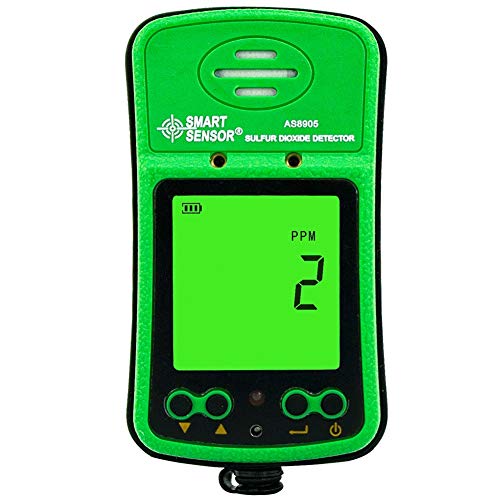
Seven rows in the table are genuine four-gas instruments covering oxygen, carbon monoxide, hydrogen sulfide and combustibles as a percentage of LEL. Two are not, and we have labeled them rather than quietly counting them as quads. The MSA ALTAIR 2X is a single-gas hydrogen sulfide monitor in a low concentration version, and it carries the only stated sensor life on the page, four years, along with a three-year instrument warranty. The SMART SENSOR unit reads sulfur dioxide only, 0 to 20 ppm at 1 ppm resolution. Both are here because a four-gas monitor is blind to any gas outside its four sensors, and workplaces with a specific hazard such as SO2 from combustion or chlorine in water treatment need a dedicated instrument. Our multi-gas detector guide works through matching sensors to hazards.
Reading LEL as a percentage, not as ppm
The combustible channel on a four-gas monitor does not report parts per million. It reports a percentage of the lower explosive limit, which is the concentration at which the gas will ignite. Methane reaches its LEL at about 5 percent by volume, so a display reading 10 percent LEL means about 0.5 percent methane in air. That convention exists because the number you care about in a flammable atmosphere is how close you are to ignition, not the absolute concentration. It also means a combustible reading of 10 percent is serious, while a ppm reading of a few hundred on a sniffer is not, and confusing the two is a common and dangerous mistake. Our ppm, LEL and volume explainer sets out the conversions.
What these listings do not tell you
Read the table across and the pattern is clear: gases are always stated, pumps are usually stated, and almost everything else is not. Alarm set points, sensor life, ingress rating, battery runtime, operating temperature range and the time a pump needs to draw a sample through a full probe are missing from most of these listings. For a personal purchase that is tolerable. For a safety program it is not, because a written procedure has to name the alarm thresholds and the calibration interval. Get the manufacturer datasheet before standardizing on any of them, and treat the table here as a shortlist rather than a specification.
Instruments were compared on the manufacturer listing text: gases named, sampling method, stated calibration, alarm behavior, probe length, stated response time and sensor life. Duplicate listings of the same instrument were collapsed, and single-gas instruments are labeled as such in the table rather than presented as four-gas monitors. We ran no tests and publish no measurements. Amazon data supplies images, availability and links only.
A WiFi natural gas alarm with an LCD showing gas concentration status and temperature, a stated response within 30 seconds, an alarm of at least 85 decibels and notifications to a phone app.
A rechargeable chlorine detector with an electrochemical sensor reading 0 to 50 ppm at 0.1 ppm resolution, a response time under 30 seconds, adjustable audible, visual and vibrating alarms and a supplied calibration certificate.
A clip on sulfur dioxide monitor built on an electrochemical sensor, reading 0 to 20 ppm in 0.1 ppm steps, with adjustable high and low alarms signalled by sound, flash and vibration and a rechargeable cell quoted at 8 to 9 hours.