As an Amazon Associate, Akermin earns from qualifying purchases. Product links on this page are affiliate links.
Choose a multi-gas detector with the standard four sensors (O₂, %LEL, CO, H₂S) unless a hazard assessment calls for others, intrinsic safety certification for the zones you enter (ATEX/IECEx or UL/CSA), alarm setpoints and TWA/STEL functions matching your jurisdiction, a battery that outlasts a shift, and datalogging. Decide between diffusion (worn) and pumped (pre-entry testing), catalytic or infrared LEL (infrared if silicone poisoning or low oxygen is a risk), and check the cost of sensors, calibration gas and a docking station over the instrument’s life; those exceed the purchase price.
Step 1: Sensors
| Sensor | Default? | When to add or change |
|---|---|---|
| Oxygen | Yes | Lead-free electrochemical for longer life |
| Combustible (%LEL) | Yes | Infrared instead of catalytic where silicones, lead or sulfur poison beads, or in inert atmospheres; catalytic for hydrogen |
| Carbon monoxide | Yes | Hydrogen-compensated version near battery charging |
| Hydrogen sulfide | Yes | Essential for sewers, wastewater, oil and gas |
| Sulfur dioxide, nitrogen dioxide | No | Diesel exhaust, combustion, some industry |
| Ammonia, chlorine | No | Refrigeration plants, water treatment |
| CO₂ (infrared) | No | Breweries, fermentation, CO₂ refrigeration, agriculture |
| VOC (PID) | No | Solvent and fuel vapor exposure |
See what a multi-gas detector is.
Step 2: Sampling
- Diffusion: worn in the breathing zone; lighter; longer battery; the standard for continuous personal monitoring.
- Pumped: draws a sample through a hose for pre-entry checks at depth or distance; add hose delay to response time. Many detectors accept a slip-on pump.
Step 3: Certification and environment
- Intrinsic safety rating for the hazardous area classification of the site.
- IP rating (IP65 or better) and drop rating for site use.
- Operating temperature range for cold or hot work.
Step 4: Alarms and records
- Low and high alarms per gas, TWA and STEL for toxic gases, configurable to local exposure limits.
- Sound (95 dB or more), bright lights, vibration.
- Datalogging with event and exposure records; download via docking station or app.
- Bump-test reminders and lockout on overdue calibration.
Step 5: Lifetime cost
Sensors are consumables: electrochemical cells 2 to 3 years, oxygen 1 to 3, catalytic LEL 3 to 5, infrared LEL 5 to 10. Calibration gas cylinders expire. A docking station automates daily bump tests, calibration, charging and records, and for a fleet it pays for itself in labor and compliance. Budget for these when comparing instruments. See sensor lifespan and bump tests and calibration.
Picks by application
| Application | Configuration |
|---|---|
| Confined-space entry (tanks, manholes, sewers) | 4-gas pumped for pre-entry plus diffusion units for entrants; H₂S essential |
| Construction and utilities | 4-gas diffusion; rugged; docking station for the fleet |
| Oil and gas | 4-gas with infrared LEL; ATEX/IECEx; often H₂S-focused |
| Wastewater | 4-gas with H₂S and CO; pumped for wet wells |
| Breweries, cold stores with CO₂ | Add infrared CO₂ sensor |
| HVAC and refrigeration plant rooms | O₂, CO, plus refrigerant-specific detectors; see gas detectors for HVAC work |
The units and setpoints are explained in understanding ppm, %LEL and %volume; a complete field kit in how to build a gas detection toolkit.
Recommended Tools
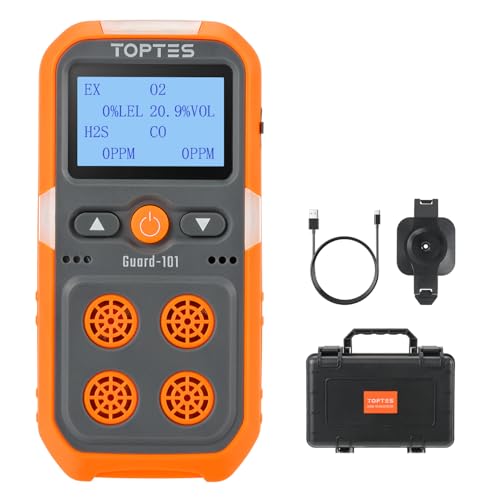


Products shown because their documented specifications fit this guide. Price and availability are on Amazon and can change.
Frequently Asked Questions
Which four gases does a standard multi-gas detector cover?
Oxygen, combustible gas (%LEL), carbon monoxide and hydrogen sulfide. That set addresses the most common confined-space hazards; other sensors are added for specific sites.
Do I need a pumped multi-gas detector?
For pre-entry testing of a space from outside, yes. For wearing during work, diffusion is lighter and cheaper. Many models take a slip-on pump.
What certification does a multi-gas detector need?
Intrinsic safety for the hazardous zone it will enter: ATEX and IECEx in Europe and internationally, UL or CSA in North America. The rating (zone, gas group, temperature class) is on the label.
Affiliate disclosure: Akermin earns a commission from qualifying Amazon purchases made through links on this page. Our editorial picks are based on documented specifications and owner feedback, not commissions.
Related Guides

WiFi Natural Gas Alarm Review: One Unit Reveals the Whole Design
A WiFi natural gas alarm with an LCD showing gas concentration status and temperature, a stated response within 30 seconds, an alarm of at least 85 decibels and notifications to a phone app.
Read More→
Forensics Detectors Cl2 Review: 5 Percent of Full Scale Is 2.5 ppm
A rechargeable chlorine detector with an electrochemical sensor reading 0 to 50 ppm at 0.1 ppm resolution, a response time under 30 seconds, adjustable audible, visual and vibrating alarms and a supplied calibration certificate.
Read More→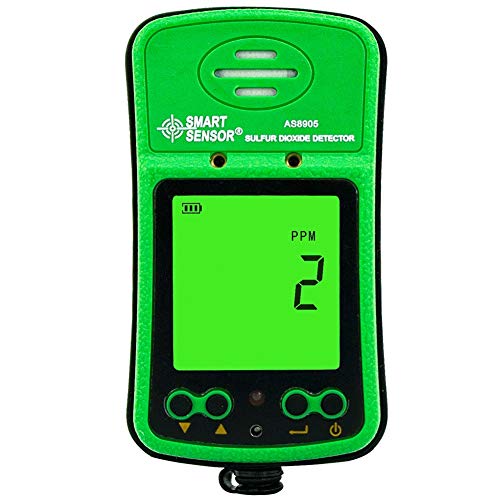
Smart Sensor SO2 Detector Review: 0.1 ppm Steps, No Accuracy Figure
A clip on sulfur dioxide monitor built on an electrochemical sensor, reading 0 to 20 ppm in 0.1 ppm steps, with adjustable high and low alarms signalled by sound, flash and vibration and a rechargeable cell quoted at 8 to 9 hours.
Read More→