As an Amazon Associate, Akermin earns from qualifying purchases. Product links on this page are affiliate links.
HVAC gas detection needs three or four instruments because the gases differ: an infrared refrigerant leak detector rated for the refrigerants you service (including A2L blends); a semiconductor combustible gas sniffer for natural gas and propane pipework; a personal CO monitor for any work around combustion appliances, with a combustion analyzer for flue gas on furnace and boiler service; and, for plant rooms, cold stores and confined spaces, an oxygen or multi-gas monitor. Choose each on its own merits; combination sniffers compromise all of them.
Gases and instruments
| Gas | Where | Instrument | Guide |
|---|---|---|---|
| HFC, HFO, A2L refrigerants | Split systems, heat pumps, chillers | Infrared refrigerant leak detector, A2L-rated | Refrigerant leak detectors |
| Hydrocarbon refrigerants (R-290, R-600a) | Domestic refrigeration, some heat pumps | Combustible sniffer or dedicated hydrocarbon detector | Combustible gas leak detectors |
| CO₂ (R-744) | Commercial refrigeration | Infrared CO₂ leak detector; fixed CO₂ monitors in plant rooms | |
| Ammonia (R-717) | Industrial refrigeration | Electrochemical ammonia detector | |
| Natural gas, propane | Furnace and boiler supply lines, rooftop units | Combustible gas sniffer | Natural gas detectors |
| Carbon monoxide (ambient) | Any combustion appliance service | Personal CO monitor; handheld CO meter | CO meters |
| Carbon monoxide (flue) | Combustion tuning and safety checks | Combustion analyzer | |
| Oxygen deficiency | Plant rooms with large refrigerant charges, cold stores, confined spaces | Oxygen or 4-gas monitor | Multi-gas detectors |
Kits by specialty
| Specialty | Carry |
|---|---|
| Residential AC and heat pumps | Infrared refrigerant detector (A2L-rated); bubble fluid; personal CO monitor if gas furnaces are on the route |
| Residential heating (gas) | Combustible sniffer; personal CO monitor; combustion analyzer; bubble fluid |
| Commercial HVAC | All of the above plus an oxygen or 4-gas monitor for plant rooms |
| Commercial refrigeration | Refrigerant detector for the refrigerants in use (HFC, CO₂, hydrocarbon, ammonia); oxygen monitor; fixed detection knowledge |
Standards and ratings to look for
- Refrigerant detectors: EN 14624; SAE J2791/J2913 for automotive; A2L rating and intrinsic safety where flammable refrigerants are serviced.
- Combustible sniffers: stated ppm sensitivity; intrinsic safety for professional use in hazardous areas.
- CO monitors: stated range, TWA/STEL, bump-test capability.
- Multi-gas: ATEX/IECEx or UL/CSA intrinsic safety.
Maintenance across the kit
Reference-leak check the refrigerant detector before each job (see testing a refrigerant leak detector); bump test CO and multi-gas monitors daily; replace sensors on schedule (see sensor lifespan). Keep tip filters clean and probes capped.
Using the readings
Refrigerant and combustible sniffers locate; their readings are at the fitting, not the room. CO and oxygen monitors protect the technician and the occupants; their readings are the room. Know which scale each shows; see understanding ppm, %LEL and %volume. A full field kit is described in how to build a gas detection toolkit for field technicians.
Recommended Tools


Products shown because their documented specifications fit this guide. Price and availability are on Amazon and can change.
Frequently Asked Questions
Can one detector find both refrigerant and natural gas leaks?
Combination semiconductor sniffers respond to both, with more false alarms and less sensitivity than dedicated instruments. Most technicians carry a dedicated refrigerant detector and a separate combustible sniffer.
Do HVAC technicians need a CO meter?
Anyone servicing gas furnaces, boilers or water heaters should carry a personal CO monitor at minimum and use a combustion analyzer for flue gas. Ambient CO readings during a service call are an important safety check.
What about A2L refrigerants?
Systems on R-32 and R-454B need a leak detector rated for A2L refrigerants and, in many jurisdictions, intrinsically safe equipment and specific procedures. Check your detector's A2L rating before servicing them.
Affiliate disclosure: Akermin earns a commission from qualifying Amazon purchases made through links on this page. Our editorial picks are based on documented specifications and owner feedback, not commissions.
Related Guides

WiFi Natural Gas Alarm Review: One Unit Reveals the Whole Design
A WiFi natural gas alarm with an LCD showing gas concentration status and temperature, a stated response within 30 seconds, an alarm of at least 85 decibels and notifications to a phone app.
Read More→
Forensics Detectors Cl2 Review: 5 Percent of Full Scale Is 2.5 ppm
A rechargeable chlorine detector with an electrochemical sensor reading 0 to 50 ppm at 0.1 ppm resolution, a response time under 30 seconds, adjustable audible, visual and vibrating alarms and a supplied calibration certificate.
Read More→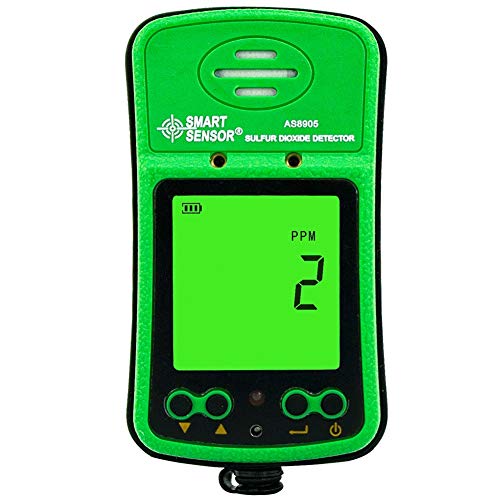
Smart Sensor SO2 Detector Review: 0.1 ppm Steps, No Accuracy Figure
A clip on sulfur dioxide monitor built on an electrochemical sensor, reading 0 to 20 ppm in 0.1 ppm steps, with adjustable high and low alarms signalled by sound, flash and vibration and a rechargeable cell quoted at 8 to 9 hours.
Read More→