As an Amazon Associate, Akermin earns from qualifying purchases. Product links on this page are affiliate links.
The three scales describe the same thing at different magnitudes. Parts per million counts molecules per million of air; %volume is the same fraction expressed as a percentage (1 %vol = 10,000 ppm); %LEL expresses concentration as a fraction of the lower explosive limit, which differs for each gas. To convert, you need the gas’s LEL: %LEL = (ppm ÷ LEL in ppm) × 100. Leak detectors read ppm because leaks are found at trace levels; safety monitors read %LEL because fire risk is what they judge; purge and process meters read %volume at high concentrations.
The conversions
- ppm ÷ 10,000 = %volume
- %volume × 10,000 = ppm
- %LEL = (ppm ÷ LEL_ppm) × 100 = (%vol ÷ LEL_%vol) × 100
- ppm = %LEL × LEL_ppm ÷ 100
Conversion table
| Gas | LEL (%vol) | LEL (ppm) | 10 %LEL | 20 %LEL | 50 %LEL |
|---|---|---|---|---|---|
| Methane | 5.0 | 50,000 | 5,000 ppm (0.5%) | 10,000 ppm (1%) | 25,000 ppm (2.5%) |
| Propane | 2.1 | 21,000 | 2,100 ppm | 4,200 ppm | 10,500 ppm |
| Butane | 1.8 | 18,000 | 1,800 ppm | 3,600 ppm | 9,000 ppm |
| Hydrogen | 4.0 | 40,000 | 4,000 ppm | 8,000 ppm | 20,000 ppm |
| Gasoline vapor | About 1.4 | About 14,000 | 1,400 ppm | 2,800 ppm | 7,000 ppm |
| Acetylene | 2.5 | 25,000 | 2,500 ppm | 5,000 ppm | 12,500 ppm |
| Ammonia | 15 | 150,000 | 15,000 ppm | 30,000 ppm | 75,000 ppm |
LEL values vary slightly between references; instruments use the value in their firmware.
Which instrument shows which
| Instrument | Scale | Reason |
|---|---|---|
| Leak sniffer | ppm or relative | Leaks are found at tens to hundreds of ppm at the fitting |
| Personal and area combustible monitor | %LEL | Explosion risk starts at 10 to 20 %LEL |
| Toxic gas monitor (CO, H₂S) | ppm | Exposure limits are in ppm |
| Oxygen sensor | %volume | Normal is 20.9 %vol; alarms at 19.5 and 23.5 |
| Purge and process monitor | %volume | Concentrations above the explosive range |
| Domestic gas alarm | Alarms at a fixed %LEL; no display | Certified setpoint |
Worked examples
- A sniffer reads 400 ppm at a propane fitting. That is 400 ÷ 21,000 = 1.9 %LEL at the fitting; a real leak, far from explosive at that point, but gas accumulates.
- A monitor reads 15 %LEL in a basement with natural gas. That is 7,500 ppm, 0.75 %vol; the high alarm is near; evacuate and ventilate.
- A methane-calibrated monitor reads 10 %LEL in propane. The true propane %LEL is higher, since the catalytic sensor responds less to propane; apply the correction factor (often 1.5 to 2) or calibrate to propane.
- A CO monitor reads 50 ppm. Flammability is irrelevant (LEL is 125,000 ppm); this is a toxic exposure reading against a 35 ppm 8-hour limit; act.
Mistakes the scales cause
- Reading a sniffer’s ppm as if it described the room; it describes the fitting.
- Assuming 100 %LEL is 100 percent gas; it is 5 percent gas for methane.
- Comparing %LEL readings across different gases without the correction factor.
- Treating a toxic gas as safe because it is far below its LEL.
Background in PPM vs %LEL in gas detection; instruments in how to choose a multi-gas detector and the gas detection category.
Recommended Tools
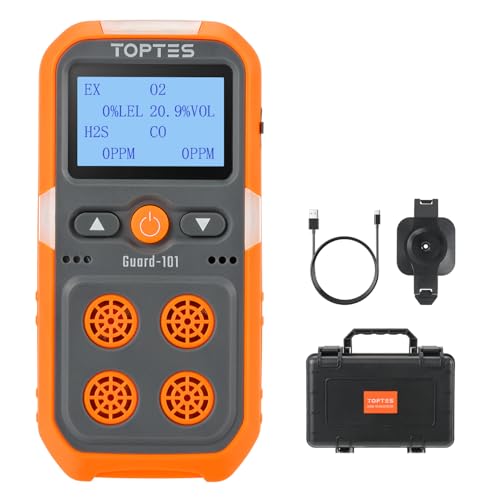

Products shown because their documented specifications fit this guide. Price and availability are on Amazon and can change.
Frequently Asked Questions
How do I convert %LEL to ppm?
Multiply the %LEL by the gas's LEL in ppm and divide by 100. For methane (LEL 50,000 ppm), 10 %LEL is 5,000 ppm. For propane (LEL 21,000 ppm), 10 %LEL is 2,100 ppm.
What is 1 %volume in ppm?
10,000 ppm. 100 %volume is 1,000,000 ppm. So 5 %volume methane is 50,000 ppm, which is methane's LEL.
Why do some gases have toxic limits far below their LEL?
Because toxicity and flammability are unrelated. Hydrogen sulfide is dangerous at 10 to 100 ppm and flammable at 40,000 ppm; carbon monoxide harms at 35 to 100 ppm and burns at 125,000 ppm. Toxic gases are monitored in ppm; flammable ones in %LEL.
Affiliate disclosure: Akermin earns a commission from qualifying Amazon purchases made through links on this page. Our editorial picks are based on documented specifications and owner feedback, not commissions.
Related Guides

WiFi Natural Gas Alarm Review: One Unit Reveals the Whole Design
A WiFi natural gas alarm with an LCD showing gas concentration status and temperature, a stated response within 30 seconds, an alarm of at least 85 decibels and notifications to a phone app.
Read More→
Forensics Detectors Cl2 Review: 5 Percent of Full Scale Is 2.5 ppm
A rechargeable chlorine detector with an electrochemical sensor reading 0 to 50 ppm at 0.1 ppm resolution, a response time under 30 seconds, adjustable audible, visual and vibrating alarms and a supplied calibration certificate.
Read More→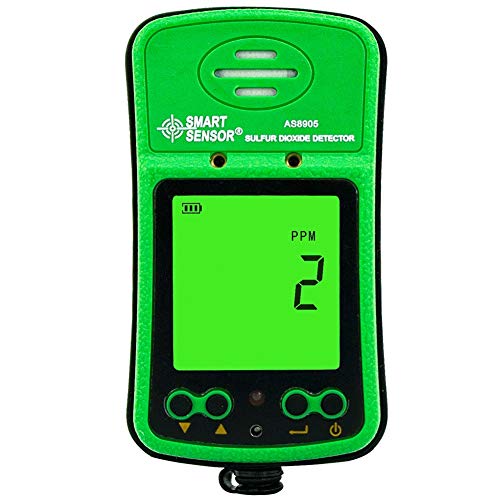
Smart Sensor SO2 Detector Review: 0.1 ppm Steps, No Accuracy Figure
A clip on sulfur dioxide monitor built on an electrochemical sensor, reading 0 to 20 ppm in 0.1 ppm steps, with adjustable high and low alarms signalled by sound, flash and vibration and a rechargeable cell quoted at 8 to 9 hours.
Read More→