As an Amazon Associate, Akermin earns from qualifying purchases. Product links on this page are affiliate links.
Parts per million (ppm) is a count: how many gas molecules per million molecules of air. Percent of lower explosive limit (%LEL) is a fraction of the concentration at which the gas can burn. Percent by volume (%vol) is the gas’s share of the air. For methane, whose LEL is 5 percent by volume: 5,000 ppm = 0.5 %vol = 10 %LEL. Leak detectors read in ppm because leaks are found at trace levels; safety monitors read in %LEL because fire risk is what they judge; %vol appears on instruments for high-concentration work such as purging.
The three scales
| Scale | Meaning | Used for | Typical instrument |
|---|---|---|---|
| ppm | Molecules per million | Trace detection, leak location, toxic gas exposure | Leak sniffers, CO meters, toxic gas monitors |
| %LEL | Percent of the lower explosive limit | Fire and explosion risk | Personal and area combustible monitors, confined-space meters |
| %vol | Percent of the air by volume | High concentrations, purging, oxygen | Thermal conductivity and infrared %vol sensors, oxygen sensors |
Converting
1 %vol = 10,000 ppm. %LEL = (concentration ÷ LEL) × 100. Each gas has its own LEL:
| Gas | LEL (%vol) | LEL (ppm) | 10 %LEL in ppm |
|---|---|---|---|
| Methane (natural gas) | 5.0 | 50,000 | 5,000 |
| Propane | 2.1 | 21,000 | 2,100 |
| Butane | 1.8 | 18,000 | 1,800 |
| Hydrogen | 4.0 | 40,000 | 4,000 |
| Gasoline vapor | About 1.4 | About 14,000 | About 1,400 |
| Acetylene | 2.5 | 25,000 | 2,500 |
A monitor calibrated to methane reading 10 %LEL in propane is not reading 10 %LEL of propane; correction factors apply, and a monitor should be calibrated to the gas it will meet.
Why the scales are hundreds apart
A leak detector that alarms at 50 ppm of methane is responding at 0.1 %LEL. That sensitivity is right for finding a pinhole at a fitting, where the gas is concentrated but the total amount is tiny. A room monitor that alarmed at 50 ppm would sound constantly in a kitchen with a gas hob. It alarms at 10 %LEL, a hundred times higher, because that is where the hazard begins. Using a leak detector to judge whether a room is safe, or a %LEL monitor to find a small leak, are both the wrong tool.
Toxic versus flammable
Some gases are dangerous long before they are flammable. Hydrogen sulfide is lethal at hundreds of ppm and flammable at 40,000 ppm. Carbon monoxide harms at 100 ppm and is flammable at 125,000 ppm. For those, the ppm scale and toxic exposure limits are what matter, which is why multi-gas monitors carry separate electrochemical sensors in ppm alongside the %LEL sensor. See what a multi-gas detector is.
Alarm setpoints
- Combustible: 10 %LEL low alarm, 20 %LEL high alarm are the common defaults.
- Domestic natural gas alarms: certified to sound below a fixed fraction of LEL, typically 10 to 20 percent.
- Leak detectors: adjustable sensitivity; no safety setpoint.
For how the sensors produce these readings, see what a combustible gas detector is. Instruments are in the gas detection category.
Recommended Tools
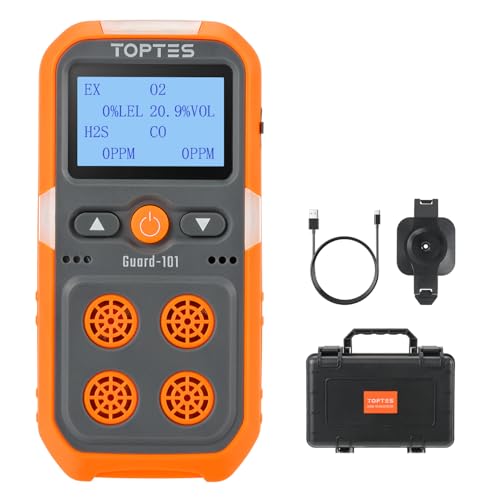

Products shown because their documented specifications fit this guide. Price and availability are on Amazon and can change.
Frequently Asked Questions
How do I convert ppm to %LEL?
Divide the ppm by the gas's LEL in ppm and multiply by 100. Methane LEL is 50,000 ppm, so 5,000 ppm is 10 %LEL. Propane LEL is 21,000 ppm, so 5,000 ppm is about 24 %LEL.
What %LEL is dangerous?
Alarms are commonly set at 10 %LEL (low) and 20 %LEL (high). Above 100 %LEL the mixture can ignite. Toxic effects of some gases begin far below the explosive range.
Why does my leak detector show ppm but my confined-space monitor shows %LEL?
Different purposes. The leak detector is tuned to find tiny leaks at the fitting; the monitor is tuned to judge whether a space is safe to enter. The two scales differ by a factor of hundreds.
Affiliate disclosure: Akermin earns a commission from qualifying Amazon purchases made through links on this page. Our editorial picks are based on documented specifications and owner feedback, not commissions.
Related Guides

Best Ultrasonic Leak Detectors for HVAC Technicians: 7 Picks
A comparison of seven ultrasonic leak detectors for HVAC technicians, covering frequency range, audio and visual output, and the jobs each one suits.
Read More→
Best Hydrocarbon Refrigerant Leak Detectors: 7 Picks for R290 and R600a
A comparison of seven refrigerant leak detectors whose listings state R290 or R600a coverage, with the sensor types, stated sensitivities and the halogen-only traps to avoid.
Read More→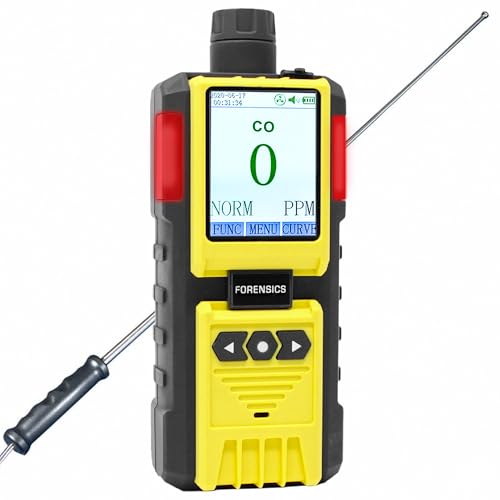
Best Carbon Monoxide Meters for Furnace Servicing: 6 Picks
Six CO meters for furnace servicing, compared on range, resolution, alarm thresholds, calibration data and logging, with the limits of each stated plainly.
Read More→