As an Amazon Associate, Akermin earns from qualifying purchases. Product links on this page are affiliate links.
A multi-gas detector is a portable instrument, usually worn on the chest or belt, that monitors several gases at once and alarms with sound, light and vibration when any exceeds a setpoint. The standard “4-gas” configuration is oxygen (too low or too high), combustible gas as %LEL, carbon monoxide and hydrogen sulfide. It is the required equipment for confined-space entry and common on construction, utility, wastewater and industrial sites. Additional sensors for other toxic gases, VOCs or CO₂ can be added on larger models.
The four sensors
| Gas | Sensor | Typical alarms | Why it is there |
|---|---|---|---|
| Oxygen (O₂) | Electrochemical (galvanic or lead-free) | Low 19.5 %vol; high 23.5 %vol | Displacement by other gases, rusting, combustion and biological processes remove oxygen; enrichment raises fire risk |
| Combustible (LEL) | Catalytic bead or infrared | 10 %LEL low; 20 %LEL high | Methane from decay, leaks of fuel gas, solvent vapors |
| Carbon monoxide (CO) | Electrochemical | 35 ppm low; 200 ppm high (varies by jurisdiction) | Engines, generators, welding, incomplete combustion |
| Hydrogen sulfide (H₂S) | Electrochemical | 10 ppm low; 15 ppm high | Sewers, sludge, decaying organics, oil and gas; lethal at low hundreds of ppm and deadens the sense of smell |
Alarm setpoints follow occupational exposure limits and vary by country; the detector also tracks time-weighted averages (TWA) and short-term exposure (STEL) for the toxic gases. See PPM vs %LEL.
Diffusion versus pumped
- Diffusion: gas reaches the sensors through a membrane. Lighter, cheaper, longer battery. For wearing during work.
- Pumped: an internal pump draws air through a hose to the sensors. Required for testing a space before entry from outside it, for sampling at depth, and for spaces with stagnant air. Many detectors accept a slip-on pump module.
Confined-space use
- Bump test the detector before the shift. See why gas detectors need bump tests.
- Pre-entry test: sample the space with a pumped detector at top, middle and bottom, since gases stratify. Wait for the readings to stabilize; a hose adds seconds per meter.
- Enter only if oxygen is in range and combustible and toxic readings are below the low alarms.
- Wear the detector in the breathing zone throughout, with continuous monitoring.
- Any alarm: leave. Investigate from outside.
- Log readings; many detectors store them for download.
Additional sensors
Five- and six-gas instruments add sensors chosen for the site: sulfur dioxide, nitrogen dioxide, chlorine, ammonia, hydrogen cyanide, CO₂ (infrared), or a photoionization detector for VOCs. Selecting them is a hazard-assessment decision; the 4-gas set is the baseline, not the ceiling.
Maintenance and life
Sensors are consumables. Electrochemical cells last two to three years; oxygen sensors one to three; catalytic LEL sensors three to five unless poisoned by silicones or sulfur. Docking stations bump test, calibrate, charge and keep records automatically, which for fleets is the practical way to stay compliant. See sensor lifespan and what can cause false gas detector readings. Detectors are in the gas detection category.
Recommended Tools
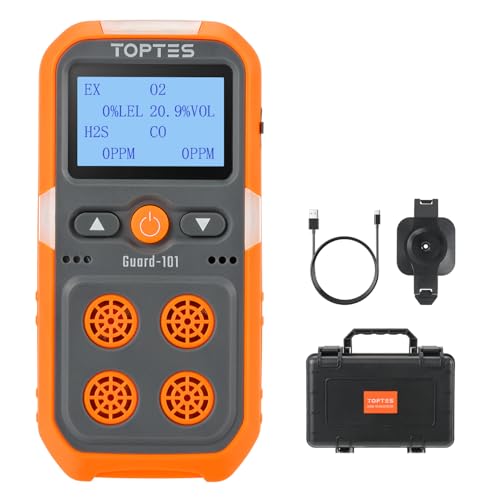

Products shown because their documented specifications fit this guide. Price and availability are on Amazon and can change.
Frequently Asked Questions
What are the four gases in a 4-gas detector?
Oxygen (O₂), combustible gases (%LEL), carbon monoxide (CO) and hydrogen sulfide (H₂S). Together they cover the most common confined-space hazards.
Do I need a pumped multi-gas detector?
For pre-entry testing of a space from outside, yes; the pump draws a sample through a hose. For wearing during work, a diffusion model is lighter and adequate.
How long do multi-gas detectors last?
The instrument lasts years; the sensors are consumables. Electrochemical CO and H₂S cells last 2 to 3 years, oxygen sensors 1 to 3 years, catalytic LEL sensors 3 to 5 years if not poisoned.
Affiliate disclosure: Akermin earns a commission from qualifying Amazon purchases made through links on this page. Our editorial picks are based on documented specifications and owner feedback, not commissions.