As an Amazon Associate, Akermin earns from qualifying purchases. Product links on this page are affiliate links.
A combustible gas detector senses flammable gases and vapors, such as methane, propane, butane, hydrogen and fuel vapors, and reports their concentration, usually as a percentage of the lower explosive limit (%LEL) or in parts per million. Handheld leak detectors (“sniffers”) have a flexible probe and a sensitive tick-rate or bar display for tracing a leak to its source; area monitors and multi-gas instruments watch a whole space and alarm at 10 to 20 percent LEL. Neither replaces a fixed gas alarm in a home with gas appliances.
What it measures
Every flammable gas has a lower explosive limit (LEL), the concentration in air below which it will not burn, and an upper limit above which the mixture is too rich. Methane’s LEL is about 5 percent by volume (50,000 ppm); propane’s about 2.1 percent. Detectors report against these limits: 10 percent LEL of methane is 0.5 percent by volume, or 5,000 ppm. Leak sniffers work far below that, down to tens of ppm, because a leak that is tiny at the fitting can accumulate elsewhere. See PPM vs %LEL in gas detection.
Sensor types
| Sensor | How it works | Strengths | Limits |
|---|---|---|---|
| Catalytic bead (pellistor) | Gas burns on a heated catalyst bead, raising its temperature and resistance | Responds to nearly all combustibles; the industrial standard for %LEL | Needs oxygen; poisoned by silicones, lead, sulfur; drifts; must be bump-tested |
| Semiconductor (metal oxide) | Gas changes the resistance of a heated tin-oxide film | Very sensitive at low ppm; cheap; the usual sniffer sensor | Non-specific; affected by humidity, alcohol, cleaners; not for accurate %LEL |
| Infrared (NDIR) | Hydrocarbon absorbs infrared at a set wavelength | No oxygen needed; immune to poisoning; stable | Does not detect hydrogen; costlier |
| Thermal conductivity | Gas changes the thermal conductivity of the sample | Works at high concentrations, %volume | Insensitive at low levels |
Sniffers versus monitors
- Leak sniffers (Klein ET120, TOPTES PT199, UEi CD100A) use semiconductor sensors on a gooseneck probe. They respond within seconds to a few ppm and increase their tick rate or bar graph as the probe nears the source. They locate; they do not quantify hazard.
- Personal and area monitors use catalytic or infrared sensors calibrated in %LEL, with alarms at fixed setpoints (typically 10 and 20 percent LEL). Multi-gas versions add oxygen, CO and hydrogen sulfide for confined-space work. See what a multi-gas detector is.
- Fixed domestic gas alarms are certified to a standard, mounted near appliances, and sound at a set fraction of LEL. They are the only appropriate protection for a home.
Using a leak detector
- Switch on in clean air and let it warm up and zero; semiconductor sensors take 30 to 60 seconds.
- Move the probe slowly along joints, fittings, valves and appliance connections, a centimeter or so from the surface. Gas is lighter (methane) or heavier (propane) than air; check above or below accordingly.
- Follow the increasing indication to the source; confirm with leak-detection fluid.
- Be aware of false responses: cleaning products, sealants, alcohol, exhaust and steam all trigger semiconductor sensors.
- If you smell gas strongly or the detector alarms in open air, leave and call the gas emergency line; do not switch anything electrical.
Maintenance
All combustible sensors drift and age. Catalytic sensors need regular bump tests against calibration gas; see why gas detectors need bump tests and calibration. Sensor lifespan is finite; see sensor lifespan. Detectors are covered in the gas detection category.
Recommended Tools

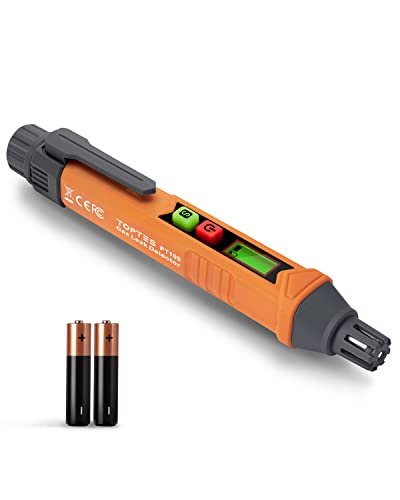

Products shown because their documented specifications fit this guide. Price and availability are on Amazon and can change.
Frequently Asked Questions
What gases does a combustible gas detector detect?
Methane (natural gas), propane, butane, hydrogen, gasoline vapor, alcohol vapor, acetylene and most other flammable hydrocarbons. Sensitivity differs by gas; detectors are calibrated to one reference gas.
Does it detect carbon monoxide?
Generally no, and a semiconductor sensor may respond weakly to CO without being reliable for it. CO needs an electrochemical sensor or a CO alarm.
What is the difference between a gas sniffer and a gas alarm?
A sniffer is a handheld with a probe, tuned for sensitivity to locate leaks. An alarm or monitor watches a space and sounds at a set percentage of the explosive limit.
Affiliate disclosure: Akermin earns a commission from qualifying Amazon purchases made through links on this page. Our editorial picks are based on documented specifications and owner feedback, not commissions.