As an Amazon Associate, Akermin earns from qualifying purchases. Product links on this page are affiliate links.
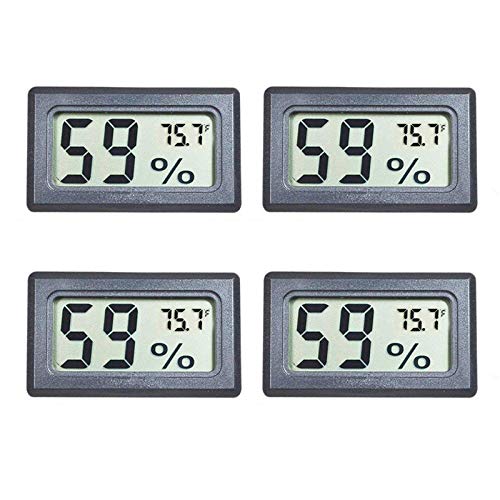
Veanic · 4-Pack Mini Indoor Temperature Humidity Meters Digital Gauge | Thermometer Hygrometer Fahrenheit (℉) Display for Reptile Tank,Jars,Guitar Case,Greenhouse, Garden, Cellar, Fridge, Closet
View on AmazonPrice and availability are shown on Amazon and can change at any time.
The Veanic 4-pack is a set of four miniature digital thermometer and hygrometer units with a stated temperature accuracy of plus or minus 2 degrees Fahrenheit and a stated humidity accuracy of plus or minus 5 percent RH. That humidity figure is the one that matters. It is honest for a small consumer sensor and it is fine for casual room comfort checks, but it is too loose for anything where a few percent RH changes the answer: verifying a dehumidifier’s setpoint, checking a coating or storage condition, or logging evidence. Buy it as a scatter of cheap readouts to put around a house or office. Do not buy it as a measurement instrument for a documented decision.
The accuracy figure that decides the job
Every humidity instrument has an error band, and the band is the single most useful number on the listing. Veanic publishes plus or minus 5 percent RH for humidity and plus or minus 2 degrees Fahrenheit for temperature. That means a reading of 50 percent RH could honestly be anywhere from 45 to 55 percent RH. The instrument is not lying; the uncertainty is simply that wide.
Whether that matters depends entirely on the question you are asking. If the question is “is this room roughly comfortable, or is it noticeably damp?” then a five point window is plenty. The gap between a dry winter room and a muggy summer basement is far wider than the error band. If the question is “has the dehumidifier brought the basement below a target?” or “is this storage area inside a contract limit?” then a five point window can straddle the answer, and you cannot tell which side you are on.
The temperature side is more forgiving in everyday use. Plus or minus 2 degrees Fahrenheit is a reasonable band for a room comfort check, though it is not a reference-grade temperature. The listing does not publish a resolution for either channel, so the smallest step the display shows is not stated in the listing bullets. A fine display step is not the same as accuracy, and it is worth remembering that a display showing tenths does not mean the sensor is good to a tenth.
What the miniature size and four-pack actually buy you
The units measure 1.89 by 1.13 by 0.6 inches, roughly 48 by 28 by 15 millimetres. That is small enough to sit on a shelf, a windowsill, or a desk without being noticed, and it is the reason these are sold in fours. You can place one in each room, one in a basement, one in a garage, and get a rough picture of how conditions differ across a building without moving a single instrument around.
That distributed placement is the real feature. Humidity varies sharply between rooms and between floors, and a single meter carried from place to place tells you about the moment you were there, not about the space over a day. Four fixed units left in place tell you more, even with a wide error band, because you are comparing several readings taken at once. The comparison is still only good to the stated accuracy, so treat differences of a few percent between two units as noise rather than as a real gradient.
The listing states the units measure conditions every 10 seconds. That is an update interval, not a logging interval. There is no memory, no export, and no timestamp in the published description. If you need a record of conditions over time, this is the wrong class of instrument, and a temperature and humidity data logger is the honest answer.
Range, display units and the probe wording
The published measuring range is minus 58 to 158 degrees Fahrenheit for temperature and 10 to 99 percent RH for humidity. That temperature span is wide, and it is wider than the sensor is accurate; the range tells you where the unit will display something, not where it is trustworthy. The humidity range stops short of the extremes at both ends, so very dry conditions below 10 percent RH and near-saturation above 99 percent RH are outside what the listing claims.
Temperature is shown in Fahrenheit only, per the listing. If your work is in Celsius you will be converting in your head, and that is a real annoyance for anyone comparing against a specification written in Celsius.
The listing calls it a “2-in-1 Meter with Built-in Probe.” Do not read “probe” as a remote or cabled sensor. Nothing in the published bullets describes an external probe, a cable, or a remote sensing element, so the sensible reading is that the sensing element is inside the case. That matters because it means the unit measures the air where the whole device sits, including any warmth from the display or from a nearby wall, and you cannot place the sensor somewhere the body cannot go.
Where this instrument stops being the right answer
A meter is not an alarm and not a logger. Nothing in the listing describes an audible alert, a threshold alarm, a phone connection, or stored history. If you need to know when humidity crosses a line while you are not looking, this cannot tell you. If you need to prove what the humidity was last Tuesday, it cannot tell you that either.
The accuracy band also rules it out of several professional uses. Coating and curing work often turns on dew point, and dew point is calculated from temperature and humidity, so the errors in both channels combine. A five percent RH band feeding a dew point calculation gives a spread wide enough to change a go or no-go decision. For that work, look at dew point meters for coating work, which are built around the tighter sensing that calculation needs.
Cold storage and building diagnostics have similar problems. A reading good to five percent RH cannot confirm that a cold room is holding a tight band, and it cannot support a report. If the job needs a defensible number, the instrument class changes, and the general guide to choosing a humidity meter for indoor use sets out how the classes differ.
Practical ownership: placement, drift and what is not published
Placement matters more than most buyers expect. Because the sensor sits inside the case, a unit pressed against a wall, sat on a windowsill in direct sun, or placed above a radiator will read the local microclimate rather than the room. Keep units a little away from surfaces, out of direct sun, and away from heat sources. Comparing one unit in sun with one in shade tells you about the sun, not the building.
Small resistive humidity sensors drift over time, and the listing publishes no calibration interval, no adjustment method, and no stated long-term stability. That is a real limitation: you cannot tell from the published data how far a unit has wandered after a season of use, and there is no described way to correct it. The practical response is to treat the four units as a relative set. If one starts reading noticeably differently from the others in the same room, that is your signal, not a calibration certificate. The listing also does not publish a battery type or a battery life figure, so plan on the assumption that these are consumable readouts rather than instruments you maintain.
For a wider view of what different monitor classes offer, the roundup of temperature and humidity monitors shows where a simple readout sits against instruments with logging, alarms, and tighter sensing.
Who the Veanic 4-pack is for, and who should walk away
Buy the Veanic 4-pack if you want several cheap, small readouts scattered around a home, office, or outbuilding to get a rough sense of temperature and humidity room by room, and you understand that each reading carries a plus or minus 5 percent RH band. Leave it on the shelf if your decision turns on a few percent RH, if you need a record over time, if you need an alarm, or if you need a number you can put in a report. In those cases the accuracy figure alone tells you this is the wrong instrument, and no amount of careful placement will fix it.
Recommended Tools


Products shown because their documented specifications fit this guide. Price and availability are on Amazon and can change.
Frequently Asked Questions
How accurate is the Veanic mini humidity meter?
The listing states plus or minus 5 percent RH for humidity and plus or minus 2 degrees Fahrenheit for temperature. A displayed 50 percent RH could honestly be anywhere from 45 to 55 percent RH. That is a normal band for a small consumer sensor, but it is too wide for tight process or documentation work.
Can I use it to check whether my dehumidifier is working?
Only loosely. A plus or minus 5 percent RH band can straddle a target setpoint, so you may not be able to tell whether the room is above or below the line. It is fine for confirming that a room feels noticeably drier than before, not for verifying a specific number.
Does it record or log readings over time?
No. The listing describes a live display only, measuring every 10 seconds, with no memory, timestamps, or export mentioned. If you need history, a data logger is the right class of instrument.
Does it have an alarm or alert?
Nothing in the listing describes an audible alert, threshold alarm, or connected notification. It is a readout, not an alarm. You have to look at it to know what it says.
Is the probe remote or built in?
The listing calls it a built-in probe, and no external probe, cable, or remote sensor is described. Treat the sensing element as inside the case, so the unit measures the air where the whole device sits, not a point you can place separately.
What about battery life and calibration?
Neither is published. The listing gives no battery type, no battery life figure, no calibration interval, and no adjustment method. Without a stated calibration route, treat the four units as a relative set and watch for one drifting away from the others in the same room.
Affiliate disclosure: Akermin earns a commission from qualifying Amazon purchases made through links on this page. Our editorial picks are based on documented specifications and owner feedback, not commissions.