Best Temperature and Humidity Monitors: 10 Reliable Picks for Precise Climate Tracking
Temperature and humidity monitors range from a gauge that costs less than lunch to a WiFi sensor that texts you when a server room warms up. The right one depends entirely on whether you need a glance, a calculated dew point or an unbroken record. This hub sorts ten current listings by what each manufacturer publishes and by the job each instrument is actually built for.
As an Amazon Associate, Akermin earns from qualifying purchases. Product links on this page are affiliate links.
Our Top Picks
Monitors were sorted by what each manufacturer listing states it measures, whether dew point or wet bulb is calculated, how the reading reaches you, and whether a record is kept. We did not run laboratory tests and publish no measurements of our own. Where a listing gives no figure the entry reads Not stated.
Best Overall
Temp Stick Remote WiFi Temperature and Humidity Sensor
A logging sensor that reports over WiFi with no subscription stated.
Listing states remote WiFi temperature and humidity monitoring
Described as 24/7 monitoring with a data logger
No subscription stated on the listing
Reports from anywhere rather than from the room you are in
Every figure here is taken from the manufacturer listing for that product at the time of research. Where a listing publishes no value the cell reads Not stated rather than an estimate. Nothing on this page is a measurement of ours.
How to Choose a Temperature and Humidity Monitor
Four questions settle the purchase:
Glance, Calculate or Record
A gauge answers what is it now. A psychrometer answers will it condense. A logger answers what happened while I was away. Buying the wrong one of the three is the usual mistake.
Dew Point Beats Relative Humidity
Seventy percent at five degrees and seventy percent at twenty five are different problems. The Extech RH300, the ALLOSUN and the Triplett MS475 all state a dew point or wet bulb figure.
How the Reading Reaches You
Local display, wireless outdoor sensor or internet reporting. Only the two Temp Stick listings state remote monitoring from anywhere, and they also state no subscription.
Accuracy Is Almost Never Published
No listing in this group states a humidity accuracy figure. Compare rooms against each other rather than against a target number, and confirm anything you plan to act on.
Why were the airflow hoods left out of this comparison?
Two of the products supplied with this topic are Testo 420 flow hoods. They do report temperature and humidity, but they are volume flow instruments for balancing ventilation, they are large and they are bought for a completely different job. A third, a solar powered panel thermometer for the inside of a car, reports temperature only and has no humidity channel at all, so it cannot belong on a temperature and humidity page.
What does a psychrometer do that a hygrometer does not?
It gives you the derived values. A hygrometer reports relative humidity and temperature; a psychrometer also reports dew point and wet bulb, which are the figures that tell you whether a surface will condense and how much drying capacity the air has. The Extech RH300 is the clearest example in this group.
How accurate are cheap humidity sensors?
No listing here publishes a figure, which is itself the answer. Small capacitive sensors in consumer gauges are commonly several percent out when new and drift further with age, dust and condensation. Use them comparatively: four gauges reading the same room should agree closely, and one that disagrees with the others is the one to distrust.
Should I put a sensor in the loft or on the ceiling?
Put it where the problem is, but keep it away from direct sun, heaters, vents and exterior walls, and get it into free air rather than against a surface. A sensor touching cold plaster reports the surface rather than the room, which will show high humidity for the wrong reason.
Do I need a full weather station?
Only if outdoor conditions are part of the question. Comparing indoor and outdoor humidity is the fastest way to decide whether opening a window will dry a room or make it damper, and the DreamSky and Sainlogic listings both cover indoor and outdoor. If everything you care about is inside, the money is better spent on logging.
Reviews
Temp Stick Remote WiFi Temperature and Humidity Sensor Best Overall
The problem with every gauge in a cupboard is that nobody is looking at it when the thing you were worried about happens. A frozen pipe, a failed dehumidifier, a greenhouse heater that tripped overnight, a holiday let that dropped below freezing in February: all of them are obvious on a graph the next morning and invisible on a display nobody read.
This listing states remote WiFi temperature and humidity monitoring with 24/7 coverage and data logging, and it makes a point of stating no subscription. That last detail is worth attention in a category where several competing products stop reporting when a payment lapses. A sensor that becomes useless without a monthly fee is a poor thing to leave in a second property.
The listing does not publish a sensor accuracy figure, a reporting interval, a battery life, a logging depth or the WiFi bands it supports. The last of those catches people out, because sensors of this type commonly need a 2.4 GHz network and will not join a 5 GHz only setup. Confirm the band, the alert method and the interval before relying on it to protect anything expensive.
Extech RH300 Digital Psychrometer Best for Dew Point
Relative humidity on its own is a poor guide to whether a surface will get wet, because the same seventy percent means something completely different at five degrees and at twenty five. Dew point is the number that matters, because it is the temperature at which the air in front of you will start condensing, and comparing it with the temperature of a wall or a pipe tells you immediately whether you have a condensation problem or a leak.
This listing states humidity, temperature, dew point and wet bulb, and describes the instrument as a psychrometer rather than a hygrometer. The distinction is real: a psychrometer is built to produce the derived psychrometric values, which is what building inspection, printing, painting, drying and HVAC commissioning actually need.
The listing does not publish accuracy figures for humidity or temperature, a response time, a measuring range or a logging capability. For a handheld used to make a judgement on site, response time is the one worth chasing, because a humidity sensor that takes several minutes to settle will give a confident wrong answer if you walk into a room and read it immediately. Let any instrument of this type stabilise before believing it.
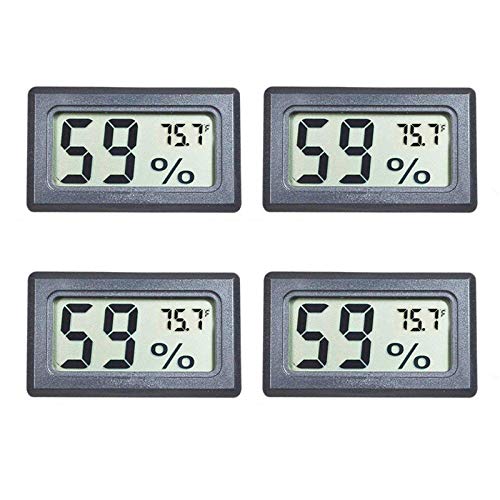
Veanic 4-Pack Mini Temperature and Humidity Gauges Best Value
Damp problems are comparative. A loft reading sixty five percent means nothing until you know the hallway is at forty five, and a cupboard that grows mould while the room beside it does not is telling you something specific about air movement. One expensive meter carried from room to room cannot show you that, because the readings are taken hours apart under different conditions.
Four cheap gauges left in four places for a week can. That is the argument for this pack, and it is a stronger argument than the price alone. The listing states simple at a glance temperature and humidity monitoring in a mini digital format, which is all these need to do.
The listing publishes no accuracy specification, no range, no resolution and no calibration method, and small capacitive humidity sensors in this class are commonly several percent out and drift over time. Use them to compare rooms against each other on the same day rather than against a target figure, and if one reading matters enough to act on, confirm it with an instrument that states its specification.
Short answer: the Temp Stick WiFi sensor is the best general buy because it states remote 24/7 monitoring with logging and no subscription, which is what protects a room nobody is standing in; the Extech RH300 is the one to carry when you need dew point and wet bulb rather than relative humidity; and the Veanic four pack is the value choice, because comparing four rooms at once beats carrying one better meter between them.
Three different jobs under one heading
The ten listings above split into three groups that rarely compete with each other. Gauges, which includes the Veanic pack and the wireless indoor and outdoor units, exist to be glanced at; they cost little and their value is coverage rather than precision. Handhelds, which includes the Extech RH300, the Protmex YT606, the ALLOSUN and the Triplett MS475, exist to be carried around a building and to produce the derived numbers that a judgement depends on. Loggers and reporting sensors, which here means the two Temp Stick listings, exist to watch a room when nobody is in it. Buying a glance when you needed a record is the most common and most expensive mistake in this category, because the failure only becomes obvious after the damage.
Relative humidity is the wrong number to act on
Relative humidity describes how close the air is to saturation at its current temperature, which means the same percentage describes wildly different amounts of water depending on how warm it is. Air at seventy percent and five degrees holds far less moisture than air at seventy percent and twenty five, and the practical consequence is that a loft at sixty percent in January may be a condensation risk while a kitchen at sixty percent in July is not. Dew point resolves it in one figure: if a surface is colder than the dew point, water will form on it. Four instruments here state a dew point or wet bulb reading, and for damp diagnosis that is the specification worth paying for. Calculating dew point from temperature and humidity covers the arithmetic if your meter does not do it.
Where the moisture meter fits
The Triplett MS475 is in the table because its listing states pin and pinless moisture measurement alongside psychrometric and infrared surface temperature functions, and that combination is exactly what damp investigation needs. Room humidity tells you about the air, a surface temperature reading tells you whether that surface is below dew point, and a moisture reading tells you whether the material itself is wet. One instrument that does all three saves swapping between two, and it means the three readings are taken at the same moment in the same place. For buildings work it is a more useful purchase than a better hygrometer. Our moisture and mould meter hub goes into that family properly.
Weather stations answer a different question
The DreamSky and Sainlogic entries report outdoor conditions as well as indoor, and the Sainlogic listing adds rain, wind speed and wind direction on a 6.5 inch colour display. That is not a more expensive room monitor, it is a different instrument. The reason it belongs here is ventilation: whether opening a window dries a room or wets it depends entirely on how the outdoor dew point compares with the indoor one, and without an outdoor sensor that comparison is guesswork. Anyone trying to dry out a building, run a greenhouse or decide when to ventilate a garage will get more from an indoor and outdoor pair than from a single more precise indoor gauge.
Nobody publishes an accuracy figure
It is worth stating plainly that not one of the ten listings in this group publishes a humidity accuracy specification, and that includes the instrument brands. Ranges, display sizes, sensor origins and feature counts are all given; the number that would let you trust a reading is not. The practical response is to treat every figure on this page as comparative. Put several sensors in one room and see whether they agree. Watch how a single sensor changes over a day rather than reading it once. Where a decision is going to cost money, such as a damp remediation or a stock storage condition, use an instrument with a published calibration and treat the consumer gauges as a screening layer. Choosing a temperature and humidity data logger covers the step up.
Listings were compared on the parameters stated, whether dew point or wet bulb is provided, the reporting method, logging and alerts, and what the listing left unstated. Owner feedback was reviewed for recurring reports of drifting humidity readings, sensors that lose their wireless link and units that fail early. We did not run laboratory tests, we publish no measurements of our own, and no figure appears on this page unless the manufacturer published it. Amazon data supplies images, availability and links only.
Resolution is the smallest change an instrument can show, accuracy is how close the shown value is to the truth, and because they are referenced to different things a published pair can differ by twenty five times or far more.
Gas alarm thresholds sit near the bottom of a span where a fixed error band in absolute units can be as large as the threshold itself, which is why a modest sounding percentage of full scale destroys the useful part of the scale.
Percent of full scale fixes an error band in absolute units across the whole span while percent of reading scales it with the display, and the difference decides whether a low reading means anything at all.