As an Amazon Associate, Akermin earns from qualifying purchases. Product links on this page are affiliate links.
A single-gas detector is the right tool when you already know which hazard you are walking into: hydrogen sulfide on a sour-gas lease, carbon monoxide on an HVAC or inspection call, oxygen in a cryogenic room. A multi-gas detector is the right tool when you do not, which is the definition of confined-space entry, where an oxygen deficiency, a combustible atmosphere and a toxic gas are all possible and any one of them can be fatal. Single-gas units are smaller, simpler and often maintenance-free for their working life; four-gas units cost more to own and maintain but cover the unknowns. The hazard assessment for the job, not preference, decides which you wear, and both need a bump test before each use and periodic calibration.
What a Single-Gas Detector Does
A single-gas monitor carries one sensor and one pair of alarm set points. The BW Clip H2S (model BWC2-H) is the archetype: a compact, one-button, single-gas unit whose listing states that high and low alarm set points are configured before activation, that it logs the 35 most recent gas events and bump test results, that it supports a hibernation mode with a case accessory or IntelliDoX dock, and that 50 detectors can be bumped in under three minutes on that dock. Its oxygen sibling, the BW Clip O2, ships with 19.5 percent low and 23.5 percent high set points and an automated self-test. The appeal is that there is nothing to configure day to day, and fleets of them can be bumped and tracked centrally.
A carbon monoxide meter belongs to the same family. The Sensorcon Inspector 2 reads CO from 1 to 1,999 ppm at 1 ppm resolution, alarms at 35 ppm low and 200 ppm high, responds in under 5 seconds with LED, 80 to 85 dB and vibration alerts, carries an IP67 rating and runs on a replaceable CR123A cell for 2 to 4 years. It is a single-gas instrument for people who need a CO number, and how to choose a carbon monoxide meter covers that category.
What a Multi-Gas Detector Does
A four-gas monitor carries an oxygen cell, a combustible gas sensor reading in percent LEL, and toxic cells for CO and H2S. The Honeywell BW Clip4 (BWC4-Y-N) covers O2, LEL, CO and H2S, and its listing states two years of continuous operation, an internal diagnostic test every 24 hours, logging of the 70 most recent events, and flashing red non-compliance indicators when the detector has not been bump tested on schedule. That last feature is the multi-gas world in one line: the instrument is only as good as its last bump test, and the tool itself nags you about it. What a multi-gas detector is and how to choose one cover the category in depth.
Side by Side
| Item | Single-gas detector | Multi-gas (four-gas) detector |
|---|---|---|
| Sensors | One (H2S, CO, O2 or another single gas) | Four: O2, LEL, CO, H2S is the standard set |
| Best use | A known, single hazard; fleet issue to every worker on a site | Confined-space entry; unknown or changing atmospheres |
| Example | BW Clip H2S: one-button, set points configured before activation, logs 35 events and bump results | BW Clip4: two-year continuous operation, daily self-diagnostic, logs 70 events, bump non-compliance indicator |
| Typical O2 set points | 19.5 percent low, 23.5 percent high (BW Clip O2) | Same |
| Bump test | Before each use | Before each use |
| Calibration | Periodic, per manufacturer schedule | Periodic, per manufacturer schedule |
| Size and weight | Smaller, lighter | Larger, heavier |
| Docking and fleet tools | IntelliDoX, MicroDock II, Fleet Manager II (BW Clip) | IntelliDoX compatible (BW Clip4) |
| What it cannot tell you | Anything about the other three hazards | Anything about gases outside its four sensors |
Where the Single-Gas Detector Wins
Known hazards. On a sour-gas lease every worker wears H2S because H2S is the hazard, and it is toxic at low ppm: its rotten-egg smell is noticeable at first and then fades as concentration rises, a form of olfactory fatigue that makes the nose useless exactly when the danger is greatest. A single-gas H2S clip is the right answer for that site, and the hydrogen sulfide detector roundup covers the current options.
Fleet simplicity. Configured before activation, one button, docked in batches. A safety manager can issue fifty and bump them all before the shift.
Trade work. A CO meter on an HVAC technician’s belt is a single-gas monitor that earns its place every day without the bulk of a four-gas.
Where the Multi-Gas Detector Wins
Confined spaces. Tanks, vaults, sewers, pits and trenches can be oxygen-deficient, contain a combustible atmosphere, or hold a toxic gas, and the entrant does not know which until the instrument says so. A four-gas monitor is the standard instrument for that entry, and it is worn for the duration, not just at the start.
Changing atmospheres. Plant work where a purge, a hot-work permit and a drain-down all happen in the same shift needs all four channels live at once.
Oxygen. A single-gas H2S or CO unit says nothing about oxygen. Below 19.5 percent a space is oxygen-deficient; above 23.5 percent it is enriched and fire risk climbs. The multi-gas detector roundup covers four-gas units built for this work, and the oxygen detector roundup covers dedicated O2 units for labs and cryogenic rooms where oxygen is the only question.
Who Should Buy Which
- Oilfield, sewer and wastewater crews: single-gas H2S for everyone on site, plus a four-gas for anyone entering a confined space.
- HVAC technicians and home inspectors: a single-gas CO meter.
- Confined-space entrants, rescue teams, plant operators: four-gas, bump tested before each entry.
- Labs, cryogenic storage and MRI rooms: single-gas O2.
The Rule That Applies to Both
Bump test before each use, calibrate on the manufacturer’s schedule, and treat a monitor that fails either as out of service. A bump test proves the sensor sees gas and the alarm fires; calibration proves the number is right. Single-gas clips make this easy with docking stations; four-gas units make it unavoidable with non-compliance warnings. Why gas detectors need bump tests and calibration explains what happens when either is skipped, and gas detector versus multi-gas detector covers the wider distinction between fixed leak alarms and personal monitors.
Recommended Tools

BW Technologies/Honeywell Analytics BWC2-H BW Clip Single-Gas Detector, Hydrogen Sulfide
View on Amazon

Products shown because their documented specifications fit this guide. Price and availability are on Amazon and can change.
Frequently Asked Questions
Is a single-gas H2S monitor enough for confined-space entry?
No. Confined-space entry requires knowing the oxygen level, the combustible gas level and the toxic gas levels, because any one of them can be the hazard. A four-gas monitor covering O2, LEL, CO and H2S is the standard instrument for that work. A single-gas unit is for a site where one hazard has already been identified.
Do single-gas monitors need bump tests too?
Yes. Every gas monitor, single or multi, needs a bump test before each use to prove the sensor and alarms respond, and periodic calibration to keep readings accurate. The BW Clip H2S listing specifically records bump test results, and the BW Clip4 flashes a non-compliance indicator when a bump test is overdue.
What are the standard oxygen alarm set points?
Commonly 19.5 percent for the low alarm and 23.5 percent for the high alarm. Below 19.5 percent the atmosphere is oxygen-deficient; above 23.5 percent it is oxygen-enriched and fire risk rises. The BW Clip O2 single-gas detector is sold with exactly those set points.
Why does a CO meter count as a single-gas detector?
Because it monitors one gas. The Sensorcon Inspector 2 reads CO from 1 to 1,999 ppm at 1 ppm resolution with alarms at 35 and 200 ppm, which makes it a single-gas instrument built for inspection and HVAC work rather than for confined-space entry.
Affiliate disclosure: Akermin earns a commission from qualifying Amazon purchases made through links on this page. Our editorial picks are based on documented specifications and owner feedback, not commissions.
Related Guides

WiFi Natural Gas Alarm Review: One Unit Reveals the Whole Design
A WiFi natural gas alarm with an LCD showing gas concentration status and temperature, a stated response within 30 seconds, an alarm of at least 85 decibels and notifications to a phone app.
Read More→
Forensics Detectors Cl2 Review: 5 Percent of Full Scale Is 2.5 ppm
A rechargeable chlorine detector with an electrochemical sensor reading 0 to 50 ppm at 0.1 ppm resolution, a response time under 30 seconds, adjustable audible, visual and vibrating alarms and a supplied calibration certificate.
Read More→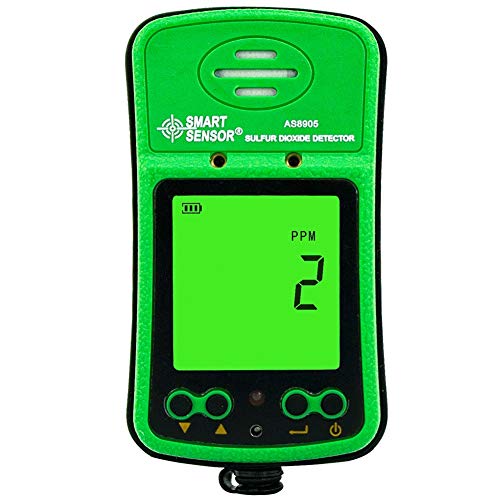
Smart Sensor SO2 Detector Review: 0.1 ppm Steps, No Accuracy Figure
A clip on sulfur dioxide monitor built on an electrochemical sensor, reading 0 to 20 ppm in 0.1 ppm steps, with adjustable high and low alarms signalled by sound, flash and vibration and a rechargeable cell quoted at 8 to 9 hours.
Read More→