Best Hydrogen Sulfide Detectors: Single-Gas H2S Monitors for Oilfield, Sewer and Plant Work
Hydrogen sulfide is toxic at low parts per million and it switches off your sense of smell before it reaches a dangerous level, which is why oilfield, wastewater and plant workers wear a dedicated H2S monitor. This guide compares the single-gas clips from manufacturer documentation and says when a four-gas unit is the better buy.
As an Amazon Associate, Akermin earns from qualifying purchases. Product links on this page are affiliate links.
Our Top Picks
Single-gas H2S monitors are personal instruments for workers exposed to sewer gas, sour gas and process leaks. They were compared on response, stated range, alarm modes, logging, battery model and calibration paperwork from manufacturer documentation and owner feedback. No laboratory testing was carried out. Every unit needs a bump test before each use and calibration on the manufacturer's schedule.
Best Overall
BW Technologies BWC2-H BW Clip H2S
Fleet-standard single-gas clip with locked set points and dock logging.
Single-gas H2S, compact, one-button operation
High and low alarm set points configured before activation
Logs the 35 most recent gas events and bump test results
Hibernation mode with case or IntelliDoX; bump 50 units in under three minutes
Manufacturer listing statements at the time of research. Where the listing gives no range or response figure, the manual must be consulted before the unit is issued.
How to Choose a Hydrogen Sulfide Detector
H2S monitors differ on four points:
Response Time
H2S concentrations change in seconds at a hatch or a manhole. A half-second response and a vibration alert give you the step back before the smell is gone.
Set Points: Locked or Adjustable
Fleet clips lock the thresholds before activation. Adjustable units suit a small crew but need a written policy so nobody raises them.
Paperwork
A calibration certificate in the box, a bump-test log and time-stamped alarms are what an auditor or an insurer asks for after an incident.
Single or Four-Gas
If the worker also enters confined spaces, a four-gas unit with H2S replaces the single-gas clip. If H2S is the only exposure, the clip is lighter and costs less.
Hydrogen sulfide paralyzes the sense of smell as the concentration rises. At low levels it smells strongly of rotten eggs; at higher levels the smell fades or disappears while the gas is still there and now dangerous. That olfactory fatigue is the reason a monitor is worn rather than a nose trusted.
What alarm levels should an H2S monitor be set to?
Use the low and high set points in your employer's or client's program, which follow the occupational exposure limits for your jurisdiction. The BW Clip has them configured before activation; the TopTes and Forensics units are user-adjustable, so record the values at commissioning and check them at each bump test.
Where on the body should the monitor be worn?
In the breathing zone, clipped to a collar, a shoulder strap or a chest pocket, not on a belt at waist height. H2S is heavier than air, so a monitor worn low will read higher than what you are breathing, and one worn in a pocket will not read at all.
Does an H2S monitor also detect sewer gas methane?
No. The electrochemical H2S cell responds to hydrogen sulfide only. Sewer gas is a mixture that also carries methane, which needs an LEL sensor, and a wet well can be short of oxygen as well. That combination is why sewer entry is normally done with a four-gas monitor rather than a single-gas clip.
Reviews
BW Technologies BWC2-H BW Clip H2S Best Overall
The BW Clip in its hydrogen sulfide version (BWC2-H) is the single-gas monitor that oilfield and utility crews are most likely to be handed, and the design is about fleet discipline rather than features. It is a compact one-button device; the high and low alarm set points are configured before activation, so a worker cannot change them in the field.
The manufacturer states automatic logging of the 35 most recent gas events and bump test results, a hibernation mode that pauses the unit when stored in the case accessory or in IntelliDoX, and bump testing of 50 detectors in under three minutes through that dock. It is compatible with IntelliDoX, MicroDock II and Fleet Manager II software.
The listing gives no range, resolution, battery life or alarm volume; those are on the Honeywell data sheet. For one worker buying one monitor, the TopTes or Forensics units below state more; for a fleet, this is the one the safety office will accept.
The Guard-633 is a clip-on H2S monitor built around response speed. TopTes states its sensor reports a hydrogen sulfide change within 0.5 seconds, which matters in the specific way H2S is dangerous: the concentration at a manhole lip or a tank hatch can go from nothing to lethal in the time it takes to lean in.
Alarms are LED, vibration and audible, thresholds are user-adjustable, and the unit logs data so a supervisor can review historical alerts. Battery is stated at up to 7 days of continuous operation from a 5-hour charge, with a real-time battery level and a low-battery alert. The shell is waterproof, dustproof and explosion-proof ABS, and calibration certificates and certification documents ship with the unit along with a standard gas hood for bump tests.
The listing does not state the measuring range or resolution. Treat it as a personal monitor to charge weekly, not a two-year clip.
Forensics Detectors' H2S monitor is the one to buy when a certificate matters and the budget does not stretch to a Honeywell. The manufacturer states a 0 to 100 ppm range at 0.1 ppm resolution, an electrochemical cell with accuracy within 5 percent of full scale and a response time under 30 seconds, and every unit arrives factory calibrated with a USA NIST calibration and QA certificate.
Alarms are adjustable audio, visual and vibration, and each alarm is logged with a digital time stamp, which is the record a contractor needs after a sewer entry. The housing is described as shock, water, dust and explosion proof, with a belt clip and USB recharging.
Against the Guard-633, the stated response is slower (under 30 seconds versus 0.5 seconds), and the listing gives no battery life. Against the BW Clip, it lacks the fleet docking. In between those two, for a small crew that keeps its own records, it is the sensible choice. One-year limited warranty.
Short answer: for a crew, the BW Clip BWC2-H is the standard single-gas H2S monitor: set points locked before activation, a 35-event log and dock-based bump testing. If you want the fastest stated response and a week of battery, the TopTes Guard-633 reacts in 0.5 seconds and ships with certificates and a gas hood. For a small crew that needs a stated range and a NIST certificate at the lowest cost, the Forensics H2S Monitor covers 0 to 100 ppm at 0.1 ppm resolution.
Why the nose is not a detector
Hydrogen sulfide is the gas of sewers, sour crude, manure pits, pulp mills and any tank where organic matter has rotted. It is toxic at low parts per million, and it has a particular trick: at low concentrations it smells of rotten eggs, and as the concentration climbs it deadens the olfactory nerve so the smell fades or vanishes while the gas is still present. Workers who have been overcome by H2S often report that the smell went away just before. A worn monitor with a loud alarm and a vibration alert is the only reliable warning, which is why every unit here is a clip-on instrument rather than a handheld sniffer.
Single-gas clip or four-gas monitor
If hydrogen sulfide is the only hazard, a single-gas clip is lighter, simpler and lower in cost than a four-gas unit, and it is what oilfield crews and tank-farm operators wear all day. If the same worker enters a manhole, a wet well or a tank, the atmosphere can also be short of oxygen or flammable, and the correct instrument is a four-gas monitor with an H2S channel; the Guard-101 and BW Clip4 in the table are there for that reason. The multi-gas detector guide compares the four-gas units in their own right.
Fleet clips versus rechargeable personal monitors
The BW Clip is designed around a docking station: the IntelliDoX bump tests a batch of units in minutes, stores the results, and the clip hibernates in its case between shifts. Its set points are fixed before activation, which is what a safety office wants, and its listing states nothing about range or battery life because Honeywell expects buyers to read the data sheet. The TopTes Guard-633 and the Forensics monitor are the other model: rechargeable over USB, thresholds adjustable by the user, logs read from the unit itself. They cost less and state more on the listing, but the discipline of charging and of not raising the alarm level rests with the crew. The two low-cost clips from DANOPLUS and HAOKESITE state a 0 to 100 ppm range and a buzzer with a red light but no response time, no power source and no certification, and belong in the drawer of someone who wants a second opinion, not on a worker entering a space.
Bump test, calibration and the certificate
An H2S sensor is an electrochemical cell that ages whether or not it sees gas. Before each shift the monitor is bump tested: a known concentration from a cylinder is applied through the hood, the reading must respond and the alarm must fire. Calibration, which adjusts the reading to match the cylinder, is done on the manufacturer’s schedule. The Forensics and TopTes units ship with a factory calibration certificate, which proves the state of the unit on the day it left the factory and nothing after that. Why gas detectors need bump tests and calibration covers the routine, and the calibration how-to in this cluster the procedure.
Reading the number
H2S monitors read in parts per million, and the alarm set points used by US programs are in the low tens of ppm, which is why a 0 to 100 ppm range at 0.1 ppm resolution is the normal specification. A four-gas unit’s LEL channel would not register hydrogen sulfide at any concentration a person could survive; the two scales measure different things, which PPM vs LEL in gas detection explains. Wear the monitor in the breathing zone, on a collar or chest strap, not on a belt.
When the alarm sounds
Move upwind and away from the source immediately, without stopping to read the display or to find the leak, and do not go back until the area has been ventilated and re-tested. If a co-worker has collapsed, the rescue belongs to the trained team with supplied-air breathing apparatus; a second person entering with the same monitor is the classic H2S double fatality. Related guides: oxygen gas detectors for the deficiency side of confined-space work.
How We Research
Monitors were compared on manufacturer documentation: stated range and resolution, response time, alarm modes and adjustability, logging, battery model, ingress and explosion-proof claims, calibration paperwork and warranty. Owner feedback was reviewed for false alarms and sensor drift. We did not run laboratory tests and publish no measurements of our own. Amazon data supplies images, availability and links only.
A WiFi natural gas alarm with an LCD showing gas concentration status and temperature, a stated response within 30 seconds, an alarm of at least 85 decibels and notifications to a phone app.
A rechargeable chlorine detector with an electrochemical sensor reading 0 to 50 ppm at 0.1 ppm resolution, a response time under 30 seconds, adjustable audible, visual and vibrating alarms and a supplied calibration certificate.
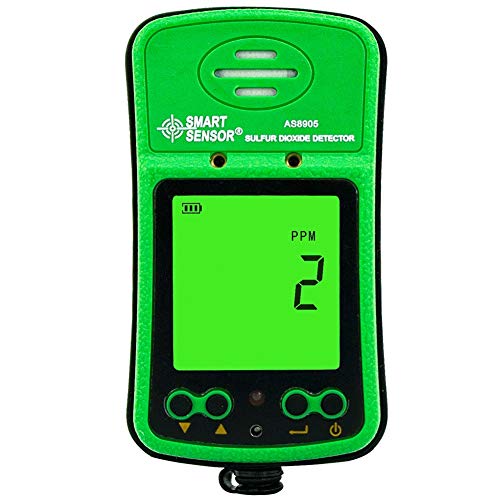
A clip on sulfur dioxide monitor built on an electrochemical sensor, reading 0 to 20 ppm in 0.1 ppm steps, with adjustable high and low alarms signalled by sound, flash and vibration and a rechargeable cell quoted at 8 to 9 hours.