
BW Technologies BWC2-X BW Clip O2
19.5 percent low and 23.5 percent high set points, automated self test, IP 66/67.
- Alarm set points 19.5% low and 23.5% high
- Automated self test
- LCD readout; single-gas clip design
- IP 66/67 ingress rating
Oxygen deficiency has no warning sign; a room purged with nitrogen or argon, or a cellar full of fermentation gas, feels normal until you collapse. These O2 monitors were compared from manufacturer documentation on set points, self test, range and resolution, certificates and battery, for confined-space crews, laboratories and rooms with cryogenic liquids.
19.5 Low
23.5 High
Know Both
As an Amazon Associate, Akermin earns from qualifying purchases. Product links on this page are affiliate links.
These are personal oxygen monitors for workers and lab staff. They were compared on alarm set points, self-test features, stated range and resolution, response, logging, battery and calibration paperwork from manufacturer documentation and owner feedback. No laboratory testing was carried out. Oxygen sensors are bump tested before use and calibrated in fresh air at 20.9 percent on the manufacturer's schedule.
19.5 percent low and 23.5 percent high set points, automated self test, IP 66/67.

0 to 30 percent at 0.1 percent, NIST certificate, time-stamped log.

Half-second response, 19.5 to 23.5 percent default window, 16-hour rechargeable battery.
No pick matches that combination yet. Try a wider budget or a different measurement.
| Product | Range / Resolution | Set Points | Alarms | Power | Notes | |
|---|---|---|---|---|---|---|
| BW Clip BWC2-X O2 | Not stated | 19.5% low / 23.5% high | LCD; automated self test | Not stated | IP 66/67; clip | View |
| Forensics Oxygen Detector | 0 to 30.0%, 0.1% | Adjustable | Audio, visual, vibration; time-stamped log | USB rechargeable | NIST certificate; response under 30 s; 1-year warranty | View |
| ZYKYCX Oxygen Detector | 0 to 30%, 0.1% | Default 19.5% to 23.5% | Sound, light, vibration | 2500 mAh, up to 16 hr, Type-C | 0.5 s response; 180 logs; temperature and humidity; 2-year sensor | View |
| TopTes Guard-101 (4-gas) | Not stated | Not stated | LED, vibration, sound; 0.5 s | Up to 14 hr | Adds H2S, CO and LEL | View |
| Forensics 4 Gas Meter | Not stated | Adjustable | Audio, visual, vibration | Not stated | Certificates; adds CO, H2S and LEL | View |
| Honeywell BW Clip4 (4-gas) | Not stated | Not stated | Not stated | 2-year continuous | Daily self test; 70-event log | View |
Manufacturer listing statements at the time of research. Fresh air reads 20.9 percent oxygen; any unit whose listing omits set points must have 19.5 and 23.5 percent (or your program's values) set and recorded before issue.
Oxygen monitors are simpler than four-gas units, but four things still separate them:
Look for 19.5 percent low and 23.5 percent high on the listing or set them yourself. A monitor with unknown thresholds is not a monitor.
An automated self test catches a dead cell. Fresh-air calibration at 20.9 percent is the routine check; a certificate covers only the day it was issued.
A fleet clip runs its stated period and is replaced. A rechargeable meter costs less but needs a charging routine.
A classified hazardous location needs a named certification. A lab, a cellar or a cryogenic store does not, and the budget units are fine there.
Normal air is 20.9 percent oxygen. US confined-space practice treats anything below 19.5 percent as oxygen-deficient and anything above 23.5 percent as oxygen-enriched, which raises fire risk. Those two figures are the set points on the BW Clip and the default window on the ZYKYCX, and the values to program into any unit that leaves them adjustable.
Liquid nitrogen, argon and helium boil off into gas that pushes air out of a poorly ventilated room; carbon dioxide from fermentation or dry ice does the same in a cellar. None of these gases has a smell, and the first symptom of low oxygen is impaired judgment, so a monitor worn or mounted in the room is the only warning.
In fresh air, away from exhaust and from the room being monitored, the unit is set to read 20.9 percent; the ZYKYCX listing describes its own menu sequence for this. A span check against a certified low-oxygen cylinder confirms the low alarm. Do it on the schedule in the manual and after any drop or exposure to solvent vapor.
Electrochemical oxygen cells are consumed by use, whether or not they ever alarm. ZYKYCX states a 2-year sensor life, TopTes states up to 5 years for the upgraded cell in the Guard-863Pro, and the BW Clip is replaced as a unit at the end of its service period. Replace on the date, not when it fails a bump test.
The BW Clip O2 (BWC2-X) is the oxygen monitor built for a safety program: the listing states the two set points that matter, a low alarm at 19.5 percent and a high alarm at 23.5 percent, which are the thresholds most confined-space programs in the US use for oxygen deficiency and enrichment. They are configured on the unit, so a worker cannot quietly widen them in the field.
The unit performs an automated self test, carries an LCD readout, and is rated IP 66/67 against dust and water, which covers a wet well or a rinse-down. Like the other BW Clips it is a compact single-gas device meant to be clipped on and left alone.
The listing gives no range, resolution, response time or battery life; those figures are on the Honeywell data sheet. For a fleet with a docking station, it is the default; for a lab with one cryogenic room, the two units below state more on their listings and cost less.
The Forensics oxygen detector is the pick when someone will ask to see the paperwork. It arrives factory calibrated with a USA NIST calibration and QA certificate, and the manufacturer states a 0 to 30.0 percent range at 0.1 percent resolution from an electrochemical cell with accuracy within 5 percent of full scale and a response time under 30 seconds.
Alarms are adjustable audio, visual and vibration, and each event is logged with a digital time stamp, so a lab manager can show when the nitrogen line in the cold room last pushed oxygen below the limit. Zero and span calibration options let a competent person re-check it against a known gas later.
The housing is described as shock, water, dust and explosion proof with a belt clip, and it recharges over USB. The listing does not state battery life or the factory alarm set points, so set 19.5 and 23.5 percent yourself at commissioning and record it. One-year limited warranty.
The ZYKYCX oxygen detector is the budget pick because its listing is unusually specific for the price class. The manufacturer states an electrochemical sensor with a 0.5-second response, a 0 to 30 percent range at 0.1 percent resolution and accuracy within 5 percent, and a triple alarm (sound, light, vibration) that triggers when oxygen leaves the default 19.5 to 23.5 percent window, the same set points the BW Clip uses.
The 2500 mAh battery is rated for up to 16 hours and charges over Type-C, the unit stores up to 180 alarm logs, and the 2.8-inch LCD shows the live reading, Max/Min values, temperature and humidity. It arrives factory calibrated with a stated 2-year sensor lifespan, and the listing describes the fresh-air recalibration procedure at 20.9 percent.
There is no third-party certification, no ingress rating and no explosion-proof claim in the listing, so it suits a lab, a brewery cellar or a storage room rather than a classified hazardous area.
Short answer: for confined-space work the BW Clip O2 is the fleet standard, with 19.5 percent low and 23.5 percent high set points stated on the listing, an automated self test and an IP 66/67 rating. If you need a stated range and a NIST calibration certificate, the Forensics Oxygen Detector reads 0 to 30 percent at 0.1 percent with a time-stamped log. For a lab, a cellar or a cryogenic store where certification is not required, the ZYKYCX O2 detector states the same default window, a half-second response and a 16-hour rechargeable battery at the lowest cost.
Every other gas on this site is dangerous because of what it adds to the air. Oxygen deficiency is dangerous because of what is missing, and nothing about a nitrogen-purged tank, an argon-flooded welding bay or a cellar full of fermentation carbon dioxide feels wrong until you are already impaired. Rust, rot and the curing of concrete consume oxygen in closed spaces; cryogenic liquids boil off and displace it; a leaking cylinder in a small room does the reverse and enriches the atmosphere so that clothing and hair burn. An oxygen sensor reads the percentage directly, and the two thresholds that matter, 19.5 and 23.5 percent, are the same on every program. Gas detector sensor types covers the electrochemical cell used in all of these units.
Fresh air is 20.9 percent oxygen. Below 19.5 percent an atmosphere is oxygen-deficient and entry is not permitted without ventilation or supplied air; above 23.5 percent it is oxygen-enriched and ordinary materials ignite easily. The Honeywell BW Clip O2 states those two values on its listing and holds them fixed; the ZYKYCX states them as its default window; the Forensics unit leaves them adjustable and does not state the factory values, so they are set and recorded at commissioning. A monitor with unknown set points is the most common failure we see in owner feedback, and it is a paperwork failure, not a sensor one.
An oxygen clip is the right tool where oxygen is the only hazard: a lab with cryogenic dewars, a cold store, a brewery cellar, a nitrogen-blanketed process room. For a manhole, a wet well or a tank, the same space can also be flammable or carry hydrogen sulfide and carbon monoxide, and the correct instrument is a four-gas monitor whose oxygen channel uses the same set points. The Guard-101, the Forensics 4 Gas Meter and the BW Clip4 in the table are there for that case; the multi-gas detector guide compares them properly and explains when one channel is enough.
A room with liquid nitrogen or argon needs the monitor where the person is, not on the far wall: worn on a collar during a fill, or placed at breathing height near the dewar during storage. The heavier-than-air cold vapor pools low first, so a monitor at floor level alarms early and one on a shelf alarms late. The ZYKYCX shows temperature and humidity beside the oxygen reading, which is useful in a cold room, and its 16-hour battery covers a working day. The Forensics unit’s time-stamped log gives the lab manager a record of every excursion, which is what an institutional safety office asks for.
An electrochemical oxygen cell is consumed by use: it reads oxygen by reacting with it, and it wears out whether or not it ever alarms. ZYKYCX states a 2-year sensor life, and the BW Clip family is replaced as a unit at the end of its service period. Calibration is done in fresh air, setting the reading to 20.9 percent, on the schedule in the manual and after any drop or exposure to solvent; a span check against a certified low-oxygen cylinder confirms the low alarm fires. The factory certificate that ships with the Forensics unit proves the state of the sensor on that day and nothing later. How to calibrate a gas detector covers the routine, and the bump-test explainer in the resources covers why the daily check is separate from calibration.
Leave the room or the space at once, by the way you came in, and do not go back until it has been ventilated and the reading confirmed from outside. Do not attempt to rescue anyone who has collapsed without supplied-air breathing apparatus; the atmosphere that dropped them will drop you in the same number of breaths. For the toxic-gas side of confined-space work see hydrogen sulfide detectors.
Monitors were compared on manufacturer documentation: alarm set points, self-test features, stated range, resolution and response, alarm modes, logging, battery, ingress and certification claims, calibration paperwork and warranty. Owner feedback was reviewed for sensor life and false alarms. We did not run laboratory tests and publish no measurements of our own. Amazon data supplies images, availability and links only.

A WiFi natural gas alarm with an LCD showing gas concentration status and temperature, a stated response within 30 seconds, an alarm of at least 85 decibels and notifications to a phone app.
Read Guide→
A rechargeable chlorine detector with an electrochemical sensor reading 0 to 50 ppm at 0.1 ppm resolution, a response time under 30 seconds, adjustable audible, visual and vibrating alarms and a supplied calibration certificate.
Read Guide→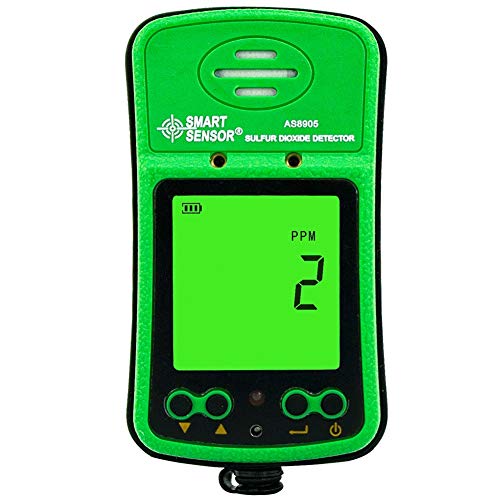
A clip on sulfur dioxide monitor built on an electrochemical sensor, reading 0 to 20 ppm in 0.1 ppm steps, with adjustable high and low alarms signalled by sound, flash and vibration and a rechargeable cell quoted at 8 to 9 hours.
Read Guide→