As an Amazon Associate, Akermin earns from qualifying purchases. Product links on this page are affiliate links.
Whether you can calibrate a gas detector depends entirely on which kind you own. A portable multi-gas monitor is designed to be calibrated by its user: you zero it in clean air, then flow a certified calibration gas of the concentration the manufacturer specifies through a hood over the sensors and let the instrument adjust its span. A handheld sniffer such as the Klein ET120 or the TopTes PT520A only zeroes itself at power-up; it has no user span adjustment and the manufacturer publishes no procedure for one. A plug-in or hardwired home gas alarm cannot be calibrated by the owner at all; you test it with its button, act on its end-of-life signal, and replace it on the manufacturer’s schedule. This article covers each case, and what to do when the answer is that you cannot.
Zero and Span: What Calibration Actually Is
Every gas sensor produces a signal that the instrument maps onto a scale. Calibration pins that map at two points: the zero tells the instrument what clean air looks like, the span what a known concentration looks like. Both drift as the sensor ages, so calibration is repeated on a schedule. A bump test is simpler: it exposes the sensor to gas only to confirm that the reading rises and the alarm sounds, with no adjustment made. The reasons both exist are laid out in why gas detectors need bump tests and calibration; this article is the how.
Calibrating a Multi-Gas Monitor
The exact steps are in the instrument’s manual and they override anything here, but the shape of the procedure is the same across brands.
- Start in clean air. Outdoors or in a room with no engines, solvents or gas appliances running. Switch on and let the warm-up finish.
- Zero. Use the instrument’s zero function so that each channel reads clean air as zero, and oxygen reads normal air. If a channel will not zero, stop; that is a fault, not something to calibrate through.
- Connect the gas. Fit the regulator the manufacturer specifies to the calibration cylinder, attach the tubing, and place the hood over the sensor ports. The TopTes Guard-101, for example, ships with a gas hood for this purpose; the listing does not name a gas mixture, so use the one its manual specifies.
- Enter calibration mode and flow gas. Open the regulator, let the readings climb and settle, and accept the calibration when the instrument indicates the readings are stable. It compares what it sees to the cylinder values and adjusts each channel’s span.
- Remove the gas and confirm recovery. Readings should return to zero in clean air within the time the manual gives. A channel that stays high or recovers slowly is ageing.
- Record it. Date, cylinder lot and expiry, result. Instruments with an alarm record, as the Guard-101 lists, help, but a written log is what an inspector asks for.
Two cautions. Calibration gas has an expiry date; an expired cylinder can be weaker than its label and will set the span so that the monitor under-reads. And a poisoned catalytic channel will not calibrate; if it refuses to reach span, the sensor is done, for the reasons in catalytic bead gas sensors explained. The instruments this applies to are covered in what is a multi-gas detector.
Handheld Sniffers: Zero Only
Consumer sniffers do half the job automatically and none of the other half. Klein describes the ET120 running an automatic zero-point calibration at power-up with flashing LEDs, and the ET190 a 30 second auto-zero; TopTes specifies a 30 second warm-up in clean air for the PT199 and PT520A. In each case the unit takes the air it started in as zero. None of these listings describes a span adjustment, a calibration port or a service procedure, and this article does not invent one. What you can do:
- Always power up in clean air, away from the suspected leak, so the zero is a real zero.
- Run a response check before you rely on it, using a safe source in the way the manufacturer allows; how to test a gas leak detector describes the method.
- Note how many bars a familiar test source lights when the unit is new. When the same source lights fewer, sensitivity has fallen and there is no adjustment to bring it back; the unit is due for replacement.
The physics behind that decline, and why zeroing cannot fix it, are explained in semiconductor gas sensors explained.
Home Alarms: Test, Do Not Calibrate
A plug-in or hardwired combustible gas alarm has no user calibration. The test button checks the circuit, the horn and, on some units, the sensor’s electrical continuity; it does not expose the sensor to gas or confirm its setpoint. Manufacturers differ on whether any gas source may be used to check the unit, and some forbid it, so follow the instructions for your model rather than a general rule. The alarm’s defense against drift is a fixed service life: it is designed to reach the end of that life and signal it, at which point you replace it. How often to press the button is covered in how often should you test a gas detector.
Who Can Do What
| Device | Zero | Span | Done by |
|---|---|---|---|
| Multi-gas monitor | User, in clean air | User, with certified gas and hood | Owner or service center, on the manufacturer’s interval |
| Handheld sniffer | Automatic at power-up | None published | Nobody; replace when response falls |
| Plug-in, hardwired or RV 12-volt alarm | None | None | Nobody; test button, end-of-life signal, replace on schedule |
When You Cannot Calibrate
The signs that a sensor is past correcting are the same across types: it will not zero in clean air, it will not reach span on fresh gas, it recovers slowly or not at all, it responds to a known source far more weakly than it once did, or the manufacturer’s stated sensor life has passed. In each case the fix is a new sensor or a new unit, not another attempt. Sniffers such as the RIDGID CD-100 micro with a field-replaceable sensor make that a smaller job; most consumer sniffers and every plug-in alarm are replaced whole. The fixed alarms are compared in the combustible gas detector roundup and the whole category in the gas leak detector guide.
Calibration Is Not the Safety Procedure
A freshly calibrated monitor tells you the truth about the air. It does not change what the truth requires. If an alarm sounds, or if you smell gas at home, leave, avoid switches and phones until outside, and call the gas utility or 911. Calibrate afterward, once the space is cleared, not as a way to check whether the alarm was right.
Recommended Tools
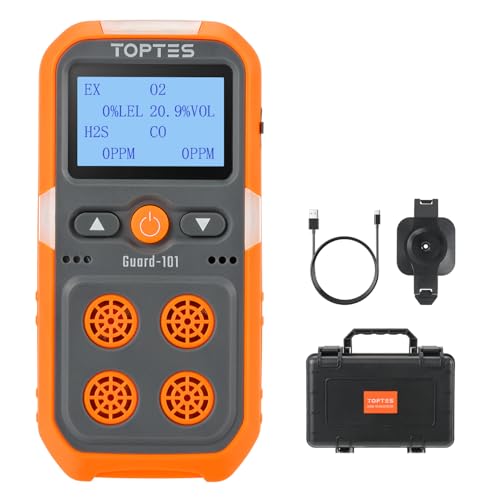


Products shown because their documented specifications fit this guide. Price and availability are on Amazon and can change.
Frequently Asked Questions
Can I calibrate a gas detector with a lighter or a gas stove?
No. Calibration requires a known concentration, and gas from a lighter or an unlit burner is an unknown, uncontrolled amount. At most, and only if the manufacturer permits it, such a source can serve as a rough response check to confirm the unit still reacts. It cannot set a span.
What calibration gas do I need for a four-gas monitor?
The mixture the manufacturer specifies for that model, which is usually a single cylinder blended with the combustible, CO, hydrogen sulfide and oxygen concentrations the instrument expects. Use it with the matching regulator and hood, check the cylinder expiry date, and never substitute a different mix because the numbers happen to be similar.
Does the auto-zero on a sniffer count as calibration?
No. Auto-zero sets the baseline to whatever air the unit was switched on in; it does nothing about span, meaning how far the reading rises for a given amount of gas. It is one half of calibration at best, and it is only useful if the air at power-up was actually clean.
How do I know a home gas alarm is out of calibration?
You cannot measure it, because the unit gives you no adjustment and usually no reading to compare. What you can do is press the test button on the schedule the instructions give, respond to the end-of-life signal, and replace the unit at the interval the manufacturer states, whether or not it still seems fine.
Affiliate disclosure: Akermin earns a commission from qualifying Amazon purchases made through links on this page. Our editorial picks are based on documented specifications and owner feedback, not commissions.
Related Guides

WiFi Natural Gas Alarm Review: One Unit Reveals the Whole Design
A WiFi natural gas alarm with an LCD showing gas concentration status and temperature, a stated response within 30 seconds, an alarm of at least 85 decibels and notifications to a phone app.
Read More→
Forensics Detectors Cl2 Review: 5 Percent of Full Scale Is 2.5 ppm
A rechargeable chlorine detector with an electrochemical sensor reading 0 to 50 ppm at 0.1 ppm resolution, a response time under 30 seconds, adjustable audible, visual and vibrating alarms and a supplied calibration certificate.
Read More→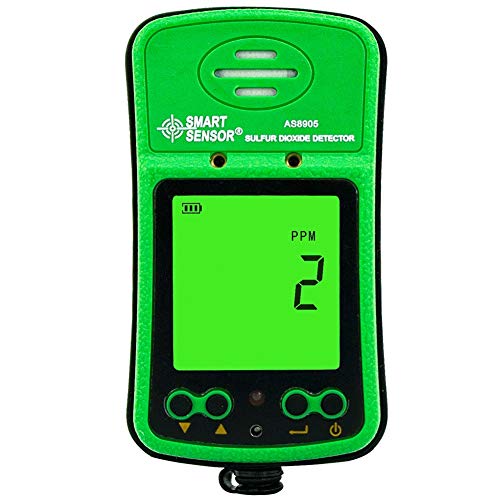
Smart Sensor SO2 Detector Review: 0.1 ppm Steps, No Accuracy Figure
A clip on sulfur dioxide monitor built on an electrochemical sensor, reading 0 to 20 ppm in 0.1 ppm steps, with adjustable high and low alarms signalled by sound, flash and vibration and a rechargeable cell quoted at 8 to 9 hours.
Read More→