As an Amazon Associate, Akermin earns from qualifying purchases. Product links on this page are affiliate links.
A semiconductor gas sensor, usually called a MOS sensor for metal-oxide semiconductor, detects a leak by resistance. Inside it is a tiny element of tin oxide sitting on a heater. In clean air the hot surface holds a layer of adsorbed oxygen that keeps the element’s electrical resistance high. When a reducing gas such as methane, propane or butane reaches the surface, it reacts with that oxygen, frees electrons in the tin oxide, and the resistance falls. The circuit reads the drop and turns it into LEDs, bars, a ppm figure or an alarm. This is the sensor inside most pocket sniffers and plug-in home gas alarms, and almost everything those products ask of you, the warm-up, the auto-zero in clean air, the odd chirp at hairspray, comes straight from how it works.
What Happens on the Surface
The heater is the key part. Tin oxide only behaves this way when it is hot, so the element is kept at its working temperature continuously while the detector is on. At that temperature, oxygen from the air sits on the surface and traps electrons, leaving the element with high resistance. A reducing gas consumes some of that surface oxygen, the trapped electrons are released, and resistance drops in proportion to how much gas is present. Remove the gas and oxygen re-adsorbs, so the resistance climbs back. That recovery takes a little time, which is why a sniffer keeps reading for a moment after you pull the probe away and why a slow sweep works better than a fast one. The general overview of the four sensor families is in gas detector sensor types; this article stays inside the semiconductor one.
Why There Is a Warm-Up
A cold element gives meaningless readings. The heater needs time to reach temperature and the surface needs time to load up with oxygen and settle to a stable baseline. Manufacturers build that wait into the product. TopTes specifies a 30 second warm-up in clean air for the PT199 and the PT520A, with a countdown on the screen of its display models; Klein describes the ET120 flashing its LEDs through an automatic zero-point calibration at power-up and the ET190 running a 30 second auto-zero. Neither listing names the sensor technology, so treat the link between that behavior and a heated semiconductor element as a well-founded inference rather than a stated fact. Plug-in alarms do the same thing after they are first powered; the Orabal 4-in-1 listing describes monitoring starting after a brief warm-up.
Auto-Zero Is Not Calibration
At the end of the warm-up, most sniffers take whatever the element reads as clean air and call it zero. That is convenient, but it has a consequence: if you switch the unit on in a room that already has gas in it, the baseline includes that gas and the sniffer under-reports until you move to cleaner air and restart. Always power up away from the suspected leak. Zeroing also says nothing about span, meaning how much the reading rises for a given concentration. That drifts as the element ages, and a consumer sniffer gives you no way to correct it; the options are covered in how to calibrate a gas detector and when you cannot.
What Else It Responds To
The surface chemistry does not care which reducing gas it sees. Alcohol vapor, acetone, paint solvents, aerosol propellants, hydrogen, the propellant in cooking spray and the fumes from a fresh solder joint all lower the resistance. That makes a MOS sniffer an excellent general leak finder and an occasionally frustrating one; the same broad response that finds a butane leak also reacts to hand sanitizer. Plug-in alarms in kitchens have the same issue with cooking wine and cleaning sprays. The list of usual suspects is in what can cause false gas detector readings. Two habits limit the problem: ventilate before sweeping, and treat a response as real only when it repeats at the same fitting after the air has cleared.
Temperature, Humidity and Ageing
Because the reading is a resistance on a hot surface, anything that changes the surface changes the reading. Cold ambient air pulls heat from the element; humid air adsorbs onto it alongside the oxygen. The effect is a baseline that wanders with the weather, which is one reason several plug-in monitors, the Orabal 4-in-1 and the Adorelf among them, display temperature and humidity next to the gas figure, and why instructions specify an operating range. Over months and years the element itself changes: the surface slowly loses sensitivity, and the heater eventually fails. That is the physical basis of the replacement dates printed on home alarms, explained in why gas detectors do not last forever.
Strengths and Limits
| Strength | Limit |
|---|---|
| Responds to low ppm concentrations, so it finds small leaks at a fitting | Output is not linear, so it measures poorly across a wide range |
| Small, rugged, low current; fits in a pen-sized housing | Needs a heater, so battery sniffers wait to warm up and auto-off to save power |
| Broad response finds any combustible leak | Broad response also chirps at solvents, alcohol and aerosols |
| Long history in consumer alarms and sniffers | Baseline drifts with temperature and humidity; no user span adjustment |
| Needs only ordinary room air | Not suited to oxygen-free or inerted spaces |
Where MOS Sensors Are the Right Choice
For locating a leak at a connector, a MOS sniffer is hard to beat: simple to build, fast to respond and sensitive enough that ranges down to about 50 ppm of methane are common on consumer listings. For continuous monitoring of a kitchen or utility room, a MOS plug-in alarm does the job as long as it is placed away from the stove and the cleaning cupboard. Where semiconductor sensors give way is industrial LEL measurement, where a catalytic bead sensor gives a more linear percent LEL, and oxygen-free or long-unattended installations, where an infrared detector is preferred. Consumer models built around this sensor are compared in the handheld gas leak detector roundup and the wider gas leak detector guide.
The Rule the Sensor Does Not Change
A MOS sensor is good at telling you a fitting is leaking in a room that is otherwise safe to stand in. It is not a reason to stay in a room that smells strongly of gas. In that case leave, keep your hands off switches and phones until you are outside, and call the gas utility or 911; the sniffer comes out afterward.
Recommended Tools

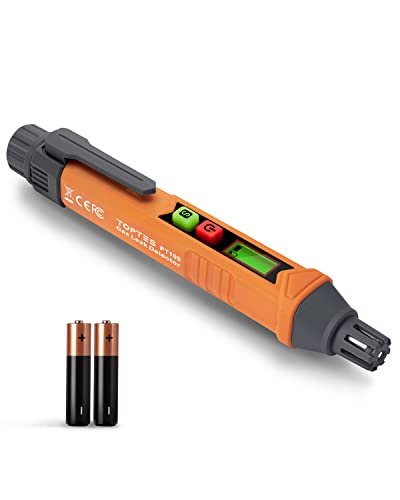

Products shown because their documented specifications fit this guide. Price and availability are on Amazon and can change.
Frequently Asked Questions
Why does a semiconductor gas sniffer beep at hand sanitizer?
Because the tin-oxide surface reacts with reducing gases in general, and alcohol vapor is one. The sensor cannot tell ethanol from methane; both lower its resistance. Move the probe away, let the reading fall, and sweep again once the sanitizer has evaporated.
Does a MOS sensor need oxygen to work?
Yes, in the sense that its resting state depends on oxygen adsorbed onto the heated surface, and the drop in resistance comes from gas reacting with that oxygen. Ordinary room air is all it needs; it is not a sensor for oxygen-free or inerted spaces, which is one reason industrial monitors use other technologies there.
Can a semiconductor sensor read percent LEL accurately?
It can be scaled to display percent LEL, as the TopTes PT210S and PT760 do, but its output is not linear across the range and depends on which gas is present. Treat a MOS percent LEL figure as a useful indication of severity for locating a leak, not as a measurement you would use to declare a space safe.
Why does a plug-in gas alarm tell you to wait after plugging it in?
The heater inside the sensor has to bring the element to its working temperature and let the surface settle before the reading means anything. Until then the resistance is still changing, and an alarm that took a reading immediately would be as likely to false alarm as to miss gas.
Affiliate disclosure: Akermin earns a commission from qualifying Amazon purchases made through links on this page. Our editorial picks are based on documented specifications and owner feedback, not commissions.
Related Guides

WiFi Natural Gas Alarm Review: One Unit Reveals the Whole Design
A WiFi natural gas alarm with an LCD showing gas concentration status and temperature, a stated response within 30 seconds, an alarm of at least 85 decibels and notifications to a phone app.
Read More→
Forensics Detectors Cl2 Review: 5 Percent of Full Scale Is 2.5 ppm
A rechargeable chlorine detector with an electrochemical sensor reading 0 to 50 ppm at 0.1 ppm resolution, a response time under 30 seconds, adjustable audible, visual and vibrating alarms and a supplied calibration certificate.
Read More→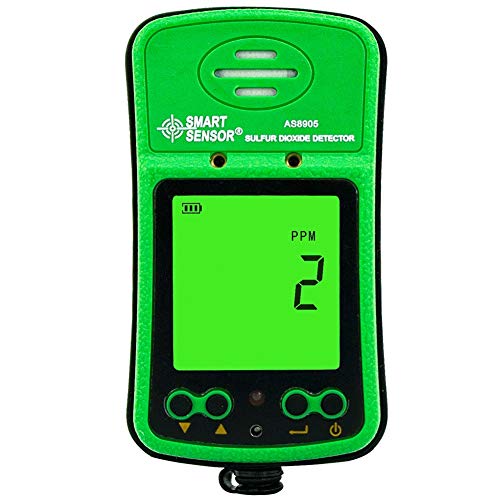
Smart Sensor SO2 Detector Review: 0.1 ppm Steps, No Accuracy Figure
A clip on sulfur dioxide monitor built on an electrochemical sensor, reading 0 to 20 ppm in 0.1 ppm steps, with adjustable high and low alarms signalled by sound, flash and vibration and a rechargeable cell quoted at 8 to 9 hours.
Read More→