As an Amazon Associate, Akermin earns from qualifying purchases. Product links on this page are affiliate links.
A catalytic bead sensor finds combustible gas by burning it. Two tiny coils of platinum wire, each embedded in a ceramic bead, are heated and wired into a Wheatstone bridge. One bead is coated with a catalyst that lets gas oxidize on its surface at the bead’s operating temperature, well below the temperature of a flame; the other bead is left inert as a reference. When combustible gas reaches the pair, it burns on the active bead only, that bead gets hotter, the resistance of its coil rises, and the bridge goes out of balance. The size of the imbalance is proportional to the amount of gas, and the instrument displays it as percent of the lower explosive limit. This is the sensor behind the LEL channel of most portable multi-gas monitors and many industrial fixed detectors. It is rarely found in pocket sniffers or plug-in home alarms.
Why the Reference Bead Matters
The reference bead is what makes the sensor usable outside a laboratory. Both beads sit in the same air, so anything that heats or cools them equally, a cold draft, a warm room, a change in humidity, cancels out in the bridge. Only the extra heat from combustion on the active bead shows up as a signal. That is why a catalytic sensor holds a steadier baseline than a semiconductor element, whose resistance wanders with the weather. It is also why the sensor can be scaled: within its working range, doubling the gas roughly doubles the imbalance, so a monitor can be calibrated at one known concentration and read the rest of the scale with reasonable confidence. The contrast with the heated tin-oxide approach is drawn in semiconductor gas sensors explained.
What a Percent LEL Reading Means Here
The bead burns whatever combustible gas arrives, so the sensor cannot say which gas it is. The monitor is calibrated with one reference gas, and the manufacturer publishes correction factors for others; a reading in a propane atmosphere on a methane-calibrated unit is an estimate until that factor is applied. What the reading does tell you directly is how close the mixture is to burning, which is the question a confined-space entrant or an HVAC technician actually has. Methane’s LEL is about 5 percent by volume, or 50,000 ppm; propane’s is about 2.1 percent, or 21,000 ppm; a reading of 10 percent LEL means one tenth of the way to that line for whichever gas the instrument was scaled to. The units are explained in ppm versus LEL in gas detection.
Weakness One: It Needs Oxygen
Combustion on the bead is still combustion, and it needs oxygen. In normal air that is a non-issue. In a tank that has been purged with nitrogen, a vessel full of gas, or a sealed space where something else has consumed the oxygen, the reaction on the bead slows or stops, and the sensor reads low or zero in an atmosphere that may be far above the explosive limit. A very rich mixture produces the same failure: with too little oxygen left to burn, the reading can peak and then fall as gas concentration keeps rising. Portable monitors flag this in various ways, and the oxygen channel next to the LEL channel exists partly to catch it. For work in inerted or oxygen-poor spaces, the infrared sensor, which does not burn anything, is the usual answer.
Weakness Two: Poisoning and Inhibition
The catalyst can be ruined. Silicone vapor from lubricant sprays, sealants, some polishes and certain electrical products deposits on the bead and blocks the catalytic surface permanently. Lead compounds do the same. A poisoned bead stays in perfect balance with its reference and reads zero, in clean air and in gas alike, with no fault indication of any kind. This is the single most important fact about catalytic sensors and the whole reason the bump test exists: exposing the sensor to a known gas before use is the only way to prove it still responds. The reasoning is laid out in why gas detectors need bump tests and calibration, and the practical steps in how to calibrate a gas detector.
Catalytic Bead Against the Alternatives
| Property | Catalytic bead | Semiconductor (MOS) | Infrared (NDIR) |
|---|---|---|---|
| Principle | Burns gas on a catalyst; reads heat as bridge imbalance | Resistance of heated tin oxide falls in reducing gas | Gas absorbs infrared at hydrocarbon wavelengths |
| Best output | Percent LEL, fairly linear | Low ppm for locating leaks | Percent LEL and percent volume |
| Needs oxygen | Yes | Yes, for its surface chemistry | No |
| Detects hydrogen | Yes | Yes | No |
| Poisoning | Silicones, lead | Less of a concern; drifts instead | Not poisoned; optics can foul |
| Failure mode | Silent; reads zero | Drift and gradual loss of sensitivity | Fail-safe; blocked optics show as a fault |
| Typical home | Multi-gas monitors, industrial fixed heads | Sniffers, plug-in alarms | Industrial fixed heads, premium portables |
Where You Will Meet One
If you carry a four-gas monitor, its LEL channel is very likely a catalytic bead, though listings rarely say so; the TopTes Guard-101, for example, specifies an LEL channel and ships with a gas hood for calibration without naming the sensor. Consumer sniffers that display percent LEL, such as the TopTes PT210S at 1 to 10 percent LEL and the PT760 at 1 to 20 percent LEL, do not state their sensor technology either, and their ppm-level sensitivity and 30 second warm-up are more consistent with a semiconductor element scaled to LEL than with a pellistor. The distinction matters for what you expect of the reading: a scaled sniffer figure is an indication, a calibrated pellistor figure is a measurement. The category overview in what is a multi-gas detector covers the instruments that rely on it. Fixed alarms for the home, which mostly use other sensors, are compared in the combustible gas detector roundup, and the gas leak detector guide covers the field.
What the Reading Does Not Change
A percent LEL figure is information, not permission. If a monitor alarms, or if you smell gas at home, the response is to leave, avoid operating anything electrical on the way, and call the gas utility or 911 from outside. A calibrated sensor makes the warning earlier and more trustworthy; it never replaces the walk out the door.
Recommended Tools
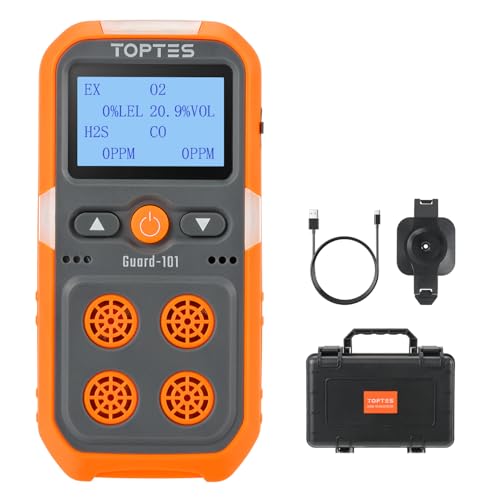


Products shown because their documented specifications fit this guide. Price and availability are on Amazon and can change.
Frequently Asked Questions
Why does a catalytic bead sensor need a bump test before every use?
Because poisoning is silent. A bead whose catalyst has been coated by silicone vapor or lead still sits in balance with its reference and reads zero in clean air, exactly as a healthy one does. The only way to know it still burns gas is to expose it to gas and watch it respond, which is what a bump test is.
What does poisoning a catalytic sensor mean?
Certain substances, silicones and lead compounds being the classic ones, deposit on the catalyst and stop gas from oxidizing on it. The bead no longer heats up in gas, so the bridge stays balanced and the reading stays low. Silicone sources include some lubricant sprays, sealants and polishes, which is why they are kept away from monitors.
Can a catalytic bead sensor be used where oxygen is low?
Not reliably. The bead burns gas, and burning needs oxygen. In an oxygen-deficient or inerted atmosphere the reaction slows or stops and the sensor under-reads. That is one reason multi-gas monitors carry an oxygen channel beside the LEL channel, and why infrared sensors are used in oxygen-free spaces.
Is a pellistor the same thing as a catalytic bead?
Yes. Pellistor is the older trade name for the catalyst-coated bead on a platinum coil; catalytic bead, catalytic combustion sensor and cat-bead all describe the same device.
Affiliate disclosure: Akermin earns a commission from qualifying Amazon purchases made through links on this page. Our editorial picks are based on documented specifications and owner feedback, not commissions.
Related Guides

WiFi Natural Gas Alarm Review: One Unit Reveals the Whole Design
A WiFi natural gas alarm with an LCD showing gas concentration status and temperature, a stated response within 30 seconds, an alarm of at least 85 decibels and notifications to a phone app.
Read More→
Forensics Detectors Cl2 Review: 5 Percent of Full Scale Is 2.5 ppm
A rechargeable chlorine detector with an electrochemical sensor reading 0 to 50 ppm at 0.1 ppm resolution, a response time under 30 seconds, adjustable audible, visual and vibrating alarms and a supplied calibration certificate.
Read More→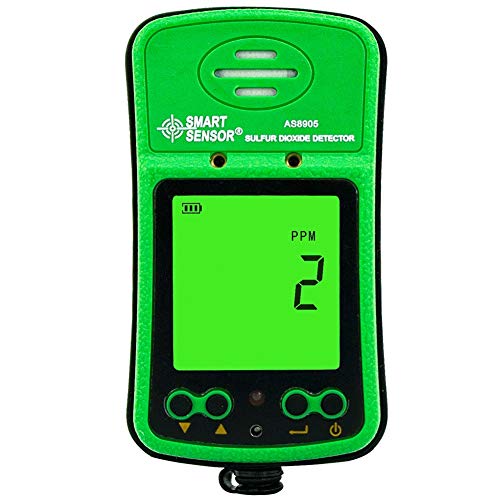
Smart Sensor SO2 Detector Review: 0.1 ppm Steps, No Accuracy Figure
A clip on sulfur dioxide monitor built on an electrochemical sensor, reading 0 to 20 ppm in 0.1 ppm steps, with adjustable high and low alarms signalled by sound, flash and vibration and a rechargeable cell quoted at 8 to 9 hours.
Read More→