As an Amazon Associate, Akermin earns from qualifying purchases. Product links on this page are affiliate links.
An infrared gas detector, usually called NDIR for non-dispersive infrared, finds combustible gas by shining infrared light through the air and measuring how much of it is absorbed at a wavelength that hydrocarbons absorb. More methane or propane in the sample means less light reaching the receiver, and the drop is read as percent LEL or percent volume. Because nothing burns and nothing reacts, the sensor needs no oxygen, cannot be poisoned by silicones or lead, and reports a fault rather than a false zero if the optics fail. Its one large blind spot is hydrogen, which does not absorb at those wavelengths. Those properties make it the sensor of choice for industrial fixed monitors and oxygen-free spaces, and they are also why you will not find it inside a pocket sniffer or a plug-in kitchen alarm.
How NDIR Works
The sensor holds an infrared source, a sample chamber open to the air, an optical filter that passes only a narrow band of wavelengths where hydrocarbons absorb, and a receiver. Most designs add a second channel at a wavelength nothing in the sample absorbs, as a reference; comparing the two cancels out changes in source brightness, dust on the window and temperature. The instrument compares the active and reference signals and converts the difference into a concentration. There is no hot catalyst, no chemistry at a surface and nothing consumed, which is the root of every advantage below. The other three sensor families are laid out in gas detector sensor types.
When Infrared Beats a Catalytic Bead
| Situation | Why infrared is preferred |
|---|---|
| Oxygen-free or inerted spaces: purged tanks, nitrogen-blanketed vessels | A catalytic bead needs oxygen to burn gas and under-reads without it; IR reads the same regardless |
| Very high gas concentrations | A rich mixture starves the bead and its reading can fall; IR keeps rising into percent-volume ranges |
| Silicone or lead exposure: sealant work, some lubricants, certain process areas | IR has no catalyst to poison |
| Long unattended fixed installation | No catalyst to age, so calibration intervals are typically longer and the sensor lasts longer |
| Anywhere a silent failure is unacceptable | Fail-safe: blocked optics or a dead source show as a fault, not a zero |
| Continuous methane monitoring at ppm-to-percent range | Stable zero, with no drift from a heated element |
The mechanism behind the first two rows, the bead’s dependence on oxygen, is explained in catalytic bead gas sensors explained.
When a Catalytic Bead Still Wins
- Hydrogen. Battery rooms, electrolysis, some fuel-cell and process work. IR does not see it; a catalytic bead burns it like any other fuel.
- Combustibles that are not hydrocarbons. The filter is tuned to a hydrocarbon absorption band. Gases that do not absorb there give little or no signal, while a bead responds to anything that burns.
- Size, weight and power. The optical assembly is larger and more complex than a pair of beads, which is one reason pocket sniffers and small plug-in alarms do not use it.
- Response character. Both are fast enough for monitoring; for locating a small leak at a fitting, the ppm sensitivity of a semiconductor sniffer remains the practical tool, as covered in gas detector sensitivity.
Reading an IR Percent LEL Figure
Like a catalytic sensor, an IR sensor is calibrated to one reference hydrocarbon, and other gases absorb differently at the chosen wavelength, so the manufacturer supplies correction factors. Unlike a catalytic sensor, it can continue to read past 100 percent LEL into percent-by-volume, which matters when the question is whether a vessel has been purged rather than whether a room is safe. Methane’s LEL is about 5 percent by volume; an IR head can report a purged tank at well above that where a bead would already be giving a misleading number. The units and the difference between them are set out in ppm, LEL and volume in gas detection.
Does a Homeowner Need Infrared?
Almost never, and the market reflects that. None of the consumer sniffers or plug-in alarms in this cluster state an infrared sensor on their listings; the TopTes PT760 and PT520A, the Klein units and the Kidde combination alarms are built around sensors that suit ppm-level leak finding and household monitoring. The TopTes Guard-101 four-gas monitor lists an LEL channel without naming its technology. Where infrared enters the picture is professional work: technicians choosing a portable for confined-space or process environments, covered in how to choose a multi-gas detector, and HVAC contractors who work around sealants and refrigeration equipment, covered in how to choose a gas detector for HVAC work. For a house, the right tools remain a fixed alarm in each appliance room and a handheld sniffer; the combustible gas detector roundup and the gas leak detector guide cover them.
Lifespan and Upkeep
Because there is no catalyst to degrade and no heated element slowly losing sensitivity, an IR sensor typically outlasts both alternatives, and its maintenance is largely about keeping the optical window clean and confirming, with a bump test, that gas still produces a reading and an alarm. It is not maintenance-free; zero and span still drift with electronics and optics, and manufacturers publish calibration intervals for their heads. The general reasons any sensor ages are covered in why gas detectors do not last forever.
What No Sensor Changes
Infrared or catalytic, fixed head or wearable, the reading is a warning and nothing more. If a gas alarm sounds in a house, or if you smell the rotten-egg odorant, leave, keep switches and phones untouched until you are outside, and call the gas utility or 911. The sensor’s job was to make that call come sooner.
Recommended Tools
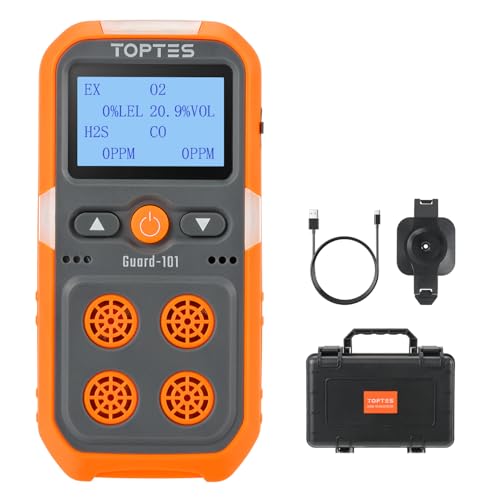


Products shown because their documented specifications fit this guide. Price and availability are on Amazon and can change.
Frequently Asked Questions
Why can an infrared gas detector not detect hydrogen?
Hydrogen does not absorb infrared light at the wavelengths the sensor watches, or indeed at all in the way hydrocarbons do. With no absorption there is no signal. A site with a hydrogen risk, such as a battery charging room, needs a catalytic or electrochemical sensor for that gas.
What does fail-safe mean for an IR sensor?
The detector expects light to reach its receiver. If the source dies, the optics are blocked or the window is fouled, the received signal drops and the instrument reports a fault rather than a clean-air zero. A catalytic bead that has been poisoned gives no such warning; it simply reads zero.
Are any plug-in home gas alarms infrared?
None of the consumer alarms or sniffers covered in this cluster state an infrared sensor on their listings, and the home market runs on semiconductor and, less often, catalytic sensors. Infrared is found in industrial fixed detectors and higher-end portable monitors.
Does an infrared detector still need calibration?
Yes. It still needs a bump test to confirm the alarm path works and periodic calibration against a known gas per the manufacturer, though intervals are typically longer than for a catalytic bead because there is no catalyst to degrade. The zero and span can still drift with optics and electronics.
Affiliate disclosure: Akermin earns a commission from qualifying Amazon purchases made through links on this page. Our editorial picks are based on documented specifications and owner feedback, not commissions.
Related Guides

WiFi Natural Gas Alarm Review: One Unit Reveals the Whole Design
A WiFi natural gas alarm with an LCD showing gas concentration status and temperature, a stated response within 30 seconds, an alarm of at least 85 decibels and notifications to a phone app.
Read More→
Forensics Detectors Cl2 Review: 5 Percent of Full Scale Is 2.5 ppm
A rechargeable chlorine detector with an electrochemical sensor reading 0 to 50 ppm at 0.1 ppm resolution, a response time under 30 seconds, adjustable audible, visual and vibrating alarms and a supplied calibration certificate.
Read More→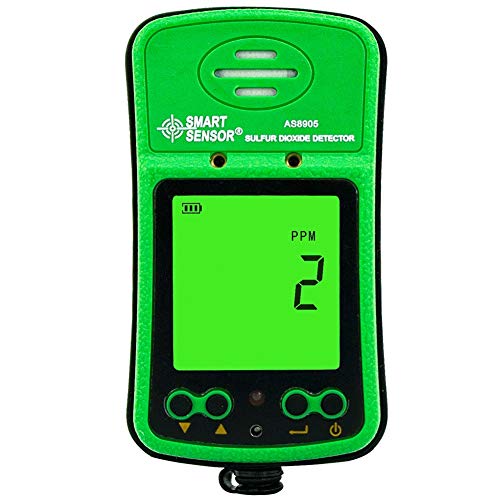
Smart Sensor SO2 Detector Review: 0.1 ppm Steps, No Accuracy Figure
A clip on sulfur dioxide monitor built on an electrochemical sensor, reading 0 to 20 ppm in 0.1 ppm steps, with adjustable high and low alarms signalled by sound, flash and vibration and a rechargeable cell quoted at 8 to 9 hours.
Read More→