As an Amazon Associate, Akermin earns from qualifying purchases. Product links on this page are affiliate links.
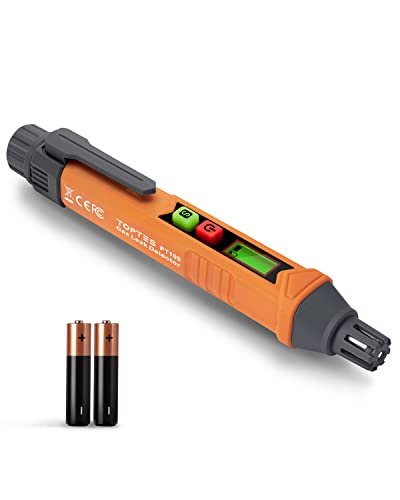
A gas detector’s sensitivity is the smallest concentration it will register, and for consumer sniffers the manufacturer states it as the bottom of the detection range. That floor is roughly 50 ppm of methane for the Klein ET120 and ET190 and the TopTes PT199 and PT520A, 100 ppm for the TopTes PT210S and PT760, and a first LED above 40 ppm for the Amprobe GSD600. Set that against methane’s lower explosive limit of about 5 percent by volume, which is 50,000 ppm, and 50 ppm is one tenth of one percent of the way to an ignitable mixture. A sniffer finds leaks around a thousand times smaller than what could burn. A fixed home alarm is deliberately less sensitive: it trips at a fraction of LEL, commonly 10 to 25 percent, so that it warns of a dangerous build-up rather than every whiff of cooking spray.
Two Different Things Called Sensitivity
The word covers two separate specifications, and confusing them is the source of most disappointment with gas detectors.
- Detection floor. The lowest concentration that produces a visible or audible response. This is what sniffer listings quote, and it is the figure that matters for tracing a leak to a fitting.
- Alarm setpoint. The concentration at which a fixed alarm sounds. Residential combustible gas alarms listed to UL 1484 are designed to trip at a fraction of LEL, and RV alarms such as the Safe T Alert series state activation below 25 percent LEL of propane. This is the figure that matters for waking you up.
A sniffer with a 50 ppm floor and an alarm with a 10 percent LEL setpoint are not one sensitive and one insensitive; they are tuned to two different questions. Handheld versus fixed gas detectors covers the rest of that split.
Putting ppm and Percent LEL on One Scale
For methane, 100 percent LEL is 50,000 ppm, so the arithmetic is simple: divide ppm by 500 to get percent LEL. The listed ranges convert as follows.
| Listed figure (methane) | Percent LEL | Where you see it |
|---|---|---|
| 40 ppm | About 0.08 | First LED on the Amprobe GSD600 |
| 50 ppm | 0.1 | Floor of the Klein ET120 and ET190, TopTes PT199 and PT520A |
| 100 ppm | 0.2 | Floor of the TopTes PT210S, PT205, PT299 and PT760; stated as 1 percent LEL on those listings |
| 640 ppm | About 1.3 | Top LED on the Amprobe GSD600 |
| 1,000 ppm | 2 | Top of the PT199 range; Klein ET120 switch point between High and Low |
| 2,000 ppm | 4 | Top of the Klein ET190 range |
| 5,000 ppm | 10 | Top of the PT210S and PT205 range |
| 10,000 ppm | 20 | Top of the ET120, PT520A and PT760 range |
| 12,500 ppm | 25 | Upper end of the common residential alarm band |
| 50,000 ppm | 100 | Methane lower explosive limit |
Two things stand out. First, the TopTes listings that say 1 percent LEL to 10 percent LEL and 100 to 5,000 ppm are describing the same range in two units. Second, every consumer sniffer tops out well below the residential alarm band, which is why a sniffer that pegs its display is telling you to leave, not to keep measuring. Propane changes the arithmetic: its LEL is about 2.1 percent, or 21,000 ppm, so 1,000 ppm of propane is closer to 5 percent LEL than to 2. The full unit story is in ppm versus LEL in gas detection.
What Limits Sensitivity in Practice
A stated floor is measured at the sensor. Several things stand between a leak and the sensor.
- Distance. TopTes specifies a detection distance of 1 to 5 cm for the PT199 and tells PT520A users to bring the probe within that range of the suspected source. Gas dilutes fast in open air; a probe held a foot away may see nothing from a leak the same probe would catch at the fitting.
- Air movement. A draft carries the plume away from the probe. Sweep with the room still.
- Response and recovery time. Sensors take a moment to respond and longer to recover, so a fast sweep passes the leak before the reading rises. Why gas sensor response time matters covers this.
- Baseline. A sniffer zeroed in air that already contains gas subtracts that gas from every later reading.
- Interferents. Solvents and alcohol raise the reading, which can hide a small real leak in the noise or produce a false one.
- Ageing. Sensitivity falls as the element ages, and a poisoned catalytic bead loses it entirely. See why gas detectors do not last forever.
Why Sniffers Have High and Low Modes
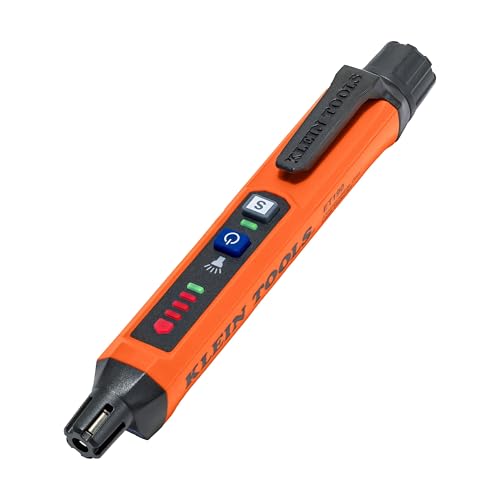
A five-bar or seven-bar display can only show a limited span at once. Klein handles this on the ET120 by giving High mode the 50 to 1,000 ppm range and Low mode the 1,000 to 10,000 ppm range; the ET190 and the TopTes PT210S list dual sensitivity modes on the same principle. High is for searching, where small changes matter; Low is for pinpointing a leak that has already pegged the display. Neither mode changes the sensor; it changes how the display is scaled. The Amprobe GSD600 takes a different approach with fixed LED thresholds above 40, 80, 160, 320 and 640 ppm, each step doubling, so the bar itself tells you roughly how much gas is present.
Choosing by Sensitivity
For checking appliance connections, any of the sniffers above is sensitive enough; the differences that matter more are probe length, readout and battery. For judging whether a room is dangerous, none of them is the right tool, and a fixed alarm with a stated setpoint or a calibrated percent LEL instrument is. For whether a very small, slow leak will ever be caught at all, which is a different question from sensitivity, see can gas detectors detect small leaks. The sniffers are compared in the handheld gas leak detector roundup, and both categories in the gas leak detector guide.
The Threshold That Matters Most
None of these numbers changes the response to a gas smell. Your nose is more sensitive to the odorant than any of these alarms is to the gas, so a smell you cannot explain is reason enough: leave, do not operate switches or phones inside, and call the gas utility or 911 from outside. A detector supplements that; it never replaces it.
Recommended Tools


Products shown because their documented specifications fit this guide. Price and availability are on Amazon and can change.
Frequently Asked Questions
Is a more sensitive gas detector always better?
For locating a leak at a fitting, a lower floor helps. For a fixed alarm it is the opposite: an alarm that tripped at 50 ppm would sound every time someone used hairspray or lit a burner, and people would unplug it. Sensitivity has to match the job, which is why sniffers and alarms are set so differently.
Why does a sniffer list its range as based on methane?
Because the sensor responds differently to each gas, the manufacturer picks one reference gas to state the numbers. The same sniffer near propane or butane will still respond, but the point at which a given bar lights will not be the exact ppm figure printed for methane.
Why does my home gas alarm not go off when I smell a faint whiff?
Your nose detects the mercaptan odorant at concentrations far below the alarm setpoint. A residential alarm is designed to sound at a fraction of the lower explosive limit, commonly 10 to 25 percent LEL, which is thousands of ppm of methane. A faint smell that a sniffer would catch is well below that line. Report it anyway.
Does sensitivity drop as the sensor ages?
Yes. Heated semiconductor elements gradually lose response, and catalytic beads can be poisoned outright. A sniffer that once lit every bar at a known test source and now lights two is telling you something. Regular response checks are the only way to see it happening.
Affiliate disclosure: Akermin earns a commission from qualifying Amazon purchases made through links on this page. Our editorial picks are based on documented specifications and owner feedback, not commissions.
Related Guides

WiFi Natural Gas Alarm Review: One Unit Reveals the Whole Design
A WiFi natural gas alarm with an LCD showing gas concentration status and temperature, a stated response within 30 seconds, an alarm of at least 85 decibels and notifications to a phone app.
Read More→
Forensics Detectors Cl2 Review: 5 Percent of Full Scale Is 2.5 ppm
A rechargeable chlorine detector with an electrochemical sensor reading 0 to 50 ppm at 0.1 ppm resolution, a response time under 30 seconds, adjustable audible, visual and vibrating alarms and a supplied calibration certificate.
Read More→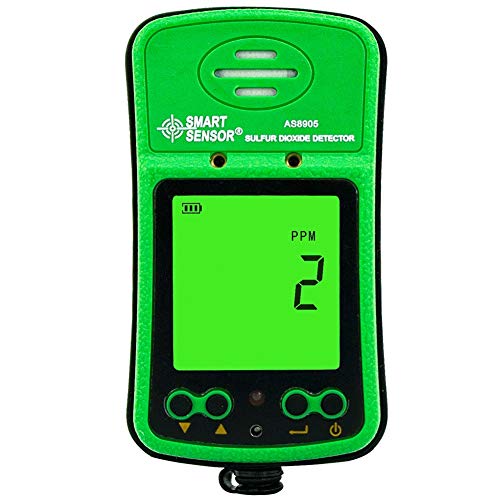
Smart Sensor SO2 Detector Review: 0.1 ppm Steps, No Accuracy Figure
A clip on sulfur dioxide monitor built on an electrochemical sensor, reading 0 to 20 ppm in 0.1 ppm steps, with adjustable high and low alarms signalled by sound, flash and vibration and a rechargeable cell quoted at 8 to 9 hours.
Read More→