As an Amazon Associate, Akermin earns from qualifying purchases. Product links on this page are affiliate links.
Response time is how long a gas sensor takes to register a change in the air around it, quoted as T50 or T90: the seconds to reach 50 or 90 percent of the final reading. Typical T90 values run from a second or two for semiconductor sniffers to a minute for some electrochemical toxic-gas cells, plus delays from filters and sample hoses. It matters because a detector moved too fast past a leak never registers it, and a confined-space reading taken too soon reports the air the hose was full of, not the air in the tank.
Typical response times
| Sensor | Typical T90 | Notes |
|---|---|---|
| Semiconductor (sniffer) | 1 to 5 s | Fast to respond, slower to recover |
| Photoionization (PID) | Under 10 s | Fast; affected by humidity |
| Catalytic bead (LEL) | 10 to 20 s | Slower with sintered flame arrestors |
| Infrared (LEL, CO₂, refrigerant) | 10 to 30 s | Depends on cell volume and flow |
| Electrochemical (CO, H₂S, O₂) | 20 to 60 s | Membrane diffusion; cold slows it further |
| Heated diode (refrigerant) | 1 to 3 s | Needs warm-up first |
What adds delay
- Filters and membranes. Dust filters and hydrophobic membranes protect the sensor and slow diffusion. A clogged filter can double the response time.
- Sample hoses. On a pumped detector, gas travels the hose before the sensor sees it: about 2 seconds per meter at typical pump rates. Manufacturers state a hose delay to add to T90.
- Temperature. Cold slows diffusion through membranes and slows electrochemical reactions; a detector at −10 °C may respond at half its room-temperature speed.
- Sensor age. Electrochemical cells slow as they deplete; a bump test that passes but takes longer than it used to is an early warning. See why gas detectors need bump tests.
- Stagnant air. Diffusion detectors rely on air movement reaching them; in still air, response is slower than the datasheet.
Recovery time
Getting back to zero after gas is removed is a separate figure and often longer. Semiconductor and heated-diode sensors saturate on a large hit and can take a minute or more to clear, which is why a leak search moves away from a strong indication before approaching again. Catalytic sensors exposed to very high concentrations can be damaged and read low afterward.
Consequences for practice
- Leak searching: move the probe slowly, a few centimeters per second, so the sensor has time to respond as it passes a source. A fast sweep misses small leaks entirely.
- Pre-entry testing: hold the sample point at each level for at least the hose delay plus two T90 periods before trusting the reading. For a 10 m hose and a 30 s electrochemical sensor, that is over a minute per point.
- Personal monitoring: the detector alarms some seconds after the gas reaches it; keep it in the breathing zone and treat any alarm as already late.
- Bump tests: the pass criterion includes responding within the specified time, not just eventually.
- Cold work: allow extra time and keep detectors warm between readings.
Related: what can cause false gas detector readings and how fast a CO₂ monitor should respond, which covers the same idea for indoor air monitors. Instruments are in the gas detection category.
Recommended Tools
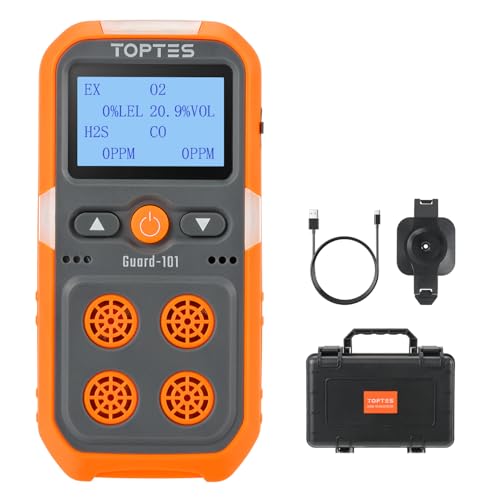

Products shown because their documented specifications fit this guide. Price and availability are on Amazon and can change.
Frequently Asked Questions
What is T90?
The time for a sensor to reach 90 percent of its final reading after a step change in gas concentration. T50 is the time to 50 percent. Datasheets quote one or both.
What is a typical T90 for a gas detector?
Catalytic LEL sensors 10 to 20 seconds; electrochemical CO and H₂S 20 to 60 seconds; infrared 10 to 30 seconds; semiconductor sniffers 1 to 5 seconds; PID under 10 seconds.
Why does a pumped detector take longer?
Sample must travel the hose; allow roughly 2 seconds per meter plus the sensor's own T90. A 10 m hose adds about 20 seconds before the reading means anything.
Affiliate disclosure: Akermin earns a commission from qualifying Amazon purchases made through links on this page. Our editorial picks are based on documented specifications and owner feedback, not commissions.
Related Guides

WiFi Natural Gas Alarm Review: One Unit Reveals the Whole Design
A WiFi natural gas alarm with an LCD showing gas concentration status and temperature, a stated response within 30 seconds, an alarm of at least 85 decibels and notifications to a phone app.
Read More→
Forensics Detectors Cl2 Review: 5 Percent of Full Scale Is 2.5 ppm
A rechargeable chlorine detector with an electrochemical sensor reading 0 to 50 ppm at 0.1 ppm resolution, a response time under 30 seconds, adjustable audible, visual and vibrating alarms and a supplied calibration certificate.
Read More→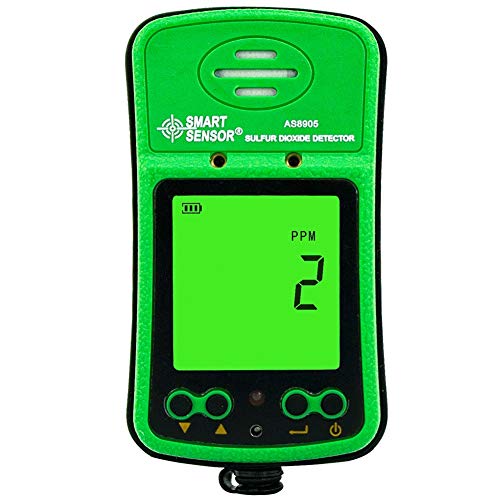
Smart Sensor SO2 Detector Review: 0.1 ppm Steps, No Accuracy Figure
A clip on sulfur dioxide monitor built on an electrochemical sensor, reading 0 to 20 ppm in 0.1 ppm steps, with adjustable high and low alarms signalled by sound, flash and vibration and a rechargeable cell quoted at 8 to 9 hours.
Read More→