
TopTes PT520A
Long gooseneck, wide range, sensible price.
- 50 to 10,000 ppm methane, 0.5-second response
- 17-inch gooseneck for pipes, tanks and fireplaces
- Seven colored bars plus 75 dB alarm
- Three AAA, mute and auto power-off, case included
A handheld gas leak detector answers one question: which joint is leaking. These sniffers were compared on detection range, adjustable sensitivity, probe reach and readout, using manufacturer specifications, with a clear line between the homeowner tools and the ones a technician will keep.
Warm Up
Sweep Slowly
Follow the Bars
As an Amazon Associate, Akermin earns from qualifying purchases. Product links on this page are affiliate links.
Handheld sniffers locate leaks; they are not alarms. These were compared on stated methane range, sensitivity modes, probe length, readout and power using manufacturer documentation and owner feedback. No laboratory testing was carried out.
Long gooseneck, wide range, sensible price.

Two sensitivity ranges and an 18-inch gooseneck.

Pen-style with a two-digit %LEL number.
No pick matches that combination yet. Try a wider budget or a different measurement.
| Product | Stated Range (methane) | Probe | Readout | Sensitivity | Power | |
|---|---|---|---|---|---|---|
| TopTes PT520A | 50 to 10,000 ppm | 17-in gooseneck | 7 bars, 75 dB | Single | 3 AAA | View |
| Klein ET120 | approx. 50 to 10,000 ppm | 18-in gooseneck | 5 LEDs, 85 dB | High / Low | Battery | View |
| TopTes PT210S | Not stated; %LEL display | 4-in probe | 2-digit %LEL, bars, 75 dB | High / Low | 2 AAA | View |
| Klein ET190 | 50 to 2,000 ppm | Pen body, pocket clip | LEDs, escalating tones | High / Low | Battery | View |
| TopTes PT199 | 50 to 1,000 ppm | Pocket body | Red screen, audible | Single | 2 AAA | View |
| UEi CD100A | Not stated | 18-in gooseneck, tip light | Tic rate, LEDs | Single | Battery | View |
| Amprobe GSD600 | 5 LED levels: >40 to >640 ppm | Flexible probe | LEDs, beep rate, earphone jack | Single | Battery | View |
| RIDGID CD-100 | Not stated | 16-in flexible probe | Visual, audible, vibration | Adjustable | Battery | View |
| TopTes PT760 | %LEL display | 12-in telescopic probe, flashlight | Screen color, tone rate | Not stated | USB-C rechargeable | View |
Ranges are the manufacturers' stated methane figures. "Not stated" means the Amazon listing does not give a number; check the manual before relying on one.
Four specifications separate these tools:
A 50 ppm floor finds the slow weep at a fitting that soapy water misses. Higher floors only find leaks you can already smell.
A low-sensitivity mode keeps the display useful close to a strong leak so you can narrow it to one joint.
Goosenecks of 16 to 18 inches reach behind ranges and over water heaters; a four-inch pen probe suits grills, RVs and stove connectors.
Bars and LEDs are enough to locate a leak. A %LEL number helps when you need to report what you found.
No. A sniffer is only sensing while you hold it near a fitting, it auto-powers off, and it is not listed as an alarm. Use it to find the leak; use a fixed alarm to guard the room.
Semiconductor sensors respond to a wide range of reducing gases and vapors: alcohol, solvents, aerosol propellants, even a freshly painted wall. Zero the unit in clean outdoor air, keep sprays away from the fitting you are checking, and treat a reading that follows the sprayed area rather than the pipe as a false positive.
Within an inch or two. TopTes states a 1 to 5 cm detection distance for the PT199. Move the tip slowly along the pipe and around each joint; gas disperses quickly, so a fast sweep passes over the leak.
Consumer sniffers self-zero in clean air at start-up; that is the only adjustment available. Trade instruments can be checked against a known gas source. If a unit no longer responds to an unlit butane lighter held near the tip, the sensor is at the end of its life.
The PT520A is the sniffer most homeowners should buy. The 17-inch gooseneck is the reason: the fittings that leak are behind the range, on top of the water heater and inside the fireplace valve box, and a pen-style detector cannot reach them without moving the appliance.
TopTes states a 50 to 10,000 ppm range on methane, which spans a faint weep at a flare nut to a leak you can already smell across the room, and the seven-bar display rises as the tip nears the source. The 30-second clean-air warm-up and the auto power-off are typical of semiconductor sniffers and worth knowing before you use it the first time.
There is no numeric readout and no data logging, which a technician might want. For the price of a service call it finds the leak; that is the job.
Klein's ET120 is built for someone who traces leaks regularly. Splitting the range into a high-sensitivity band for faint leaks and a low-sensitivity band for strong ones means the LEDs stay informative instead of pinning at full scale as soon as you approach a real leak, which is the weakness of single-range sniffers.
The automatic zero at start-up (Klein flashes the LEDs during self-calibration) removes the guesswork about whether the unit has settled, and the 18-inch gooseneck clips onto the body so the tip does not get crushed in a tool bag. The 85 dB alert is a tool-bag alert, not a room alarm.
It costs more than the consumer sniffers and has no screen. If you want a %LEL number, look at the PT210S; if you want a tool that will still be working after years of service calls, this is the Klein.
The PT210S is the pocket sniffer with a number on it. Where the PT520A shows bars, the PT210S displays the leak as a two-digit percentage of the lower explosive limit, so you can describe what you found to a technician in the unit their instruments use.
TopTes specifies a 0.5-second response, a screen that turns red as bars rise, a 75 dB buzzer and dual sensitivity modes. The four-inch probe is the trade-off: it reaches a stove connector and a grill regulator but not the far side of a water heater. It fits a shirt pocket, which the gooseneck models do not.
A %LEL display on a consumer sniffer is an indication, not a calibrated measurement, and semiconductor sensors need clean-air zeroing. As a companion to a fixed alarm and for RV and grill checks, it is the most informative sniffer at its price.
Short answer: buy the TopTes PT520A if you are a homeowner who wants to check appliance connections and trace the occasional smell; its 17-inch gooseneck reaches the fittings that actually leak. Buy the Klein ET120 if you trace leaks regularly and want two sensitivity ranges and a tool-bag build. Choose the TopTes PT210S if a %LEL number in your pocket matters more than reach.
A handheld gas leak detector carries a small heated semiconductor sensor at the end of a probe. Combustible gas changes the sensor’s resistance, and the unit turns that into bars, LEDs or a tone whose rate rises with concentration. Held next to a fitting, it finds a leak that a soap solution would take minutes to show. It is not an alarm: it samples only where you point it, it switches itself off after a few minutes, and no consumer sniffer is listed under UL 1484. The handheld vs fixed gas detector article covers the split; the main gas leak detector guide covers the alarm you should own as well.
Manufacturers quote a methane range such as 50 to 10,000 ppm. The low figure matters most: a slow leak at a compression fitting is a few hundred ppm right at the joint and falls off within inches. A unit that starts at 50 ppm will find it; a unit that starts higher only confirms what your nose already knows. The high figure, and a low-sensitivity mode, matter when the leak is strong, because a single-range sniffer pins at full scale a foot away and cannot narrow the source to one joint. The Klein ET120 and the TopTes PT210S both offer two modes for that reason. The LEL explainer covers what the percentage on the PT210S and PT760 screens means.
The fittings that leak are the ones you cannot see: the flare nut behind the range, the union on top of the water heater, the valve inside a fireplace, the regulator under an RV. A 16 to 18-inch gooseneck (PT520A, ET120, UEi CD100A, RIDGID CD-100) reaches them without pulling the appliance out. Four-inch pen probes (PT210S, ET190, PT199) suit grill hoses, stove connectors and RV compartments, and they fit a pocket. The PT760’s telescopic probe and built-in flashlight are a middle ground.
Power on in clean air and wait through the warm-up; every unit here needs 10 to 30 seconds. Move the tip slowly along the pipe, pausing at each joint, and watch for the bars to rise and then fall as you pass the source. If the alarm pins immediately anywhere in the room, stop: that is a ventilate-and-leave situation, not a tracing job, and the procedure in how to use a combustible gas detector safely applies. Keep cleaning sprays, alcohol and fresh paint away from the area; the sensor responds to them too, which is the most common source of false positives owners report.
The UEi CD100A, RIDGID CD-100 and Amprobe GSD600 are the models HVAC and plumbing technicians carry. They add a tip light, vibration alert or an earphone jack for noisy plant rooms, field-replaceable sensors on the RIDGID, and long service histories. For a homeowner those features rarely justify the price over a PT520A or ET120. Our combustible gas detector guide covers the trade models in their own right.
Before you rely on a reading, confirm the tool responds: an unlit butane lighter held near the tip for a second should trigger it. If it does not, the sensor has aged out. How to test a gas leak detector covers the safe way to do this for sniffers and for wall alarms.
Sniffers were compared on manufacturer documentation: stated detection range and gas basis, sensitivity settings, probe length, alert types, warm-up and power. Owner feedback was reviewed for false triggering near solvents and for sensor life. We did not run laboratory tests and we do not publish sensitivity figures of our own. Amazon data supplies images, availability and links only.

A WiFi natural gas alarm with an LCD showing gas concentration status and temperature, a stated response within 30 seconds, an alarm of at least 85 decibels and notifications to a phone app.
Read Guide→
A rechargeable chlorine detector with an electrochemical sensor reading 0 to 50 ppm at 0.1 ppm resolution, a response time under 30 seconds, adjustable audible, visual and vibrating alarms and a supplied calibration certificate.
Read Guide→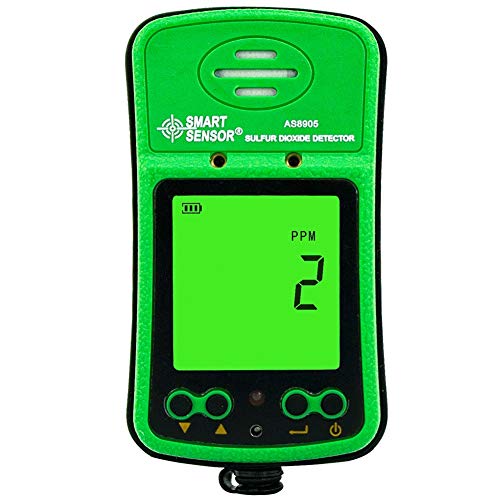
A clip on sulfur dioxide monitor built on an electrochemical sensor, reading 0 to 20 ppm in 0.1 ppm steps, with adjustable high and low alarms signalled by sound, flash and vibration and a rechargeable cell quoted at 8 to 9 hours.
Read Guide→