Best Multi-Gas Detectors: 4-Gas Monitors for Confined Spaces and Plant Work
A multi-gas detector is the personal monitor a worker wears into a manhole, a tank or a pit, and it has to read oxygen, combustibles, carbon monoxide and hydrogen sulfide at once. This guide compares the maintenance-free clips, the rechargeable display units and the budget meters that ship with a calibration certificate, from manufacturer documentation.
As an Amazon Associate, Akermin earns from qualifying purchases. Product links on this page are affiliate links.
Our Top Picks
These are personal four-gas monitors for confined-space entry and plant rounds. They were compared on gases covered, runtime model, alarm modes, logging and export, calibration paperwork and stated certifications from manufacturer documentation and owner feedback. No laboratory testing was carried out; a multi-gas monitor must be bump tested before each use and calibrated on schedule regardless of which one you buy.
Manufacturer listing statements at the time of research. Ranges and alarm set points are absent from most of these listings and must be taken from the manual or data sheet before the unit is put into service.
How to Choose a Multi-Gas Detector
Four questions sort the market:
Two-Year Clip or Rechargeable
A maintenance-free clip runs for its stated period and is then replaced. A rechargeable unit costs less and lasts longer but depends on someone charging it.
Bump and Calibration Workflow
Every monitor needs a bump test before each use and periodic calibration. Fleet units make compliance visible; budget units make you keep the log yourself.
Records and Export
After an incident, the log is the evidence. Event counts, time stamps and USB export separate the instruments from the gadgets.
Certification Named
For a classified hazardous location the unit needs a named intrinsic-safety rating. "Explosion-proof" on a listing is not the same as a certificate you can produce.
Oxygen (O2), combustible gas as a percentage of the lower explosive limit (LEL), carbon monoxide (CO) and hydrogen sulfide (H2S). Together they cover the three ways a confined space kills: too little or too much oxygen, a flammable atmosphere, and the two toxic gases most often found in sewers, tanks and pits.
What is a bump test and how often is it done?
A bump test exposes the sensors to a known gas from a cylinder through a hood to confirm each one responds and the alarms fire. It is done before each day of use. Calibration, which adjusts the reading to the known concentration, is done on the schedule the manufacturer sets. The BW Clip4 flashes a non-compliance warning when its bump schedule is missed.
Can I use a multi-gas monitor in a home?
You can, and TopTes and Forensics list home use, but a residential CO alarm listed to UL 2034 is the correct device for a house because it is designed to be left running for years. A multi-gas monitor is a personal instrument for a worker entering a space, not a wall alarm.
Why do the listings not state ranges or alarm levels?
Industrial monitors are sold on the assumption that the buyer reads the data sheet, and marketplace listings often copy only the marketing bullets. Before putting any of these into service, get the manual, record the ranges and the low and high set points for each gas, and check them against your own program, which for oxygen typically means 19.5 percent low and 23.5 percent high.
Reviews
Honeywell BW Clip4 BWC4-Y-N 4-Gas Detector Best Overall
The BW Clip4 is the four-gas monitor most safety programs already know, and the reason is the maintenance model. Honeywell states two years of continuous operation: the unit is activated once and runs for that period, with no nightly routine for the crew to forget. For a contractor whose workers cannot be relied on to dock a charger every evening, that is the whole argument.
It monitors the four confined-space gases, oxygen, combustibles (LEL), carbon monoxide and hydrogen sulfide, performs one internal diagnostic test every 24 hours and automatically logs the 70 most recent events. Flashing red non-compliance indicators warn that the detector has not been bump tested according to schedule, which turns the safety rule into something a supervisor can see from across the yard.
The listing gives no ranges, resolution or alarm set points, so those come from the Honeywell data sheet, and the docking and record workflow is described in Honeywell's documentation rather than on the listing.
The Guard-863Pro is the pick for anyone who wants to see what the gas is doing, not just whether it crossed a line. Its TFT color screen shows the four readings as a concentration matrix and as trend curves, which is how you spot hydrogen sulfide climbing in a wet well before the low alarm. TopTes states the screen stays readable in low light.
The manufacturer lists sensors from DDS (UK), an upgraded oxygen sensor with a service life of up to 5 years, a 0.5-second response and a continuous triple alarm (sound, light, vibration) that keeps going until the levels return to the set limits. USB data export covers alarm records, fault logs, calibration records and operation history, which is what an entry supervisor asks for after an incident.
Battery is 2.5 hours to full and over 18 hours of operation, so it is a charge-nightly instrument rather than a two-year clip. A gas hood for bump testing ships in the box.
Forensics Detectors' 4 gas meter is the budget pick because it arrives factory calibrated with calibration and QA certificates, which is the piece of paper an occasional confined-space entrant otherwise has to pay a lab for. The manufacturer states nano sensors for oxygen, carbon monoxide, hydrogen sulfide and combustibles (LEL) with zero and span calibration options for later checks.
Alarms are adjustable audio, visual and vibration when preset levels are reached. The housing is high-strength ABS with a rubber feel and an anti-slip grip, described as water-resistant, dust-proof and explosion-proof, with a 1-year limited warranty and product testing in the USA.
What the listing leaves out is as important as what it includes: no ranges, no response time, no battery life and no third-party certification numbers are stated. For a plant program with a fleet policy, the BW or TopTes units answer more of those questions; for a contractor who enters a pit twice a month and needs a certificate on file, this does the job.
Short answer: for a crew that enters confined spaces, the Honeywell BW Clip4 is the default: two years of continuous operation, a daily self test and a flashing warning when a bump test is overdue. If you want to watch the readings trend on a color screen and export the logs over USB, the TopTes Guard-863Pro is the rechargeable alternative. For occasional entries where a calibration certificate in the box matters more than fleet features, the Forensics 4 Gas Meter covers the same four gases at the lowest cost.
Why four gases travel together
A confined space, which in practice means a manhole, a wet well, a tank, a silo, a vault or a trench, can hurt a worker in three ways. The atmosphere can be short of oxygen because something has consumed it (rust, rot, a purge gas) or rich in oxygen because a cylinder is leaking. It can be flammable, measured as a percentage of the lower explosive limit. And it can carry a toxic gas, of which carbon monoxide from engines and hydrogen sulfide from sewage and decay are the two most common. One instrument that reads all four is the minimum for entry, and every unit on this page reads exactly those four. What is a multi-gas detector covers the sensor types behind each reading, and the gas detector vs multi-gas detector comparison in the resources explains why a handheld sniffer or a wall alarm is not a substitute.
Two-year clips versus rechargeable instruments
The market splits on how the monitor is kept alive. The Honeywell BW Clip4 and its BW Technologies twin are activated once and run continuously for a stated two years, after which they are replaced; there is no charging routine and no battery door. That model exists because the failure mode of every rechargeable monitor is the same: it was not on the charger last night. The TopTes Guard-863Pro (over 18 hours per 2.5-hour charge) and Guard-101 (up to 14 hours) and the Forensics and XLA units are rechargeable; they cost less up front and can be serviced, but they depend on a discipline the clip does not need. A plant with a tool crib and a docking station gets on well with either; a contractor with vans does better with the clip.
Bump testing and calibration are not optional
Every multi-gas monitor is bump tested before each use: gas from a cylinder is applied through a hood, each sensor must respond and each alarm must fire, and the result is recorded. Calibration, which corrects the reading against a known concentration, follows the manufacturer’s schedule. The BW Clip4 makes the bump rule visible with a flashing red non-compliance indicator when the schedule is missed, and the GasAlertMicroClip XL shows calibration, bump and self-test status on its screen. The TopTes units ship with a gas hood; the Forensics units support zero and span calibration and arrive with a certificate for the factory calibration. Why gas detectors need bump tests and calibration explains the difference and what a certificate does and does not prove.
Reading the four channels
Oxygen is displayed as a percentage, and the set points most US programs use are 19.5 percent for the low alarm and 23.5 percent for the high; fresh air reads 20.9. Combustibles display as a percentage of the lower explosive limit, so 10 percent LEL means the atmosphere is one tenth of the way to flammable, not one tenth gas. Carbon monoxide and hydrogen sulfide display in parts per million, and both are dangerous at concentrations far below what the LEL channel would notice. The ppm vs LEL explainer in this cluster works through the units, and the point of the Guard-863Pro’s trend curves is that a rising H2S trace matters before it reaches the set point.
What the listings leave out
Only the Honeywell listing states a runtime, and none of the listings gives measuring ranges or factory alarm set points for all four channels; the TopTes and XLA listings state response times, the Forensics listing does not. Several units are described as explosion-proof without a named certification, and one (XLA) quotes an Exib IIB T3 Gb marking. For entry into a classified hazardous location, the unit’s intrinsic-safety certificate is a document your safety officer will need to see, so get the manual and the data sheet before you rely on any marketplace bullet. Where this table says “Not stated”, that is the reason.
When a channel alarms
Leave the space immediately and by the planned route; do not stop to take a reading or to investigate. The attendant outside logs the alarm, and nobody re-enters until the atmosphere has been ventilated and re-tested from outside. If a worker is down, the rescue is by the trained team with supplied air, never by a co-worker with the same monitor, which is how most multiple-fatality confined-space incidents happen. For single-gas alternatives see hydrogen sulfide detectors and oxygen gas detectors.
How We Research
Monitors were compared on manufacturer documentation: gases covered, stated runtime or charge cycle, alarm modes and response, logging and export, calibration paperwork, ingress and certification claims and warranty. Owner feedback was reviewed for sensor failures and false alarms. We did not run laboratory tests and publish no measurements of our own. Amazon data supplies images, availability and links only.
A WiFi natural gas alarm with an LCD showing gas concentration status and temperature, a stated response within 30 seconds, an alarm of at least 85 decibels and notifications to a phone app.
A rechargeable chlorine detector with an electrochemical sensor reading 0 to 50 ppm at 0.1 ppm resolution, a response time under 30 seconds, adjustable audible, visual and vibrating alarms and a supplied calibration certificate.
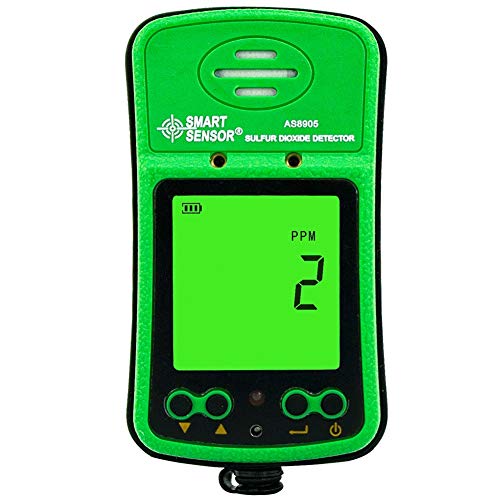
A clip on sulfur dioxide monitor built on an electrochemical sensor, reading 0 to 20 ppm in 0.1 ppm steps, with adjustable high and low alarms signalled by sound, flash and vibration and a rechargeable cell quoted at 8 to 9 hours.